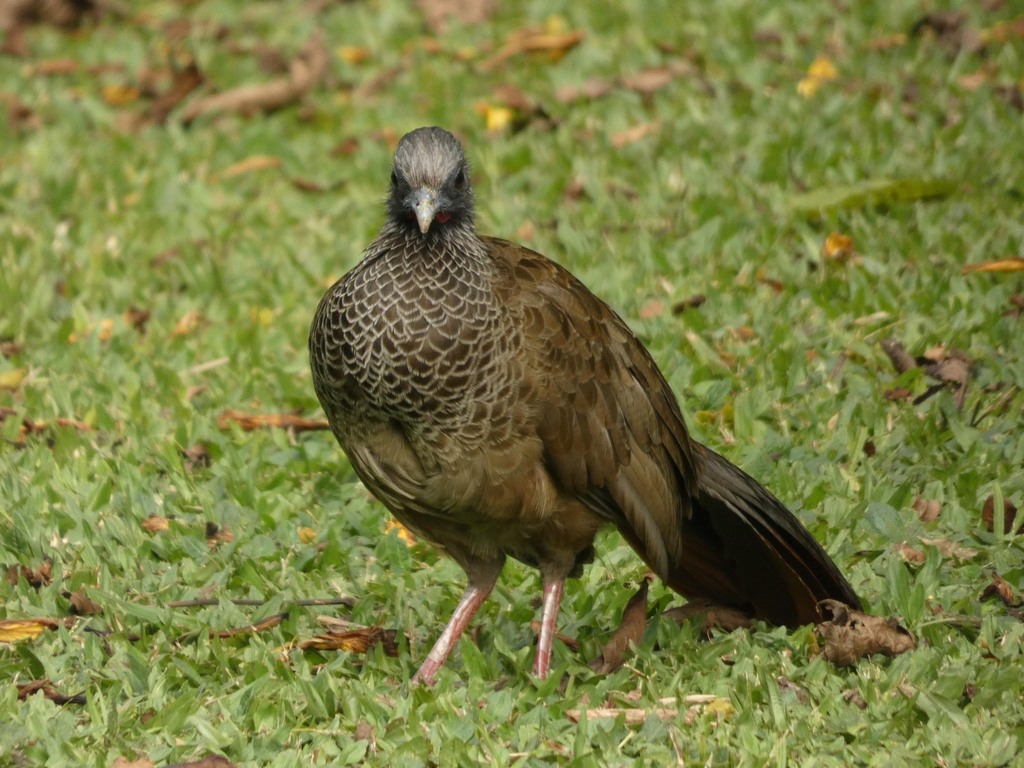
Colombian Chachalaca
Photo © Luis G Restrepo
Photo © Luis G Restrepo — CC BY 4.0 — Source: iNaturalist photo #413477866Identification
The Colombian chachalaca is a plump, forest-dwelling bird measuring 50–60 cm in length, characterized by a long slender neck, small head, sturdy legs, and an elongated tail. Adults are similar in appearance between sexes. The upperparts are predominantly brown, shading to greyish-brown on the wings, while the outer tail feathers display rufous-brown coloring. The head and neck are grey with a distinctive red dewlap on the throat. A key distinguishing feature is the breast plumage: grey feathers with prominent white scalloping, setting it apart from the similar Speckled chachalaca. The belly is buffy with rufous shading on the thighs and flanks. The legs and feet are pinkish, the bill is dark grey at the base fading to white at the tip, and a patch of grey bare skin encircles the dark brown eye.
Range & Habitat
Endemic to Colombia's inter-Andean valleys, the Colombian chachalaca occurs in two populations: the upper Magdalena River basin (from Huila Department to Santander) and the Cauca River valley (from Cauca Department to Antioquia). Once fairly widespread, its distribution is now highly fragmented due to historical hunting pressure and habitat loss. The species inhabits the upper tropical zone, typically found on the edges of dry to humid forests and mature second growth. While it can tolerate degraded habitat including scrub and thickets, and shows relative tolerance of human settlements where not persecuted, research indicates the bird prospers best in mature forests where fallen tree trunks provide foraging, shelter, and nesting opportunities.
Behaviour & Diet
Colombian chachalacas are highly arboreal, spending most of their time foraging from mid-level to the canopy in search of trees with abundant food supplies, particularly Ficus or Cecropia species. They typically forage in pairs and small groups, sometimes forming larger assemblies of up to 20 individuals. These birds are social and vocal, engaging in noisy choruses of the distinctive "chac-a-lac" call that gives them their common name. They fly readily within and between trees but avoid long-distance flights.
The species is highly frugivorous, with diet studies from the Cauca valley documenting 26 plant species consumed: fruits (77.2%), leaves (16.2%), and flowers (3.6%), with occasional consumption of soil, dead leaves, and stones. As large frugivores, Colombian chachalacas play a crucial ecological role in tropical forest maintenance through seed dispersal via defecation, with many seeds showing elevated germination rates after passing through the birds' digestive systems. Breeding occurs in February in the Magdalena valley; the species is presumed monogamous and possibly territorial during breeding season.
Best Time & Places to See It
The Colombian chachalaca is best located in the inter-Andean valleys of Colombia, particularly in remaining mature forest patches within the Magdalena and Cauca river basins. February represents the breeding season in the Magdalena valley and is a potentially productive period for observation. Look for this species in mid-level to canopy areas of undisturbed forest where large fruiting trees, especially Ficus and Cecropia, are present. Early morning hours often yield the best sightings, when the birds are most vocal and active in their foraging routines. Listen for their characteristic chorusing calls to locate groups.
Photography Tips
Photograph Colombian chachalacas in the mid-story and canopy strata where they spend most of their time. The bird's arboreal habits and preference for dense vegetation present challenges; patience and positioning beneath fruiting trees will increase encounter chances. The grey breast with white scalloping and red dewlap are key field marks worth capturing. Early morning light filtering through forest canopy will best reveal plumage details. Slow shutter speeds or panning techniques may help counteract movement through branches. Group foraging behavior offers opportunities for dynamic multi-bird compositions, while the bird's relatively large size (50–60 cm) provides good detail potential even at distance through telephoto lenses.
Guided Birding Tour
Natural Serranía de los Yariguíes National Park
El Carmen de Chucurí, Colombia
+320 birds+3 mammals
Where the northern cordilleras of Colombia rise toward cloud forest, the Serranía de los Yariguíes unfolds across nearly 1,820 square kilometers of some of the most…
VIEW NATIONAL PARKNatural Farallones de Cali National Park
Buenaventura, Colombia
+733 birds+27 mammals
Where the Pacific coastal plain meets the western slopes of the Andes, Farallones de Cali National Park sprawls across nearly 3,500 square kilometers of dramatic topography…
VIEW NATIONAL PARKNatural Chingaza National Park
Junín, Colombia
+285 birds+6 mammals
Where the Andes rise above three thousand metres in the Cundinamarca region, high-altitude grasslands and cloud forests converge in a landscape shaped by both geology and…
VIEW NATIONAL PARKPuracé National Natural Park
Puracé, Colombia
+327 birds+2 mammals
Where the Andes thrust upward across southwestern Colombia, Puracé National Natural Park spans nearly 2,631 square kilometers of some of South America's most dramatic montane terrain.…
VIEW NATIONAL PARKGuácharos Cave National Natural Park
Acevedo, Colombia
+359 birds
High in the Andean foothills of southern Huila, where mist-laden slopes rise above 1,600 metres, lies a landscape carved by underground rivers and crowned by karst…
VIEW NATIONAL PARKNatural Nevado del Huila National Park
Planadas, Colombia
+117 birds
Where the Colombian Andes rise above 5,000 metres, tropical cloud forest yields to páramo and glaciated peaks, and the Planadas region of Tolima contains one of…
VIEW NATIONAL PARKNo community photos yet. Log in to add the first one.
No community observations of this species yet.