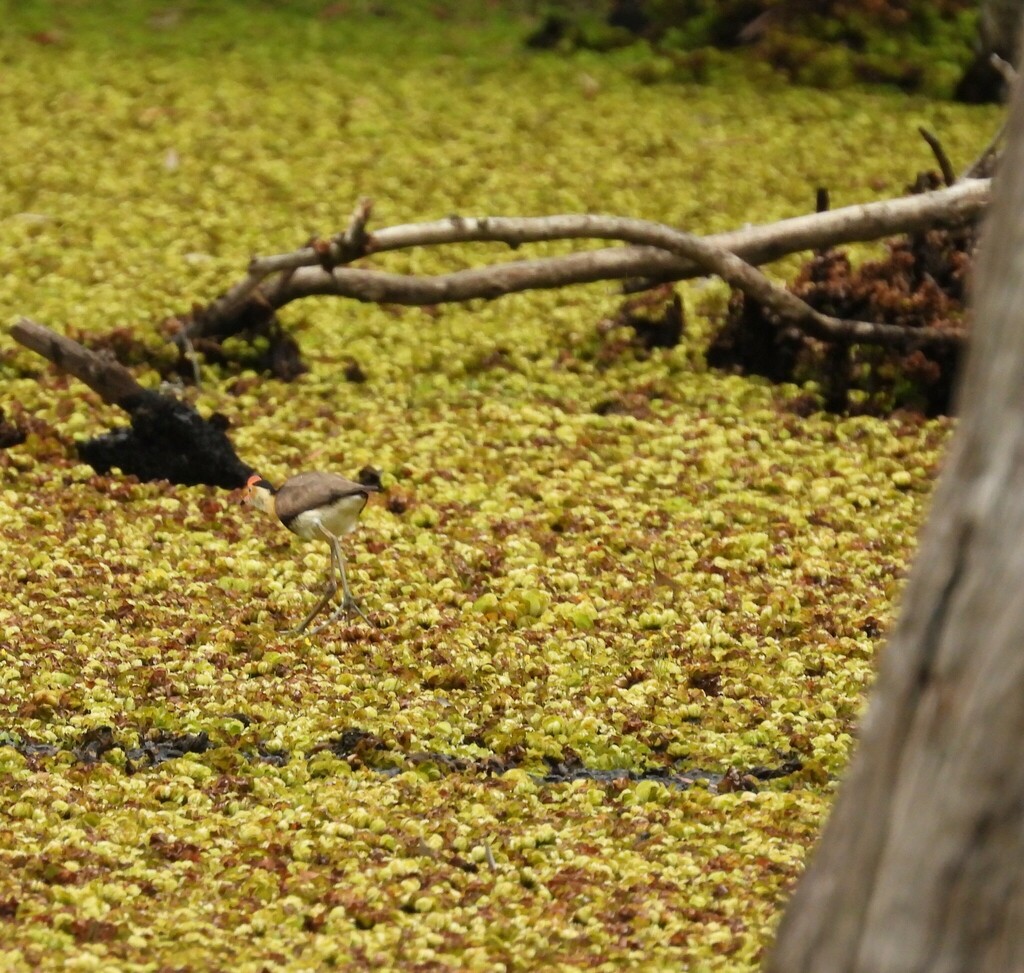
Comb-crested Jacana
Photo © Mark Clarke
Photo © Mark Clarke — CC BY 4.0 — Source: iNaturalist #257107443Identification
The comb-crested jacana is unmistakable among waterbirds. Its most striking feature is the vivid fleshy red wattle covering the forehead and forecrown, which contrasts sharply with a white face and throat. A bold black crown and hindneck frame this distinctive head pattern, while a broad black band runs across the lower breast above a white belly. The comb itself shifts in colour with the breeding season—deeper pink during breeding and more orange at other times. The back and upperwings are grey-brown, with black primary coverts, rump and tail. In flight, the black underwings and flight feathers are particularly prominent, along with the bird's characteristically long legs and extremely long toes trailing behind.
Sexual dimorphism is evident: females are notably larger, measuring 24–27 cm in length and weighing 120–150 g, while males are more compact at 20–22 cm and 68–84 g. The wingspan ranges from 39 to 46 cm.
Range & Habitat
This jacana is found across a broad region of South-east Asia and Australasia, including south-eastern Borneo, the southern Philippines, Sulawesi, the Moluccas, the Lesser Sunda Islands, and areas of New Guinea including New Britain. Its range extends into northern and eastern Australia. Although the species is rare and localised throughout this distribution, it is not considered globally threatened.
The comb-crested jacana is a specialist of large freshwater wetlands, swamps and lakes where abundant floating vegetation creates a mat-like surface on the water. Water-lilies, water hyacinth and similar plants provide both the habitat structure and feeding opportunities that this species depends upon.
Behaviour & Diet
As a member of the Jacanidae family, the comb-crested jacana is superbly adapted to life on floating vegetation, walking slowly and deliberately across the water surface with its characteristic long-toed feet. It often congregates in flocks and when disturbed will fly low over the water before landing again on open vegetation.
The species is polyandrous, with a reversal of typical breeding roles: only males incubate the eggs. Females lay four lustrous, pale brown eggs marked with black on flimsy nests built on floating or emergent vegetation. The young are precocial, hatching well-developed and soon departing the nest. In terms of diet, the comb-crested jacana gleans seeds and aquatic insects from the floating vegetation surface. Its vocalisation is distinctive—a squeaky, high-pitched chittering or shrill trill sometimes punctuated by an explosive soft bugle.
Best Time & Places to See It
Finding the comb-crested jacana requires visiting suitable freshwater wetlands within its range across northern and eastern Australia, New Guinea and the Indonesian archipelago. Your best chances lie at large swamps and lakes with extensive mats of floating vegetation. Due to the species' localised distribution, checking recent sighting records and consulting local birding guides for the specific area you plan to visit is strongly recommended.
Photography Tips
The comb-crested jacana's striking head pattern and contrasting plumage make it a rewarding photography subject, though patience is essential given its preference for skulking on floating vegetation. Photograph from a distance to avoid flushing the bird, and be prepared for slow, deliberate movements across the water. The bright red comb and white face are most vibrant during breeding season. Capture images of the bird in flight to showcase the trailing long toes and black flight feathers—a characteristic jacana silhouette.
Kakadu National Park
Kakadu, Australia
+273 birds+46 mammals
Kakadu National Park is Australia’s largest national park and one of the world’s most remarkable protected areas, covering nearly 20,000 square kilometres in the tropical north…
VIEW NATIONAL PARKDaintree National Park
Dedin, Australia
+362 birds+37 mammals
Daintree National Park is one of the world’s oldest and most biologically diverse tropical rainforests, protecting an extraordinary landscape where ancient forests meet the Great Barrier…
VIEW NATIONAL PARKSpringbrook National Park
Australia
+195 birds+25 mammals
Subtropical rainforest meets open eucalypt woodland across a mountainous terrain where the McPherson Range rises sharply from the Queensland coast, creating a patchwork of microclimates and…
VIEW NATIONAL PARKLamington National Park
Australia
+227 birds+24 mammals
Where subtropical rainforest rises steeply from the Queensland coast, Lamington National Park spreads across 541 square kilometres of one of Australia's most biodiverse mountain landscapes. The…
VIEW NATIONAL PARKRinyirru National Park
Lakefield, Australia
+258 birds+7 mammals
Where the savanna grasslands of far north Queensland meet seasonal wetlands and eucalypt woodlands, Rinyirru National Park sprawls across more than 12,500 square kilometres of rugged,…
VIEW NATIONAL PARKBribie Island National Park
Brisbane, Australia
+284 birds+20 mammals
Across tidal flats and shallow waterways north of Brisbane, Bribie Island National Park spreads across nearly four hundred square kilometres of subtropical coastal wilderness—a patchwork of…
VIEW NATIONAL PARKWhitsunday Islands National Park
Whitsundays, Australia
+163 birds+9 mammals
Crystalline waters lap against seventy-four islands where rainforest canopies tumble down to pristine beaches and coral gardens flourish in the shallows. This archipelago off Queensland's coast…
VIEW NATIONAL PARKLitchfield National Park
Australia
+175 birds+15 mammals
Where weathered sandstone plateaus rise above the savanna woodlands of Australia's Top End, Litchfield National Park unfolds as a landscape of dramatic contrasts shaped by a…
VIEW NATIONAL PARKNitmiluk National Park
Australia
+186 birds+27 mammals
Dramatic sandstone gorges carved by the Katherine River slice through the tropical savanna of Australia's Top End, creating a landscape where escarpments tower above crystalline pools…
VIEW NATIONAL PARKGreat Sandy National Park
Australia
+306 birds+40 mammals
Where coastal dunes rise inland from the Queensland coastline, Great Sandy National Park encompasses a landscape of remarkable ecological diversity shaped by subtropical humid conditions year-round.…
VIEW NATIONAL PARKGirringun National Park
Australia
+231 birds+10 mammals
Where granite gorges cleave through subtropical woodland in North Queensland, Girringun National Park unfolds across rugged terrain shaped by millions of years of weathering and erosion.…
VIEW NATIONAL PARKNoosa National Park
Marcus Beach, Australia
+216 birds+8 mammals
Subtropical eucalypt woodland and open forest meet coastal heathland along the Noosa Peninsula, where the temperate waters of the Tasman current moderate the Queensland climate into…
VIEW NATIONAL PARKNo community photos yet. Log in to add the first one.
No community observations of this species yet.