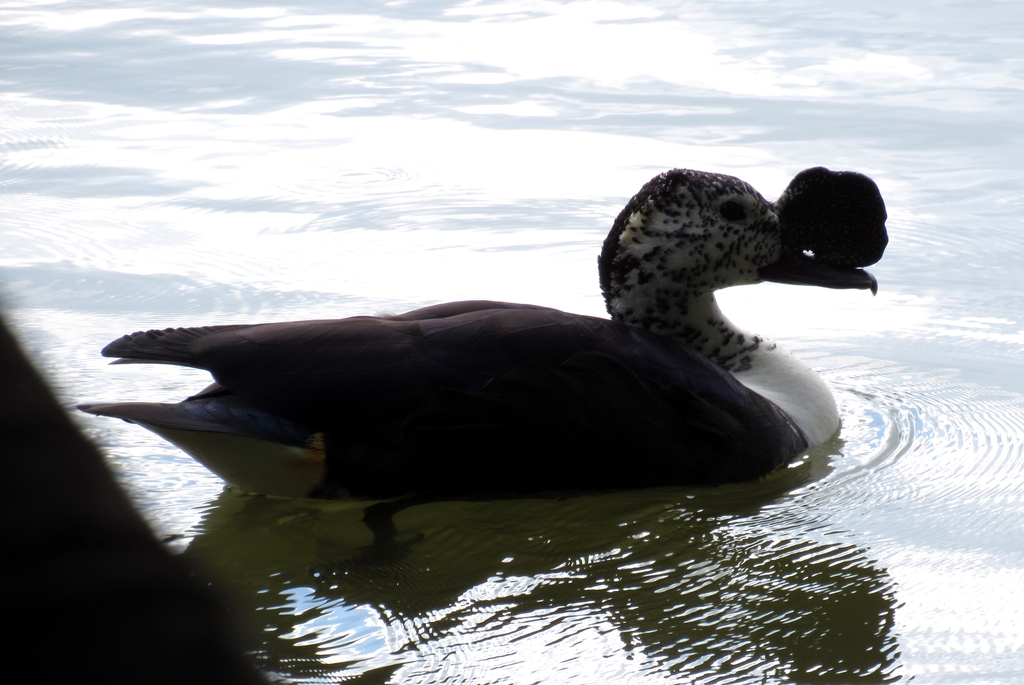
Comb Duck
Photo © Rafael Rosa
Photo © Rafael Rosa — CC BY-SA 4.0 — Source: iNaturalist photo #606234767Identification
The comb duck is one of the largest duck species, measuring 56 to 76 cm in length with a wingspan of 116 to 145 cm. Adults are unmistakable: they display a distinctive white head heavily freckled with dark spots, a pure white neck and underparts, and glossy blue-black upperparts with striking bluish and greenish iridescence particularly visible on the secondary feathers. Males are considerably larger than females and sport a prominent black knob on the bill—the feature that gives the species its name. The species is often split taxonomically from the knob-billed duck, with the comb duck being generally smaller and having darker flanks (black in males, medium grey in females). Immature birds can occasionally be confused with fulvous whistling ducks at distance, but they are usually readily identified when seen alongside adults.
Range & Habitat
The comb duck inhabits tropical wetlands across continental South America, with its range extending south to the Paraguay River region in eastern Paraguay, southeastern Brazil, and extreme northeastern Argentina. Vagrant individuals occasionally appear on Trinidad. The species breeds in still freshwater swamps and lakes throughout the tropics, preferring these peaceful aquatic environments for nesting and foraging.
Behaviour & Diet
Largely resident year-round, comb ducks disperse during the wet season. They are highly gregarious, typically seen in small flocks during the wet season but aggregating into groups of up to 100 individuals in the dry season; sometimes these flocks separate by sex. The species is notably arboreal, frequently perching in trees—a behaviour unusual among ducks.
Comb ducks are primarily herbivorous, feeding on vegetation through grazing and dabbling, though they also consume small fish, invertebrates, and seeds to a lesser extent. They can become agricultural pests in rice-farming regions. Breeding males exhibit unusual polygamous behaviour, potentially maintaining two simultaneous mates or up to five successive partners; they defend females and young but not nest sites. Females nest in tree holes or tall grass, lining nests with reeds, grass, or feathers. Clutches range from seven to 15 yellowish-white eggs, and multiple females may use the same "dump nest," sometimes containing up to 50 eggs.
Best Time & Places to See It
Comb ducks are most conspicuous during the dry season when flocks aggregate at still freshwater lakes and swamps throughout their South American range in Paraguay, Brazil, and northeastern Argentina. The wet season offers better breeding opportunities to observe nesting behaviour and family groups, though flocks are smaller at this time.
Photography Tips
The striking white head with dark spots contrasts dramatically against the glossy blue-black upperparts, making comb ducks highly photogenic. Their tree-perching behaviour offers unique opportunities for action shots. Early morning light accentuates the iridescent secondary feathers beautifully. During the dry season, congregations of up to 100 birds provide excellent opportunities for flock photography. Look for males with their characteristic bill knobs perched prominently in trees overlooking wetlands.
Cerros de Amotape National Park
District of San Jacinto, Ecuador
+246 birds+1 mammals
Arid mountains rise abruptly from Peru's northwestern frontier, their slopes clothed in xerophytic scrubland and seasonal deciduous forest that transforms these Andean foothills into one of…
VIEW NATIONAL PARKParque Nacional de Galápagos
Santo Tomás, Ecuador
+139 birds+23 mammals
Volcanic peaks and weathered lava fields dominate this remote archipelago in the Pacific, where the interplay of cold ocean currents and tropical latitude creates an ecological…
VIEW ISLAND & ARCHIPELAGOChapada Diamantina National Park
Brazil
+346 birds+5 mammals
Where granite peaks and sandstone cliffs rise abruptly from the Brazilian interior, Chapada Diamantina National Park sprawls across 4,215 square kilometers of some of Brazil's most…
VIEW NATIONAL PARKEl Rey National Park
Municipio de Las Lajitas, Argentina
+317 birds+4 mammals
Where the eastern slopes of the Andes descend into northwestern Argentina's subtropical transition zone, El Rey National Park unfolds across 841 square kilometers of dramatically varied…
VIEW NATIONAL PARKNo community photos yet. Log in to add the first one.
No community observations of this species yet.