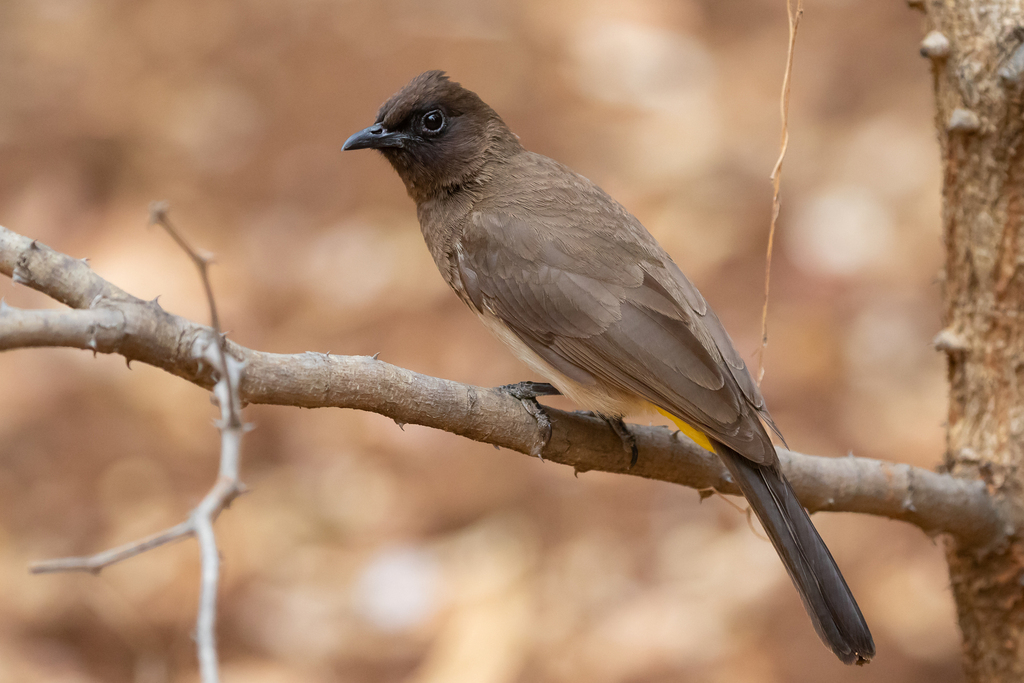
Common Bulbul
Photo © Johannes S.
Photo © Johannes S. — CC BY 4.0 — Source: iNaturalist photo #643798831Identification
The common bulbul is a small passerine measuring 18–20 cm in length, characterized by a distinctive dark brown head and brown upperparts contrasting with dull grey underparts. It has a fairly short, thin bill with a slightly downwards-curving upper mandible, and dark brown eyes surrounded by a dark eye-ring. The bill, legs, and feet are black. Sexes are similar in plumage, though males are on average larger. Several subspecies display yellow undertail coverts, which can aid in identification. The bird's loud, distinctive call—a rapid "doctor-quick doctor-quick be-quick be-quick"—is often the first indication of its presence.
Range & Habitat
The common bulbul is widespread throughout most of Africa except for very arid areas, with ten recognized subspecies showing geographical variation across the continent. Remarkably, the species has recently begun breeding in southernmost Spain at Tarifa, expanding its range beyond its traditional African stronghold. It inhabits diverse environments including woodland, coastal bush, forest edges, riverine bush, and montane scrub, as well as mixed farming habitats, exotic thickets, gardens, and parks, demonstrating considerable adaptability to different landscapes.
Behaviour & Diet
The common bulbul is usually encountered in pairs or small groups and is a conspicuous, active, and noisy bird that characteristically perches at the top of bushes. Its flight is distinctive and bouncing, resembling that of a woodpecker. The species primarily feeds on fruit but supplements its diet with nectar, insects, and seeds, making it an opportunistic forager.
Breeding patterns vary geographically: in moist tropical regions, the species nests year-round, while elsewhere it breeds more seasonally with peaks coinciding with the rainy season. Females construct cup-shaped, thick-walled nests 1–5 metres above ground in tree branches, typically away from the main trunk. Clutches contain 2 to 5 eggs, incubated by the female for 12–15 days. Chicks fledge after 13–16 days and receive parental care until around 40 days of age. The species frequently falls victim to parasitism by the Jacobin cuckoo.
Best Time & Places to See It
The common bulbul is a common resident breeder throughout much of Africa, making it relatively easy to locate in suitable habitat. In seasonal breeding areas, the onset of the rainy season offers the best opportunities for observation, when breeding activity peaks. Its conspicuous behaviour and loud calls make it detectable even in dense vegetation, and its preference for perching at bush-tops increases visibility. Gardens, parks, and woodland edges near human settlements are particularly rewarding locations for viewing.
Photography Tips
Photographers should focus on the bird's characteristic top-of-bush perching behaviour, which provides excellent photographic opportunities with minimal obstruction. The distinctive dark brown head and contrasting plumage are most striking in clear, direct light. Early morning hours, when the bird is most vocal and active, offer the best chances for encounters. The bouncing, woodpecker-like flight can provide dynamic shooting opportunities for those with fast enough equipment. In subspecies with yellow undertail coverts, capturing this field mark in flight shots adds diagnostic value to images.
Bwindi Impenetrable National Park
Lake Mburo National Park
Mabamba Swamp
Murchison Falls National Park
Queen Elizabeth National Park
Aberdare National Park
Abijata-Shalla Lakes National Park
Addo Elephant National Park
Amboseli National Park
Nothing matches these filters.
No community photos yet. Log in to add the first one.
No community observations of this species yet.