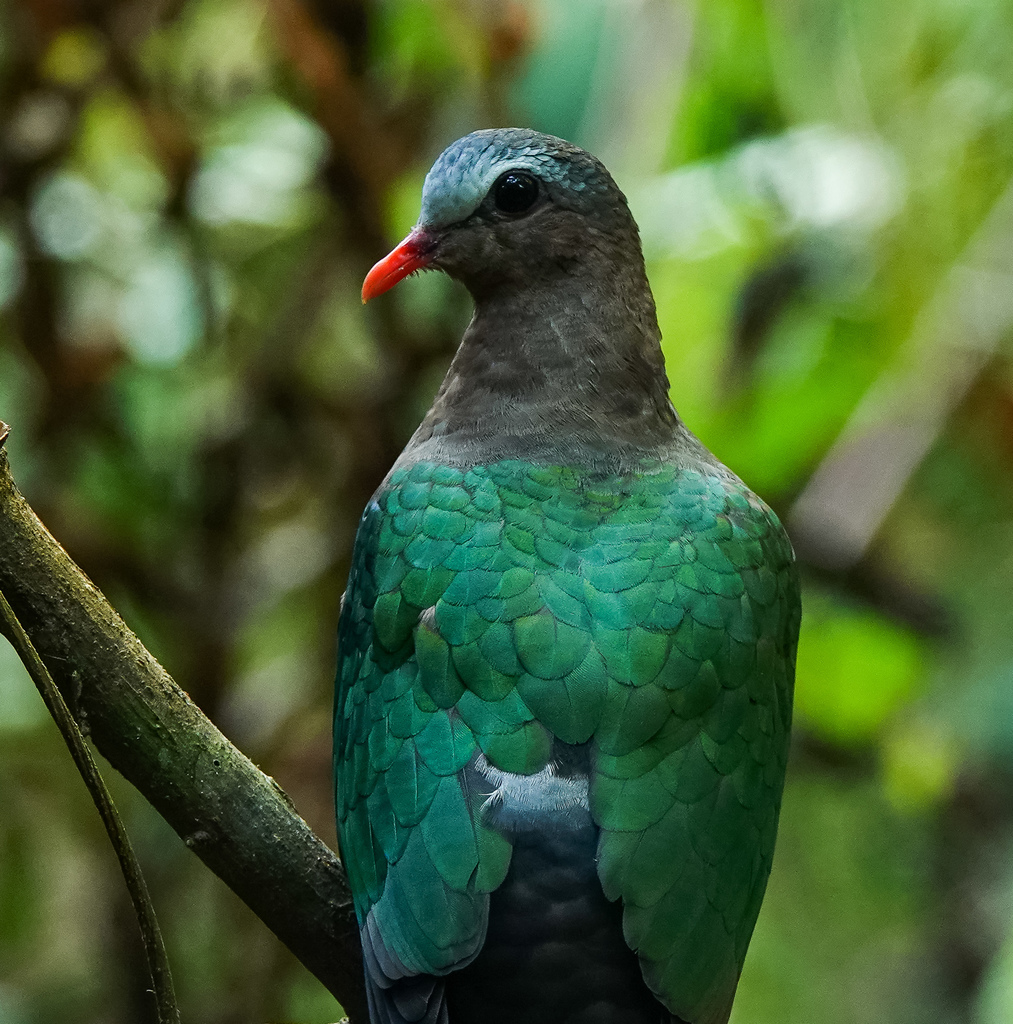
Common Emerald Dove
Photo © Rejoice Gassah
Photo © Rejoice Gassah — CC BY 4.0 — Source: iNaturalist #105956714Identification
The Common Emerald Dove is a stocky, medium-sized pigeon measuring 23–27 cm in length. Its most striking feature is the bright emerald green colouration on the back and wings, which contrasts sharply with blackish flight feathers and tail. In flight, broad black and white bars are visible on the lower back. The head and underparts are dark vinous pink, fading to greyish on the lower belly. The bird has dark brown eyes, a bright red bill, and rufous legs and feet.
Sexual dimorphism is evident in this species. Males display a distinctive white patch on the edge of the shoulders and a grey crown, features absent in females. Females tend to have a browner overall complexion with a grey mark on the shoulder. Immature birds resemble females but can be distinguished by brown scallops on their body and wing plumage.
Range & Habitat
The Common Emerald Dove is a widespread resident breeding pigeon native to the tropical and subtropical parts of the Indian subcontinent and Southeast Asia. Six subspecies are recognised across its range, extending from India to south China, Malaysia, the Philippines, Indonesian and west Papuan islands, as well as Sri Lanka, the Andaman and Nicobar Islands, Christmas Island, and islands off north New Guinea.
This species favours tropical forests and similar dense wet woodlands, as well as farms and mangroves. It builds a scant stick nest in a tree up to five metres high and typically lays two cream-coloured eggs. The Common Emerald Dove is the state bird of the Indian state of Tamil Nadu.
Behaviour & Diet
The Common Emerald Dove is generally tame and approachable. It is either solitary or occurs in pairs or small groups. The bird is notably terrestrial, spending much of its time searching for fallen fruit on the ground and roosting in trees rather than foraging among branches. Its diet consists of seeds and fruits from a wide variety of plants.
The call is a low, soft moaning coo consisting of about six to seven coos, starting quietly and rising in volume, along with a nasal "hoo-hoo-hoon". During courtship, males perform a distinctive bobbing dance. The dove's flight is fast and direct with regular wing beats and occasional sharp flicks characteristic of pigeons generally. It often flies low between patches of dense forest and is a particularly adept flyer through forested areas. When disturbed, it frequently walks away rather than taking flight.
Best Time & Places to See It
The Common Emerald Dove is a common species throughout its range in tropical and subtropical regions of Asia. Travellers should search for it in tropical forests, dense wet woodlands, farmland, and mangrove habitats across the Indian subcontinent, Southeast Asia, and associated islands. Its preference for dense vegetation and ground-foraging behaviour means it is best located by listening for its distinctive calls and watching for movement on the forest floor and in low undergrowth.
Photography Tips
The brilliant emerald green plumage and contrasting black-and-white markings make this dove an attractive photographic subject. The bird's generally tame and approachable nature works in the photographer's favour. Focus on capturing the distinctive bright emerald back and wings, and try to photograph birds in flight to showcase the characteristic black and white bars on the lower back. Early morning when birds are most active and calling will provide the best opportunities for both locating and photographing this species in its forest habitat.
Kanha Tiger Reserve
Minneriya National Park
Aketajawe Lolobata National Park
Bako National Park
Bandhavgarh National Park
Bandipur National Park
Banke National Park
Bardiya National Park
Chitwan National Park
Nothing matches these filters.
No community photos yet. Log in to add the first one.
No community observations of this species yet.