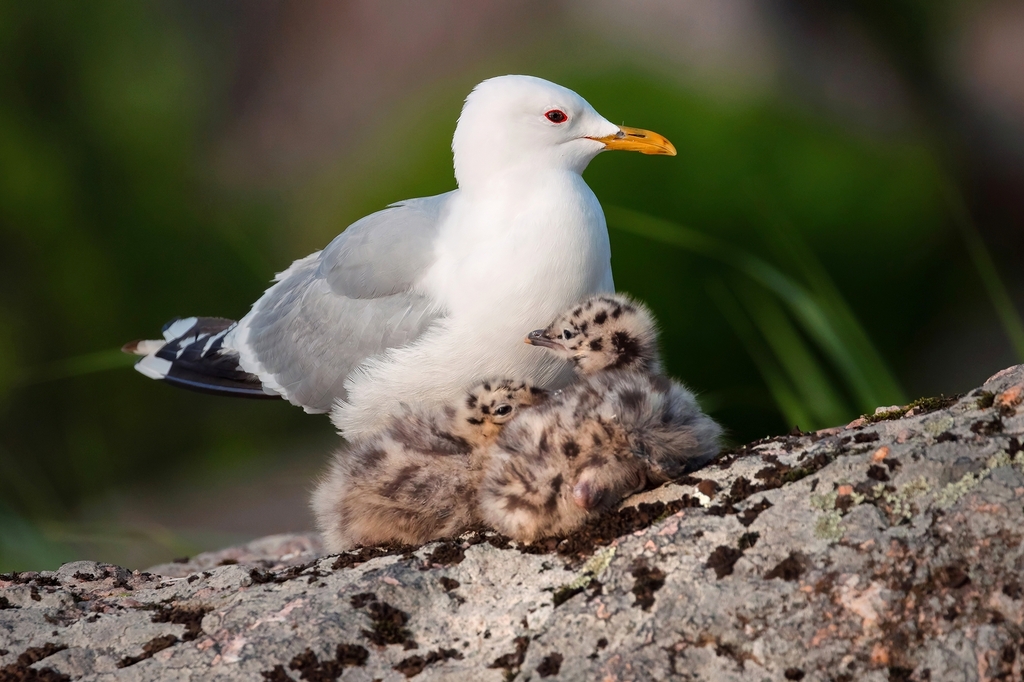
Common Gull
Photo © Олеся
Photo © Олеся — CC BY 4.0 — Source: iNaturalist photo #518004005Identification
The common gull is a noticeably smaller gull, measuring 40–46 cm in length with a wingspan of 100–115 cm. Adults are distinguished by a grey back and white underparts, with black wingtips marked by large white "mirrors" on the outer primary feathers. The bill is shorter and more tapered than similar species, displaying a greenish-yellow colour that is unmarked during breeding season. In winter, the head becomes streaked with grey and the bill often shows a poorly defined blackish band near the tip. Legs are bright yellow during breeding season, becoming duller in winter.
Immature birds present a different appearance, with scaly black-brown upperparts, a neat wing pattern, and pink legs that gradually turn greyish in the second year before eventually becoming yellow. Young birds take three years to reach full maturity (up to four years in the Kamchatka subspecies). The common gull's call is a distinctive high-pitched "laughing" cry that helps identify it in the field.
Range & Habitat
The common gull breeds across the cool temperate regions of the Palearctic, ranging from Iceland and Scotland eastward to Kamchatka in the Russian Far East. Most populations are migratory, dispersing southward in winter to reach the Mediterranean Sea, the southern Caspian Sea, and the seas around China and Japan. Northwest European populations are at least partly resident, remaining through the colder months. The species occasionally appears as a scarce winter visitor to coastal eastern Canada.
This gull favours areas near water, breeding colonially or sometimes solitarily in marshes and on the ground or in small trees close to water bodies. Its preference for cool-climate breeding grounds and temperate wintering areas makes it a fixture of both northern and Mediterranean regions throughout the year.
Behaviour & Diet
Common gulls typically breed in colonies, though some pairs nest solitarily. Both parents construct a lined nest and share incubation duties for clutches of one to three eggs, which hatch after 24–26 days. The precocial chicks remain near the nest and are cared for by both parents until fledging at around 35 days of age.
Like most gulls, common gulls are opportunistic omnivores that both scavenge and hunt small prey. The global population is estimated at approximately one million pairs, with Europe supporting more than half of all breeding birds—possibly as much as 80–90% of the world total, making them the most numerous gull in that region.
Best Time & Places to See It
Common gulls are easiest to observe during the breeding season in Iceland, Scotland, and across the Palearctic from Scandinavia to northeastern Siberia, where they gather in colonies. In winter, they disperse widely across temperate regions, making them visible along Mediterranean coasts, around the Black and Caspian seas, and throughout the coastal regions of China and Japan. European coasts are particularly productive year-round, especially where northwest populations remain resident.
Winter months are best for observing these gulls outside their breeding range, when large numbers congregate in milder southern regions. Coastal areas and harbours are prime locations, as the species favours marine and estuarine environments.
Photography Tips
The common gull's smaller size relative to herring gulls makes it an interesting subject for comparative photography. Focus on capturing the distinctive greenish-yellow bill with its elegant taper, and the large white mirrors on the black wingtips—key field marks that separate this species from similar gulls. In breeding plumage, the clean white head and bright yellow legs create striking contrast.
Winter birds offer different photographic opportunities, with grey streaking on the head and the sometimes-visible blackish bill tip providing subtle but identifiable features. Young birds in their immature plumage present unique challenges and rewards; the scaly brown upperparts and developing leg colouration are worth documenting across seasons to illustrate the species' three-year maturation process.
Delta de l’Ebre Natural Park
Alaska Maritime National Wildlife Refuge
Alta Murgia National Park
Åsnens National Park
Avesnois Regional Nature Park
Baikal National Park
Bannau Brycheiniog National Park
Biebrza National Park
Boucles de la Seine Normande Regional Nature Park
Nothing matches these filters.
No community photos yet. Log in to add the first one.