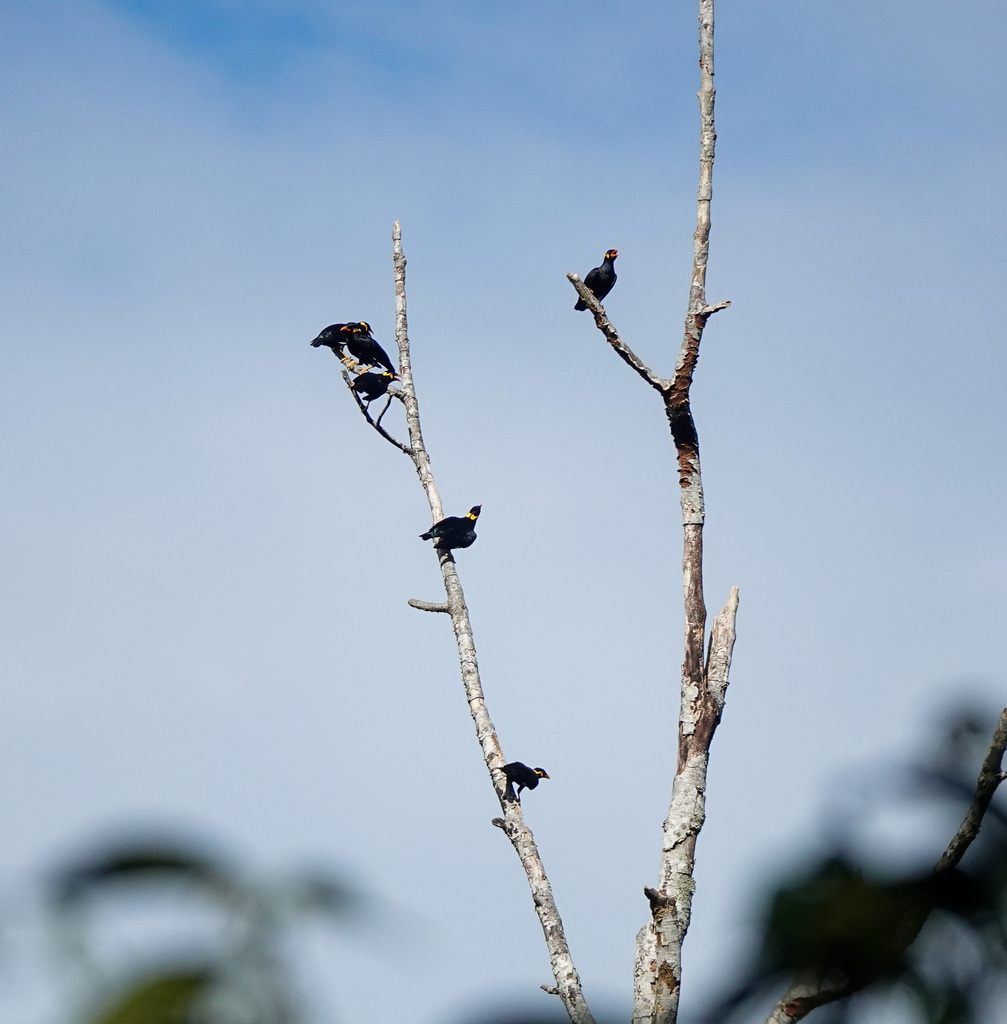
Common Hill Myna
Photo © Rejoice Gassah
Photo © Rejoice Gassah — CC BY 4.0 — Source: iNaturalist #101251496Identification
The common hill myna is a stocky, jet-black starling approximately 29 cm in length, noticeably larger than the common myna. Its most distinctive features are bright orange-yellow naked skin patches and fleshy wattles on the sides of its head and nape. The plumage is overall green-glossed black with purple tinges on the head and neck. In flight, large white wing patches are conspicuous; these are mostly hidden when the bird is perched. The bill and strong legs are bright yellow, and yellow wattles extend from the eye to the nape where they join. Sexes are similar in appearance, though juveniles have duller bills. Different subspecies vary subtly in size, wattle patterns, and plumage glossiness.
Range & Habitat
The common hill myna is found across the hills of South and Southeast Asia as a resident breeder. Its range extends from Kumaon in India eastward through Nepal, Sikkim, Bhutan, and Arunachal Pradesh, across the lower Himalayas, terai, and foothills up to 2,000 m elevation. Distribution continues east through Southeast Asia, reaching southern China, Thailand, northern Indonesia, and the Philippines (Palawan). Nine recognized subspecies occupy different regions across this vast range, from northeastern peninsular India to various Indonesian islands including Java, Sumatra, Borneo, and the Andaman and Nicobar Islands.
Behaviour & Diet
The common hill myna is highly vocal, particularly at dawn and dusk, producing loud, shrill descending whistles followed by various calls. Both sexes have extraordinary vocal ranges, including melodious whistles, wails, screeches, and gurgles that often sound remarkably human-like. Each individual possesses a repertoire of three to 13 call types learned when young, with dialects varying rapidly across geography—birds separated by more than 15 km share no common call types. The species is found in small groups in forest clearings high in the canopy. In captivity, common hill mynas are renowned mimics, rivaling the grey parrot in their ability to reproduce human speech, whistled tunes, and everyday sounds with astonishing accuracy, though they do not imitate other birds in the wild.
Best Time & Places to See It
The common hill myna is most active and vocal during dawn and dusk hours, when birds gather in small flocks in high forest clearings. Look for them in hilly and mountainous regions across South and Southeast Asia, particularly in Nepal, Bhutan, Thailand, and Indonesia. The species is relatively common throughout its range and one of the most frequently spotted birds in Asian aviculture, making it accessible to dedicated birdwatchers and nature enthusiasts across the region.
Photography Tips
To photograph the common hill myna effectively, plan visits during dawn and dusk when birds are most active and vocal, making them easier to locate. Position yourself to capture the distinctive white wing patches, which are visible only in flight—anticipate takeoff moments from forest clearings in the canopy. The bright yellow bill, legs, and facial wattles provide excellent contrast against the jet-black plumage and should be rendered sharply. Small group dynamics offer compositional opportunities; patience in high-elevation forest habitats will reward you with clear views of these striking starlings in their natural setting.
Langtang National Park
Helambu, Nepal
+364 birds+14 mammals
Where the southern slopes of the Himalayan highlands descend toward the subtropical valleys of central Nepal, Langtang National Park sprawls across one of the subcontinent's most…
VIEW NATIONAL PARKOrang National Park
Rangagarapathar, India
+298 birds+1 mammals
Where the Brahmaputra's floodplains meet the foothills of Assam, Orang National Park unfolds across a mosaic of riverine grasslands, forests and wetlands that pulse with the…
VIEW NATIONAL PARKKhangchendzonga National Park
Sakkyong, India
+290 birds+1 mammals
Where the eastern Himalayas surge toward their crowning peaks, Khangchendzonga National Park embraces a landscape of almost overwhelming vertical drama. Rising from subtropical river valleys into…
VIEW NATIONAL PARKPhou Khao Khouay National Protected Area
Thaphabath District, Thailand
+113 birds
Where the Annamite Mountains descend into central Thailand's monsoon forests, Phou Khao Khouay National Protected Area sprawls across rugged limestone terrain interlaced with river valleys and…
VIEW NATIONAL PARKKhao Yai National Park
Prachantakham District, Thailand
+377 birds+46 mammals
Evergreen dipterocarp forest blankets the rolling terrain of this national park in eastern Thailand, where limestone hills rise abruptly from the forest floor and seasonal streams…
VIEW NATIONAL PARKKhao Laem Ya-Mu Ko Samet National Park
Mueang Rayong District, Thailand
+159 birds+3 mammals
Where limestone hills meet the Gulf of Thailand, Khao Laem Ya–Mu Ko Samet National Park stitches together a mosaic of terrestrial and marine worlds that few…
VIEW NATIONAL PARKKaziranga National Park
Kohora, India
+422 birds+26 mammals
Dawn breaks over the floodplains of the Brahmaputra, where tall grasslands stretch endlessly beneath monsoon-heavy skies. This sprawling wilderness of northeastern Assam is a mosaic of…
VIEW NATIONAL PARKBako National Park
Kuching, Malaysia
+210 birds+17 mammals
Weathered sandstone cliffs rise dramatically from the South China Sea, their ochre faces sculpted by millennia of wind and tide into a landscape of extraordinary geological…
VIEW NATIONAL PARKTaman Negara National Park
Kampong Samas, Malaysia
+393 birds+48 mammals
Where ancient rainforest meets limestone peaks, one of Southeast Asia's oldest protected wilderness preserves sprawls across 4,343 square kilometers of primordial landscape. Dipterocarp giants tower overhead,…
VIEW NATIONAL PARKGunung Mulu National Park
Long Seridan, Malaysia
+280 birds+39 mammals
Where granite monoliths pierce the rainforest canopy of Sarawak, an ancient limestone karst landscape reveals one of Southeast Asia's most biodiverse strongholds. Soaring peaks cloaked in…
VIEW NATIONAL PARKGaoligong Mountain National Nature Reserve
Nujiang Lisu Autonomous Prefecture, China
+443 birds+13 mammals
VIEW NATURE RESERVENo community photos yet. Log in to add the first one.
No community observations of this species yet.