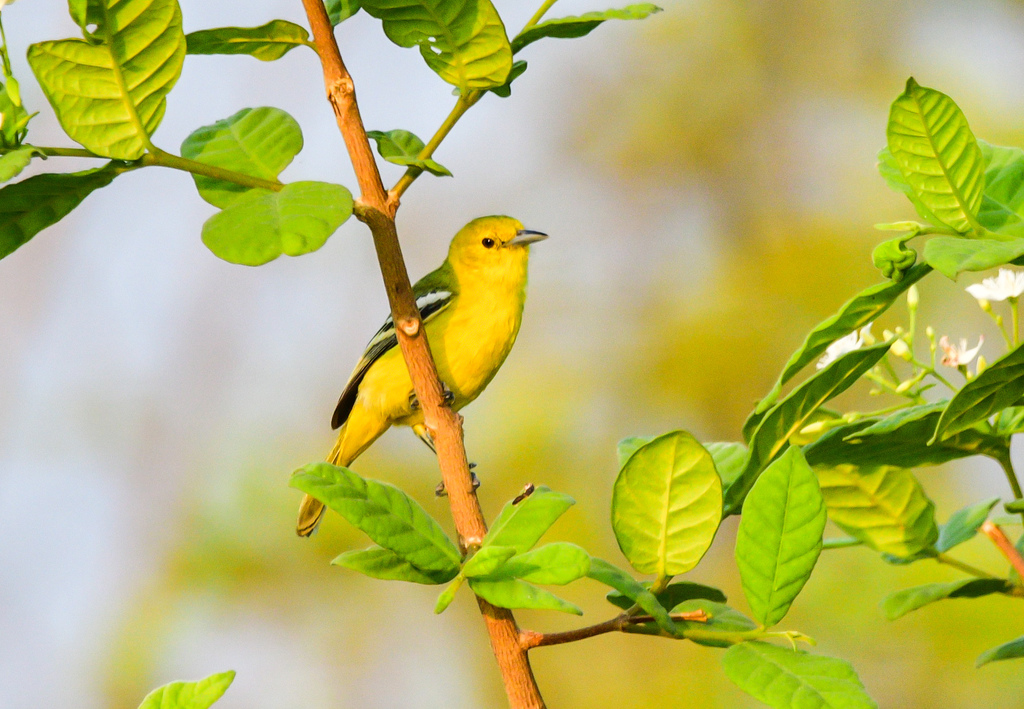
Common Iora
Photo © Surabhi Srivastava
Photo © Surabhi Srivastava — CC BY 4.0 — Source: iNaturalist photo #177241363Identification
The common iora is a small passerine with a pointed, notched beak and striking sexual dimorphism. Males in breeding season sport a black cap and back, with black wings and tail year-round, contrasted by bright yellow undersides and two prominent white wing bars. Females display greenish wings and an olive tail, also with yellow underparts. Plumage variation across eleven recognized subspecies means that male breeding plumage can be highly variable—from populations with minimal black on the crown to others with jet black caps and mantles. The two white wing bars are particularly prominent in male breeding plumage and help distinguish this species from the similar Marshall's iora, which always shows white tail tips.
Range & Habitat
The common iora is widely distributed across the tropical Indian subcontinent and Southeast Asia, with distinct subspecies found from the northwestern Himalayas and northwestern India through the Indian peninsula, into Myanmar, Thailand, Laos, Cambodia, Vietnam, southern China, Sumatra, Borneo, Java, Bali, and the Philippines. This species inhabits scrub and forest environments where it is easily detected by its loud, distinctive vocalizations and vibrant plumage.
Behaviour & Diet
Common ioras forage actively in trees, gleaning insects from branches while moving through the canopy in small groups; they often join mixed-species feeding flocks. Their calls comprise churrs, chattering, and whistles, with a distinctive trilled song of "wheeee-tee," and they occasionally mimic the calls of other birds such as drongos.
During breeding season, mainly after the monsoons, males perform spectacular acrobatic courtship displays, launching into the air with all feathers fluffed—especially the pale green rump feathers—then spiralling down before spreading the tail and drooping the wings. Pairs nest in tree forks in small, compact cup-shaped structures woven from grass and cobwebs, laying two to four greenish-white eggs that hatch after approximately 14 days, with both parents incubating. The species moults twice yearly, and nests face predation from snakes, lizards, crow-pheasants, and crows, plus brood parasitism by banded bay cuckoos.
Best Time & Places to See It
The breeding season, particularly the period following the monsoons, is the best time to observe common ioras, when males are most vocal and perform their impressive aerial displays. Look for them throughout their range in scrub and forest habitats across India, Southeast Asia, and the islands of the region, from the Himalayas to Java and Borneo.
Photography Tips
The common iora's bright yellow underparts and contrasting black plumage make it visually striking for photography. During breeding season, position yourself to capture males in their dramatic display—watch for them launching skyward with fluffed feathers creating a distinctive green, black, yellow, and white "ball" effect before spiralling downward. The loud, distinctive calls make locating these birds easier than many forest species. Photograph them while they forage deliberately through branches, gleaning insects, and watch for their characteristic tail-spreading and wing-drooping postures. Early morning when they are most vocal and active offers the best opportunities for both images and sound recording.
Kanha Tiger Reserve
Minneriya National Park
Angamedilla National Park
Bako National Park
Bandhavgarh National Park
Bandipur National Park
Banke National Park
Bardiya National Park
Chitwan National Park
Nothing matches these filters.
No community photos yet. Log in to add the first one.
No community observations of this species yet.