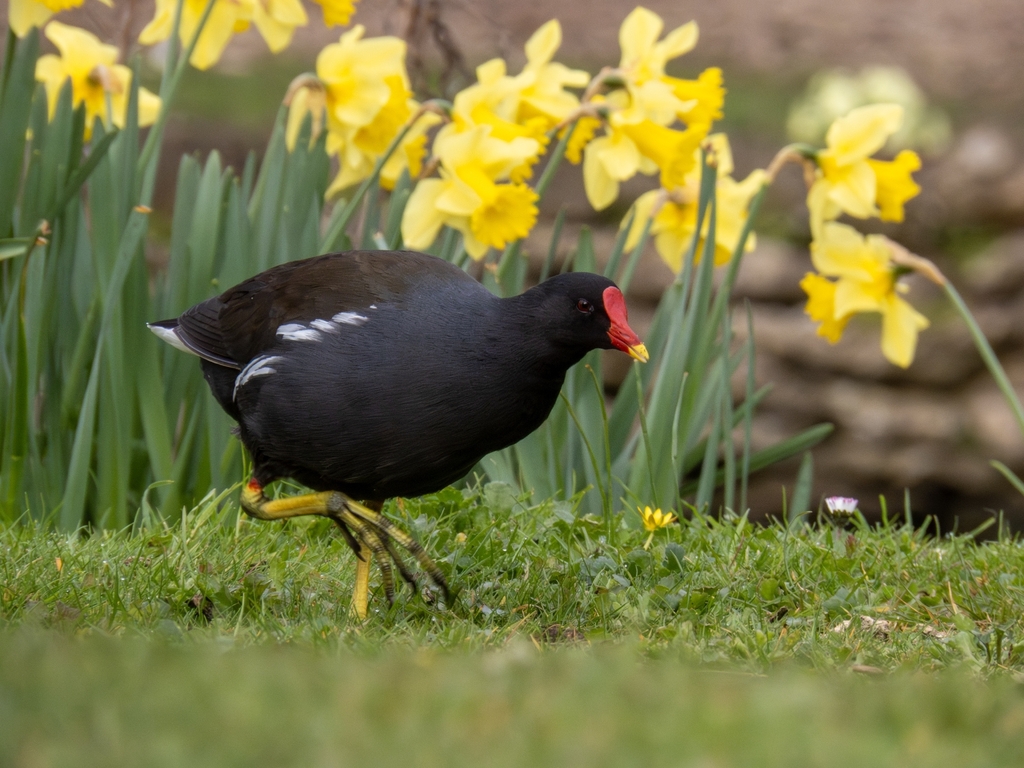
Common Moorhen
Photo © Rhys
Photo © Rhys — CC BY 4.0 — Source: iNaturalist photo #633307968Identification
The common moorhen is a distinctive rail with predominantly black and brown plumage, immediately recognizable by its bright red frontal shield and red bill with a yellow tip. Adults display white undertail coverts and white streaks on the flanks, contrasting sharply with their dark upperparts, while their yellow legs are another key identifying feature. Young birds are considerably browner and lack the distinctive red shield entirely, making them appear quite different from adults. The moorhen is a midsized to large rail, ranging from 30 to 38 centimetres in length with a wingspan of 50 to 62 centimetres.
Several subspecies are distributed across the Old World, with minor variations in plumage. The African subspecies meridionalis is smaller than the nominate European form and shows slaty blue-grey upperwing coverts, while the Asian orientalis subspecies has a notably larger shield. When threatened, this vocal bird emits loud hisses and produces a wide range of distinctive gargling calls.
Range & Habitat
The common moorhen is widely distributed across Africa, Europe, and Asia, making it one of the most common Old World rail species. It is absent from polar regions and many tropical rainforests, but thrives in well-vegetated marshes, ponds, canals, rivers, and lakes throughout its range. The species has successfully adapted to human-modified landscapes and can even be found in city parks.
Populations vary in their migratory patterns depending on geography. Birds in temperate regions where waters freeze, such as eastern Europe, migrate to more temperate climates during winter, while those in milder areas remain resident year-round. In China, populations south of the Yangtze River are largely non-migratory, whereas northern populations migrate seasonally.
Behaviour & Diet
Common moorhens are opportunistic feeders, consuming a wide variety of vegetable material and small aquatic creatures. They forage beside or in water, sometimes walking across lilypads or upending in shallow water to feed. While often secretive by nature, they can become surprisingly tame in areas where they are undisturbed, making them relatively approachable for observers.
During breeding season, moorhens are highly territorial and will vigorously defend their domains, fighting with other moorhens as well as ducks and other waterbirds. They build basket-like nests on the ground in dense vegetation, typically laying around eight eggs in early spring (mid-March to mid-May in Northern hemisphere temperate regions), with fewer eggs in later broods. Both parents share incubation duties for approximately three weeks and cooperatively feed their young. Chicks fledge after 40 to 50 days and become independent within weeks. Remarkably, when threatened, young moorhens can cling to their parents' bodies while the adults fly to safety, carrying their offspring with them.
Best Time & Places to See It
Common moorhens are present year-round in most of their range, though spring and early summer offer the best opportunities to observe breeding behaviour and territorial interactions. Any well-vegetated wetland habitat—marshes, ponds, canals, lakes with aquatic vegetation, or even urban parks with water features—offers potential sightings. The species' adaptability means it can be found in surprisingly diverse locations across its range.
Early morning visits to wetlands often yield the most sightings, as moorhens are more active during dawn and dusk. Look along reed beds and dense vegetation at the water's edge, and listen for their distinctive gargling calls, which can help pinpoint their location before you spot them.
Photography Tips
The moorhen's striking colour combination—bold red shield and bill contrasting with black plumage and yellow legs—makes it highly photogenic. Position yourself quietly at the water's edge during early morning or late afternoon light to capture the characteristic red and yellow tones at their most vibrant. Patient waiting near nesting sites during breeding season can reward you with intimate family moments, including the fascinating behaviour of chicks clinging to parents.
Since moorhens often forage in shallow water or on lilypads, a telephoto lens will help you maintain distance while capturing detailed shots of feeding behaviour. The birds' tendency to become tame in undisturbed areas means you may achieve closer approaches than with more wary species, but always move slowly and deliberately to avoid startling them.
Bwindi Impenetrable National Park
Kanha Tiger Reserve
Lake Mburo National Park
Mabamba Swamp
Murchison Falls National Park
Queen Elizabeth National Park
Aberdare National Park
Abijata-Shalla Lakes National Park
Abruzzo, Lazio and Molise National Park
Nothing matches these filters.
No community photos yet. Log in to add the first one.
No community observations of this species yet.