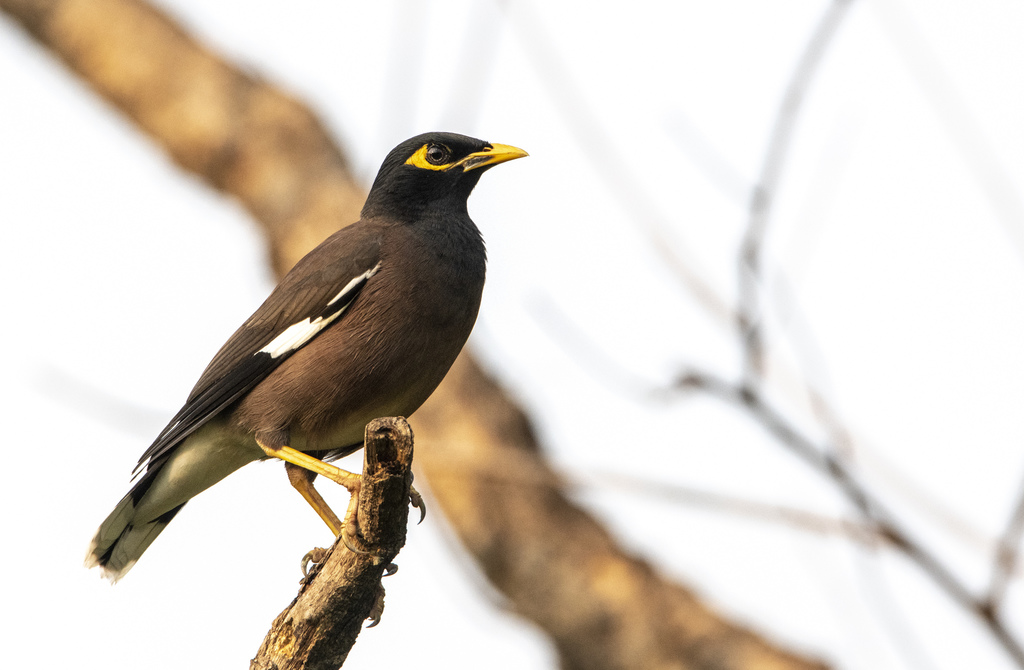
Common Myna
Photo © David F. Belmonte
Photo © David F. Belmonte — CC BY 4.0 — Source: iNaturalist photo #112489365Identification
The common myna is a distinctive and readily identifiable bird, measuring approximately 23 centimetres in length. It has a brown body contrasting sharply with a black hooded head, and a characteristic bare yellow patch behind the eye. The bright yellow bill and legs are equally striking. Look for white patches on the outer primaries and white wing linings on the underside, along with a white tail tip. The sexes are similar in appearance, and birds are usually seen in pairs.
Birds from northwestern India tend to be paler than their darker counterparts in southern India, following Gloger's rule. The Sri Lankan subspecies is notably darker than the Indian subspecies and features half-black and half-white primary coverts with a larger yellow cheek-patch, making regional variation a useful identification feature for travellers across its range.
Range & Habitat
Native to Asia, the common myna's original range spans from Iran and Pakistan through India, Nepal, Bhutan, Bangladesh and Sri Lanka, extending eastward to Afghanistan, Myanmar, Malaysia, Indochina, and China. The species has been introduced far beyond its native range, establishing populations across Canada, Australia, New Zealand, South Africa, Hawaii, and numerous Pacific and Indian Ocean islands.
Typically found in open woodland, cultivation and around human habitation, the common myna thrives in urban and suburban environments. Its remarkable success in cities stems from its evolutionary origins in India's open woodlands—the bird is pre-adapted to habitats with tall vertical structures and minimal ground vegetation, characteristics that mirror city streets and urban landscapes. This adaptability has made it one of the world's most invasive bird species, declared so by the IUCN in 2000.
Behaviour & Diet
An omnivorous bird with a strong territorial instinct, the common myna is highly vocal and social. Its varied calls include croaks, squawks, chirps, clicks, whistles and growls, often accompanied by feather-fluffing and head-bobbing. The species screeches warnings to warn its mate or other birds of nearby predators or when taking flight. Before settling into communal roosts, common mynas engage in "communal noise," vocalising in unison with their neighbours.
Their combination of singing and "speaking" abilities has made them popular as cage birds throughout their range. The species' omnivorous diet and adaptability to human-modified landscapes have contributed to its ecological success, though this success comes at the cost of significant impacts on native biodiversity in introduced regions.
Best Time & Places to See It
Common mynas are abundant and conspicuous throughout their native Asian range, particularly in open woodland, urban parks and gardens, and around human settlements. They are easiest to observe in cities and towns across India, southern China, Southeast Asia and Sri Lanka, where they are extremely common. Their bold, confident behaviour makes them approachable subjects in urban environments.
The species is active throughout the day and year, with no seasonal migration in most of its range. Early morning and late afternoon are particularly good times to observe flocks and hear their impressive vocal displays, especially around communal roosting sites where birds gather in large numbers before nightfall.
Photography Tips
The common myna's contrasting plumage—brown body, black hood, and bright yellow facial markings—photographs well in good light. The bird's rounded wings and square-tipped tail provide distinctive silhouettes. Capture the characteristic yellow patch behind the eye and bright yellow bill and legs, which are key identification features. Pairs are frequently seen together, offering opportunities for behavioural photography.
Their habituation to humans in urban areas makes them relatively approachable compared to wild birds. Early morning light enhances the contrast between their dark and pale plumage. Photograph them during their expressive vocal displays, when they fluff their feathers and bob their heads, or capture the dramatic scenes of communal roosting, where large flocks gather to vocalise in unison before settling for the night.
Minneriya National Park
Addo Elephant National Park
Angamedilla National Park
Arthur’s Pass National Park
Augrabies Falls National Park
Bako National Park
Bandhavgarh National Park
Bandipur National Park
Banke National Park
Nothing matches these filters.
No community photos yet. Log in to add the first one.
No community observations of this species yet.