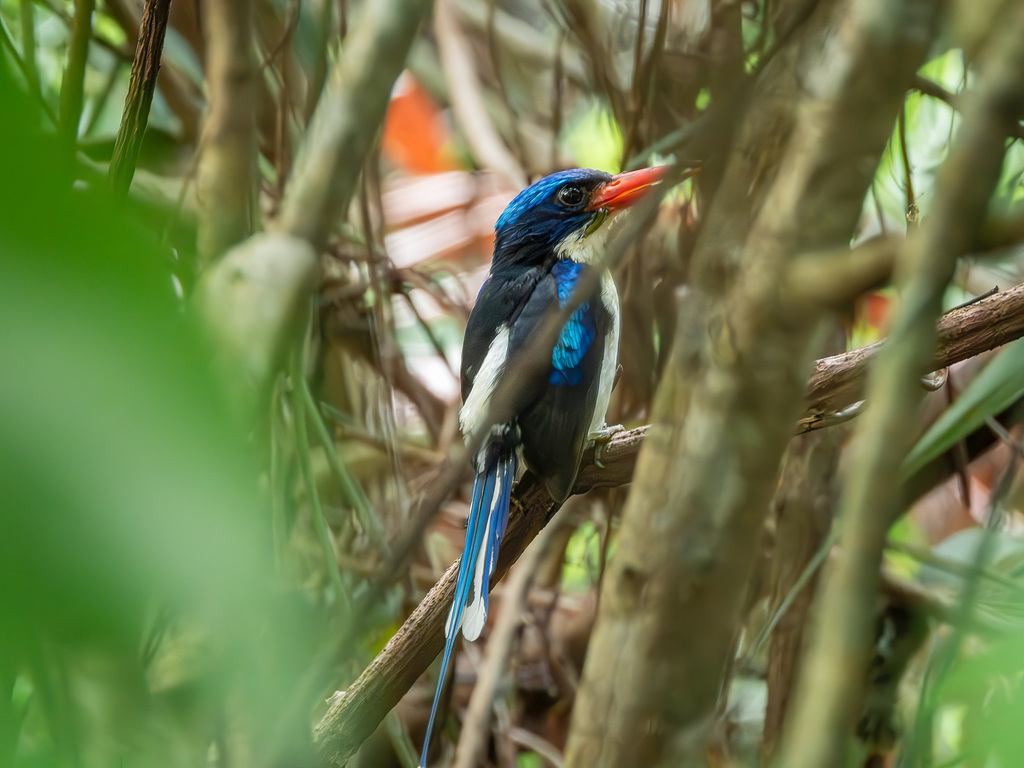
Common Paradise Kingfisher
Photo © Jason Alexander
Photo © Jason Alexander — CC BY 4.0 — Source: iNaturalist #292518521Identification
The common paradise kingfisher is a striking and distinctive bird with vivid plumage that makes it unmistakable in the field. It features a bright red bill, a dark turquoise cap with brighter blue edges, and blackish cheeks. The upper parts are bluish-black, while the under parts are pure white with blue and white under-wing coverts. Its most characteristic feature is its elongated central tail feathers, which have a blue base and are terminated by a spoon-shaped enlargement—a trait shared with other paradise kingfishers that sets them apart from typical kingfishers with short tails. The species is similar in appearance to the buff-breasted paradise kingfisher, though it differs in breast coloration.
Range & Habitat
The common paradise kingfisher is found in the forested interior of New Guinea and on offshore islands to the north, with a rather patchy distribution. The species occurs mostly below 500 metres on the mainland and up to 820 metres on Karkar Island, inhabiting subtropical or tropical moist lowland forests of the Maluku Islands and New Guinea. With 15 recognised subspecies distributed across the region—three on mainland New Guinea, eleven on the Maluku Islands, and two on other islands—the bird shows significant geographic variation. Sister species occupy nearby islands, each apparently descended from founding populations of common paradise kingfishers that became isolated and underwent separate evolution.
Behaviour & Diet
This common and mostly non-migratory species exhibits interesting ecological habits, though some populations move out of monsoon rainforest during the dry season. Pairs defend territories of 0.3 to 0.5 hectares. Unlike typical kingfishers that hunt in water, paradise kingfishers are specialised insect-hunters, darting down to pick up insects and small land-molluscs from the ground. Their breeding behaviour is equally distinctive: they nest in active termite nests in trees, excavating holes as much as 15 centimetres long that lead to a chamber at the end. A clutch of about five eggs is laid between November and March, with both parents caring for the young.
Best Time & Places to See It
The common paradise kingfisher is common throughout its range, making it a realistic target for travellers visiting New Guinea and the Maluku Islands. The breeding season from November to March is the best time to locate birds, as they are actively defending territories and visiting nest sites. The species' preference for forested interiors at lower elevations makes it most accessible in lowland tropical forest areas below 500 metres, where patient observation in suitable habitat offers good chances of encounters.
Photography Tips
Photographing this kingfisher requires patience and an appreciation for its forest habitat. The bird's vivid colours—particularly the red bill, turquoise cap, and white under parts—provide striking photographic opportunities when light conditions are favourable. The elongated tail feathers with their distinctive spoon-shaped tips are a key feature to capture. Since the species forages on the ground for insects and molluscs, positioning yourself near likely feeding areas in lowland forest will improve your chances of obtaining sharp images of this beautiful and relatively accessible paradise kingfisher.
No community photos yet. Log in to add the first one.
No community observations of this species yet.