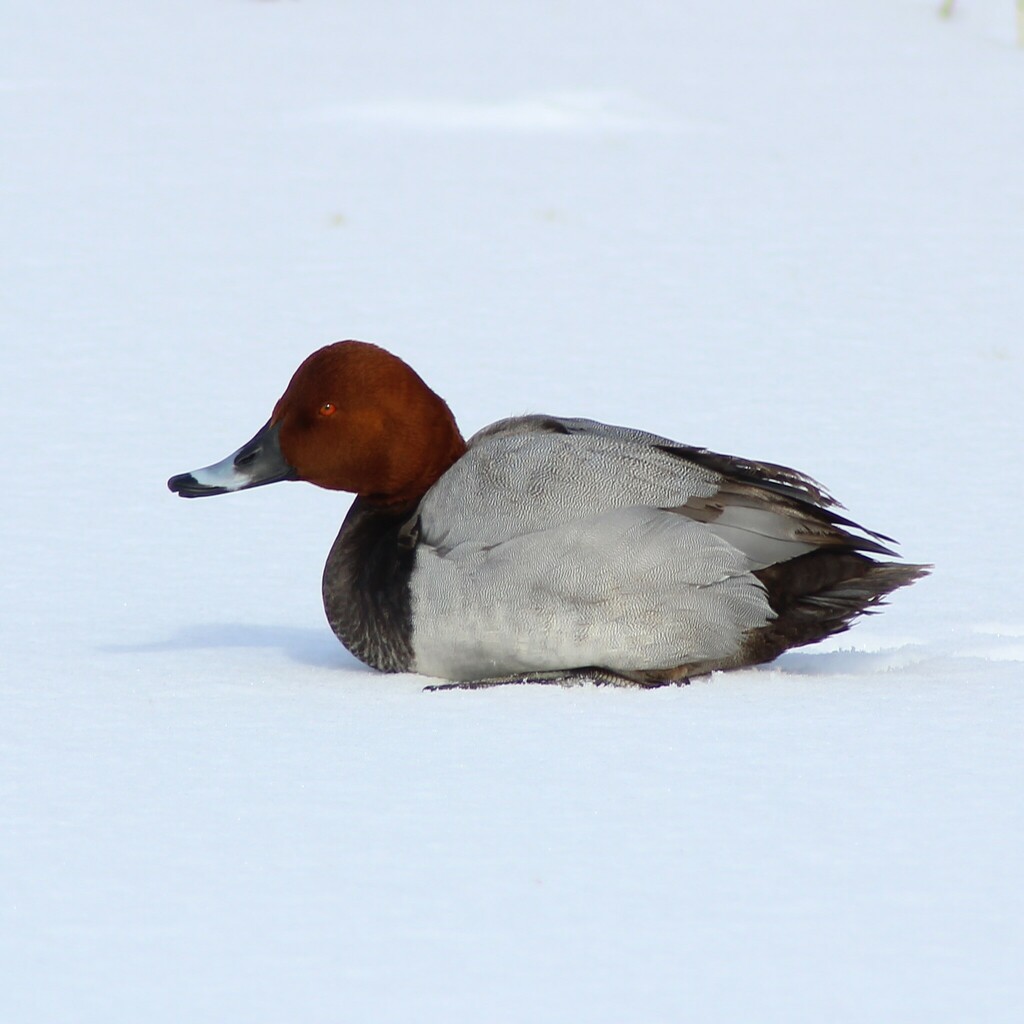
Common Pochard
Photo © Юлия Захаренко
Photo © Юлия Захаренко — CC BY 4.0 — Source: iNaturalist #263740245Identification
The common pochard is a plump, medium-sized diving duck measuring 42–49 cm in length with a wingspan of 72–82 cm. It is stocky and short-tailed, with a distinctive sloping forehead and relatively long bill. Males are notably larger and heavier than females, averaging 467 to 1,240 g depending on season.
Males are unmistakable in their breeding plumage: a rich chestnut-coloured head and neck contrasts sharply with a black breast and tail, while the body is pale grey with fine vermiculations. The bill is dark grey with a characteristic wide blue-grey band across the middle, and the iris is yellow-orange to red, becoming brighter during breeding season. Females are more subdued, with a brown iris (sometimes yellowish-brown), and grey legs and feet shared with males. Juveniles have a yellow-olive iris that attains adult colouration by their first winter.
Range & Habitat
The common pochard is widespread across the Palearctic, breeding primarily in Scandinavia and the steppe regions of Siberia. These migratory ducks winter farther south and west, with large numbers overwintering in Great Britain after retreating from Russia and Scandinavia. In the British Isles, birds breed in eastern England and lowland Scotland, with small and gradually increasing numbers in Northern Ireland and sporadic breeding in the Republic of Ireland. They favour marshes and lakes with at least a metre of water depth for breeding.
While primarily Eurasian, common pochards have occasionally appeared as vagrants in North America, particularly in the United States and Canada, with rare records from South America including Colombia.
Behaviour & Diet
Common pochards are highly gregarious birds, forming large flocks in winter often mixed with other diving duck species. They are strong, direct fliers capable of reaching speeds of 22–24 m/s. Males are generally silent, though they may whistle softly during courtship, while females produce a soft growl transcribed as "krrr" when flushed.
These ducks feed primarily by diving to retrieve plant material (including seeds), small fish, molluscs, and aquatic invertebrates from beneath the water's surface, though they will also upend and dabble at items on the surface. Remarkably, they do most of their feeding at night and regularly forage in close association with Bewick's and whooper swans, gleaning food items disturbed by the swans' trampling activities—behaviour that can double their food intake rate compared to independent foraging.
Best Time & Places to See It
Winter is the prime season for observing common pochards in Britain, when large numbers from continental populations arrive to overwinter. Eastern England, lowland Scotland, and parts of Northern Ireland offer reliable viewing opportunities. Great Britain's lakes and marshes host significant wintering populations, while small groups occasionally appear on the River Thames and other southern English waterways.
Spring and early summer are best for observing breeding birds in their northern Palearctic range. Look for them on deeper freshwater lakes and marshes with dense surrounding vegetation, particularly in temperate and northern Europe.
Photography Tips
The striking plumage of male pochards makes them rewarding photographic subjects, particularly their chestnut heads, black breasts, and pale grey bodies. Photograph males in breeding season when their iris becomes particularly bright. Early morning or late evening light will best reveal their subtle vermiculations and iridescence.
Capture their diving behaviour by positioning yourself at water level on stable ground or blinds. Winter flocking behaviour provides opportunities for habitat shots and images showing their gregarious nature. Females and juveniles present more subtle identification challenges—photograph these individuals carefully to practise distinguishing them from similar species like the canvasback and redhead.
Kanha Tiger Reserve
Abruzzo, Lazio and Molise National Park
Alaska Maritime National Wildlife Refuge
Alpilles Regional Nature Park
Alta Murgia National Park
Altai Tavan Bogd National Park
Appennino Lucano Val d’Agri Lagonegrese National Park
Appennino Tosco-Emiliano National Park
Asinara National Park
Nothing matches these filters.
No community photos yet. Log in to add the first one.
No community observations of this species yet.