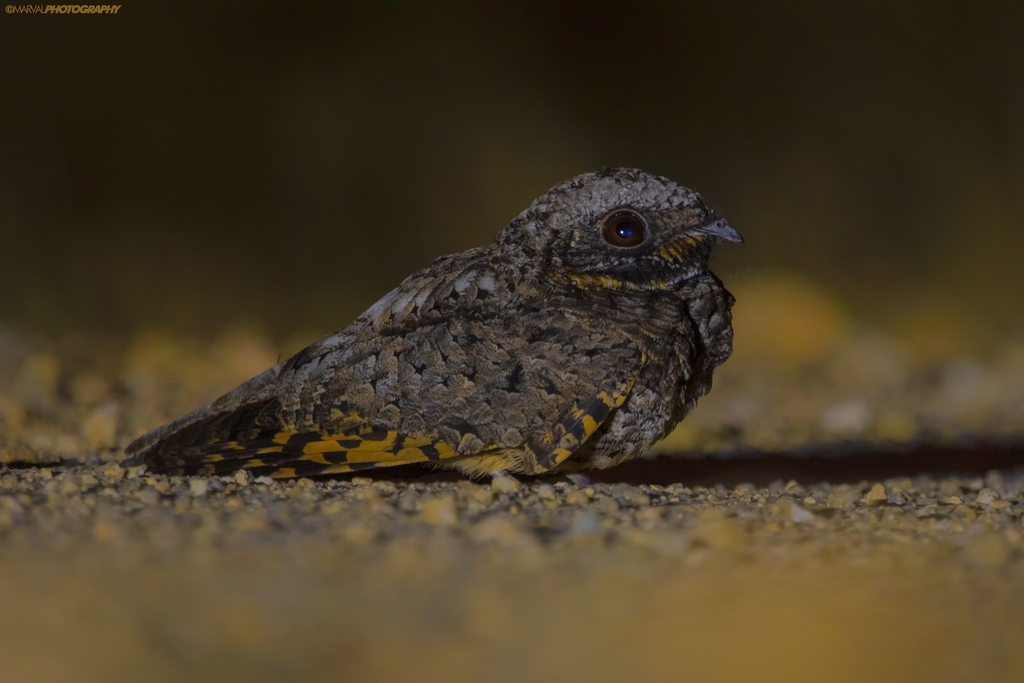
Common Poorwill
Photo © MarvalPhotography19
Photo © MarvalPhotography19 — CC BY 4.0 — Source: iNaturalist photo #243027332Identification
The common poorwill is North America's smallest nightjar, measuring just 18 centimetres in length with a wingspan of approximately 30 centimetres and weighing 36–58 grams. It is distinguished from similar nightjars by its diminutive size, short bill, rounded wings that reach the end of its short tail at rest, and pale gray coloration with black patterning above. Both sexes are similar, though males show slightly more prominent white tips on the outer tail feathers. The bird is named for its distinctive monotonous call—a "poor-will" repeated from dusk to dawn, which at close range may reveal a third syllable as "poor-will-low." In flight, it also utters a sharp chuck note.
Range & Habitat
The common poorwill is found from British Columbia and southeastern Alberta through the western United States to northern Mexico. It inhabits dry, open areas characterized by grasses or shrubs, and can even be found on stony desert slopes with minimal vegetation. Many northern populations migrate to winter within the breeding range in central and western Mexico, though some birds remain further north on the southern edge of the species' range in the United States, where they enter an extraordinary state of extended torpor lasting weeks to months—behaviour unique among birds and close to true hibernation.
Behaviour & Diet
The common poorwill is primarily nocturnal and feeds on night-flying insects including moths, beetles, and grasshoppers, frequently snatching prey from the ground or leaping into the air to catch it. Like owls, it ejects pellets of indigestible parts and is known to drink on the wing. Breeding occurs from March to August in southern portions of the range and from late May to September further north. The nest is a shallow scrape on the ground, often at a hill's base and partially shaded by vegetation. Clutches typically contain two pale or creamy eggs, sometimes with darker mottling, which both parents incubate for 20–21 days to hatching and a further 20–23 days to fledging. Usually one brood is raised annually, though females may occasionally raise a second clutch nearby while males tend the first nest's young. When disturbed on the nest, adults tumble, hiss, and gape their mouths in a snake-like display.
Best Time & Places to See It
Common poorwills are nocturnal and best located by listening for their distinctive call during dusk and night hours. They are most active during their breeding season from March to August in the south and May to September in the north. Suitable habitats—dry, open grasslands, shrublands, and desert slopes—span from British Columbia and the western United States through northern Mexico. To observe wintering torpid birds in their extraordinary hibernation state, target the southern edges of the U.S. range, particularly California and New Mexico, where birds shelter concealed in rock piles during winter months.
Photography Tips
Photographing common poorwills presents a significant challenge due to their nocturnal habits and cryptic coloration. Use a headlamp or red-light torch to locate roosting birds at night without disturbing them. Since they nest on bare ground with minimal cover, approach nesting birds with extreme caution and respect; the adults' snake-like defensive display is worth capturing but never at the cost of nest abandonment. Patience is essential—sit quietly near suitable habitat at dusk and listen for their calls to guide your positioning. Use high ISO and fast lenses to compensate for low-light conditions, and be prepared for the possibility that this smallest of North American nightjars may remain frustratingly difficult to photograph despite your best efforts.
Arches National Park
Badlands National Park
Bear River Migratory Bird Refuge
Big Bend National Park
Bitter Lake National Wildlife Refuge
Black Canyon of the Gunnison National Park
Bosque del Apache National Wildlife Refuge
Bryce Canyon National Park
Cabeza Prieta National Wildlife Refuge
Nothing matches these filters.
No community photos yet. Log in to add the first one.
No community observations of this species yet.