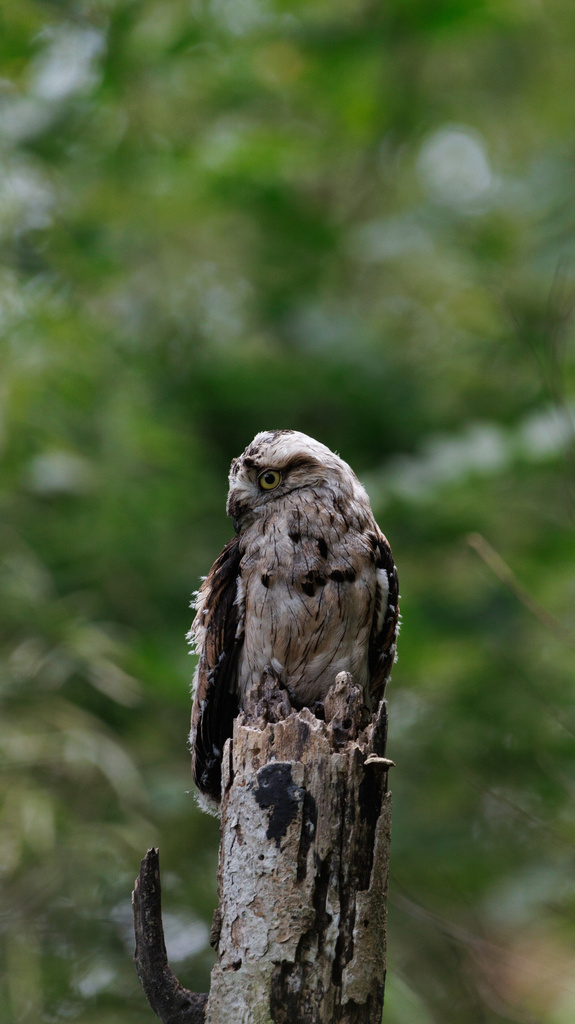
Common Potoo
Photo © Roger A. Morales-Flores
Photo © Roger A. Morales-Flores — CC BY 4.0 — Source: iNaturalist photo #288727361Identification
The Common Potoo is a medium-sized nocturnal bird, 34–38 cm long, instantly recognizable by its strikingly large yellow eyes and unusually wide mouth. Its cryptic plumage of mottled red-brown, white, black, and grey allows it to blend seamlessly into tree branches and stumps—a camouflage so effective that the bird is often overlooked despite being fairly common throughout much of its range. The sexes appear similar. Most distinctive is the bird's remarkable eye anatomy: it possesses two or three slits in its eyelids that remain permanently open, allowing it to see even when its eyes appear closed. The pupils can constrict dramatically, transforming the appearance of the eye from a giant yellow iris to a small dark spot, depending on the bird's level of alertness.
Range & Habitat
The Common Potoo is found across mainland South America east of the Andes, occurring in Trinidad and Tobago and in every mainland South American country except Chile, though vagrants occasionally reach that country. One subspecies ranges from eastern Nicaragua through Central America and western Colombia, Ecuador, and Peru, while the nominate subspecies inhabits the remainder of South America from the Andes to the Atlantic. The species favors open woodlands and savannah but avoids cooler montane regions, rarely found above 1,900 m elevation. It prefers wooded habitats and gallery forests but generally avoids arid regions. Birds at the southern edge of the range may undertake short seasonal migrations northward in winter.
Behaviour & Diet
This nocturnal insectivore hunts from fixed perches, capturing insects mid-air using its cavernous mouth in the manner of flycatchers or shrikes. Its diet includes flies, moths, ants, termites, grasshoppers, locusts, and crickets—all swallowed whole. The bird's unique upper-mandible tooth assists in foraging. The Common Potoo is a master of camouflage, deliberately choosing perches matching its own body diameter and adjusting its angle to mimic the branch or stump on which it rests. When undisturbed, it sits with eyes open and bill horizontal; when alarmed, it adopts a striking "freezing" posture with beak pointed vertically upward and eyelids closed, remaining motionless. Responses to disturbance vary from fleeing to threat displays to remaining still even when touched.
Best Time & Places to See It
As a nocturnal species and resident breeder, the Common Potoo is best sought after dark in open woodlands and savannah habitats throughout its extensive South American range. The bird's haunting, melancholic song—a descending series of "BO-OU" notes dropping in both pitch and volume—is often the first indication of its presence. Dawn and dusk visits to suitable wooded habitats offer the best opportunities, particularly during the breeding season when birds are most vocal and active. Gallery forests around the Uruguayan-Brazilian border are particularly good locations.
Photography Tips
Photographing the Common Potoo presents a fascinating challenge: the bird's extraordinary camouflage makes locating it the primary difficulty. Listen for its distinctive melancholic song to pinpoint roosting birds. Once located perched on a stump or branch, the potoo's remarkable immobility allows approach, but movement should be slow and deliberate. The bird's most photogenic feature—those enormous yellow eyes—is best captured when the bird is alert and relaxed. Using a headlamp or red light after dark can help reveal the eye slits and bright tapetum lucidum reflections. Patience and familiarity with the bird's preferred perch sites will yield the best results.
Emas National Park
Brazil
+333 birds+23 mammals
Across the high plateaux of central Brazil, where the cerrado grasslands roll toward distant horizons under an immense sky, Emas National Park anchors one of South…
VIEW NATIONAL PARKSerra do Cipó National Park
Brazil
+379 birds+5 mammals
Where granite escarpments rise above the Atlantic Forest transition zone in southeastern Brazil, Serra do Cipó National Park unfolds across a landscape of dramatic ridges, cascading…
VIEW NATIONAL PARKCorcovado National Park
Puerto Jiménez, Costa Rica
+444 birds+48 mammals
Where the Osa Peninsula juts into the Pacific, rainforest descends almost to the tide line, and Corcovado National Park protects one of Central America's most intact…
VIEW NATIONAL PARKManuel Antonio National Park
Quepos, Costa Rica
+426 birds+22 mammals
Where tropical rainforest descends steeply to a rocky Pacific coastline, Manuel Antonio National Park distills Central American biodiversity into one of Costa Rica's most compressed and…
VIEW NATIONAL PARKArenal Volcano National Park
Peñas Blancas, Costa Rica
+551 birds+21 mammals
Straddling the border between Alajuela and Guanacaste in northwestern Costa Rica, this national park rises dramatically around one of Central America's most active volcanic systems. The…
VIEW NATIONAL PARKTortuguero National Park
Roxana, Costa Rica
+420 birds+23 mammals
Canals and lagoons thread through a labyrinth of lowland rainforest where the Caribbean coast of Costa Rica meets the wetland frontier. This is terrain shaped by…
VIEW NATIONAL PARKBraulio Carrillo National Park
Las Horquetas, Costa Rica
+547 birds+18 mammals
Where the Caribbean slope descends from the central volcanic cordillera toward the humid lowlands of Heredia, Braulio Carrillo National Park preserves one of Costa Rica's most…
VIEW NATIONAL PARKPiedras Blancas National Park
Golfito, Costa Rica
+386 birds+24 mammals
Where the Golfo Dulce meets the southwestern Pacific coast of Costa Rica, Piedras Blancas National Park protects a dramatic transition zone where lowland rainforest descends toward…
VIEW NATIONAL PARKGuanacaste National Park
Santa Elena, Costa Rica
+461 birds+17 mammals
Where the Pacific slopes of northwestern Costa Rica rise toward the Continental Divide, dry tropical forest gives way to cloud-laden peaks and misty ridges—a landscape that…
VIEW NATIONAL PARKYasuní National Park
Aguarico, Ecuador
+601 birds+43 mammals
Where the western Amazon basin converges with Ecuador's Orellana Province, lowland rainforest reaches toward the horizon in an unbroken canopy of staggering botanical density. Yasuní National…
VIEW NATIONAL PARKCerros de Amotape National Park
District of San Jacinto, Ecuador
+246 birds+1 mammals
Arid mountains rise abruptly from Peru's northwestern frontier, their slopes clothed in xerophytic scrubland and seasonal deciduous forest that transforms these Andean foothills into one of…
VIEW NATIONAL PARKNatural Sierra de Chiribiquete National Park
Solano, Colombia
+359 birds+27 mammals
Massive table-top mountains rise abruptly from the lowland rainforest of southeastern Colombia, their sheer sandstone cliffs and isolated summits creating some of the most dramatic topography…
VIEW NATIONAL PARKNatural Utría National Park
Alto Baudó (Pie de Pató), Colombia
+372 birds+11 mammals
Where the Chocó's coastal mountains plunge toward the Pacific, Utría National Park preserves one of Colombia's most biodiverse and least-visited wilderness expanses. Sprawling across 1,287 square…
VIEW NATIONAL PARKNatural la Paya National Park
Puerto Leguízamo, Colombia
+262 birds+4 mammals
Where the Amazon's western reaches fold into the Andes foothills, La Paya National Park sprawls across more than 8,500 square kilometers of pristine Amazonian rainforest in…
VIEW NATIONAL PARKNatural Serranía de los Yariguíes National Park
El Carmen de Chucurí, Colombia
+320 birds+3 mammals
Where the northern cordilleras of Colombia rise toward cloud forest, the Serranía de los Yariguíes unfolds across nearly 1,820 square kilometers of some of the most…
VIEW NATIONAL PARKNatural Farallones de Cali National Park
Buenaventura, Colombia
+733 birds+27 mammals
Where the Pacific coastal plain meets the western slopes of the Andes, Farallones de Cali National Park sprawls across nearly 3,500 square kilometers of dramatic topography…
VIEW NATIONAL PARKMorrocoy National Park
Municipio Silva
+290 birds
Where the Caribbean coast of northwestern Venezuela meets protected coastal waters, a mosaic of mangrove forests, sandy beaches, and coral reef systems defines Morrocoy National Park.…
VIEW NATIONAL PARKGuácharos Cave National Natural Park
Acevedo, Colombia
+359 birds
High in the Andean foothills of southern Huila, where mist-laden slopes rise above 1,600 metres, lies a landscape carved by underground rivers and crowned by karst…
VIEW NATIONAL PARKNatural Uramba Bahía Málaga National Park
Buenaventura, Colombia
+308 birds+15 mammals
Where the Pacific coastal rainforest descends to mangrove estuaries and rocky headlands, Uramba Bahía Málaga National Park unfolds across nearly 1,000 square kilometres of Colombia's Valle…
VIEW NATIONAL PARKNatural Sierra de la Macarena National Park
Vista Hermosa, Colombia
+566 birds+15 mammals
Across nearly 20,000 square kilometres of Colombia's Meta Department, the terrain rises from lowland savanna into Andean foothills through a mosaic of gallery forests, palm-fringed wetlands,…
VIEW NATIONAL PARKAmacayacu National Park
Leticia, Colombia
+567 birds+25 mammals
Where the Rio Amazonas curves through the tri-border region where Colombia, Peru, and Brazil converge, Amacayacu National Park sprawls across more than 5,250 square kilometres of…
VIEW NATIONAL PARKItatiaia National Park
Brazil
+519 birds+12 mammals
Where granite peaks pierce the Atlantic rainforest canopy in southeastern Brazil, Itatiaia National Park rises as one of the country's oldest and most ecologically vital protected…
VIEW NATIONAL PARKSaint-Hilaire/Lange National Park
Brazil
+225 birds
Subtropical Atlantic forests rise and fall across the plateaus of inland Paraná, where Saint-Hilaire/Lange National Park protects nearly 578 square kilometres of Brazil's most biodiverse woodland…
VIEW NATIONAL PARKSerra da Bocaina National Park
Brazil
+441 birds+5 mammals
Where the escarpment of the Serra da Bocaina rises sharply from the Atlantic coastal plain, tropical rainforest cloaks steep mountainsides that climb toward peaks exceeding 2,000…
VIEW NATIONAL PARKViruá National Park
Brazil
+389 birds+6 mammals
Across the northern frontier of Roraima, where the forest canopy rises from ancient Amazonian lowlands, Viruá National Park protects nearly 3,700 square kilometres of terra firme…
VIEW NATIONAL PARKIguaçu National Park
Brazil
+387 birds+17 mammals
Where the Paraná Plateau plunges toward the Atlantic watershed, six thousand square kilometers of subtropical rainforest cling to steep gorges and river valleys in this corner…
VIEW NATIONAL PARKIlha Grande National Park
Brazil
+233 birds
Across the subtropical plateaus and Atlantic forest remnants of southern Brazil, a vast protected landscape spanning nearly 4,600 square kilometers safeguards one of the continent's most…
VIEW NATIONAL PARKSerra do Teixeira National Park
Brazil
+160 birds+5 mammals
Rugged plateaus and deep escarpments define this 3,112-square-kilometre sweep of the Brazilian Northeast, where the crystalline bedrock of the Borborema Plateau rises abruptly from the surrounding…
VIEW NATIONAL PARKSerra da Capivara National Park
Brazil
+156 birds+6 mammals
Across the semi-arid plateaus and deeply incised canyons of northeastern Brazil, where Piauí's ancient sandstone formations rise and fall in weathered waves, Serra da Capivara National…
VIEW NATIONAL PARKSão Joaquim National Park
Brazil
+222 birds+9 mammals
Where the southern Brazilian highlands rise above the Atlantic Forest, São Joaquim National Park protects nearly 1,000 square kilometers of montane terrain that shifts between temperate…
VIEW NATIONAL PARKSerra dos Órgãos National Park
Brazil
+446 birds+13 mammals
Granite peaks thrust skyward through the Atlantic Forest canopy in the mountains immediately north of Rio de Janeiro, their bare rock faces rising above a landscape…
VIEW NATIONAL PARKSete Cidades National Park
Brazil
+125 birds+1 mammals
Sete Cidades sprawls across 113 square kilometres of northeastern Brazil's interior plateau, where weathered sandstone formations rise dramatically from the cerrado landscape. The park's geology tells…
VIEW NATIONAL PARKChapada dos Guimarães National Park
Brazil
+450 birds+1 mammals
Where weathered sandstone plateaus rise above the cerrado grasslands of central Brazil, Chapada dos Guimarães National Park protects 624 square kilometres of ecological transition zone that…
VIEW NATIONAL PARKPantanal Matogrossense National Park
Brazil
+322 birds+17 mammals
Where the flooded forests of central Brazil meet vast seasonally inundated grasslands, Pantanal Matogrossense National Park sprawls across nearly 2,900 square kilometers of one of the…
VIEW NATIONAL PARKChapada Diamantina National Park
Brazil
+346 birds+5 mammals
Where granite peaks and sandstone cliffs rise abruptly from the Brazilian interior, Chapada Diamantina National Park sprawls across 4,215 square kilometers of some of Brazil's most…
VIEW NATIONAL PARKSerra do Gandarela National Park
Brazil
+333 birds+3 mammals
Where granite massifs rise through Atlantic Forest in southeastern Brazil's highlands, Serra do Gandarela National Park protects nearly 1,000 square kilometres of montane terrain that few…
VIEW NATIONAL PARKBrasília National Park
Plano Piloto, Brazil
+338 birds+15 mammals
Cerrado grassland and scattered woodland sweep across the central Brazilian plateau where this national park sprawls across more than a thousand square kilometres of the Federal…
VIEW NATIONAL PARKAraucárias National Park
Brazil
+231 birds+3 mammals
Where the southern Brazilian highlands rise into cool temperate forest, Araucárias National Park protects one of the Atlantic Forest's most distinctive ecosystems across 506 square kilometres…
VIEW NATIONAL PARKAmazônia National Park
Brazil
+439 birds+6 mammals
Where the Rio Amazonas and its tributaries weave through the heart of Pará state, a vast tapestry of rainforest stretches across 23,611 square kilometers of unbroken…
VIEW NATIONAL PARKJaú National Park
Brazil
+354 birds+3 mammals
Vast floodplain forests and blackwater rivers define this remote corner of western Amazonas, where the Rio Negro and its tributaries have carved an intricate mosaic of…
VIEW NATIONAL PARKPacaás Novos National Park
Brazil
+279 birds+1 mammals
Across the border between Rondônia and Amazonas, vast tracts of humid tropical forest rise and fall in gentle undulations, carved by clear-flowing rivers that feed into…
VIEW NATIONAL PARKAnavilhanas National Park
Brazil
+468 birds+8 mammals
Across the Rio Negro in central Amazonas, an archipelago of over a thousand islands rises from the world's largest rainforest river system, creating a labyrinth of…
VIEW NATIONAL PARKCampos Amazónicos National Park
Amazonas, Brazil
+434 birds+7 mammals
Sprawling across the southwestern Amazon basin in Amazonas state, this 27,263-square-kilometre national park encompasses some of the region's most pristine lowland rainforest, where terra firme forest…
VIEW NATIONAL PARKSerra do Divisor National Park
Brazil
+448 birds+10 mammals
Where the western Amazon meets the Andes foothills, Serra do Divisor National Park sprawls across one of South America's most biodiverse and least accessible frontiers. Spanning…
VIEW NATIONAL PARKPico da Neblina National Park
Brazil
+103 birds
Where the Amazon's western rampart rises into perpetual mist, Pico da Neblina National Park sprawls across more than 33,000 square kilometres of some of Earth's least…
VIEW NATIONAL PARKOtishi National Park
Río Tambo, Peru
+108 birds
Where the Andes descend toward the Amazon basin, vast cloud forests cloak the ridges and valleys of Peru's Río Tambo watershed, and this is where Otishi…
VIEW NATIONAL PARKYanachaga–chemillén National Park
Palcazu, Peru
+639 birds+6 mammals
Where the eastern slopes of Peru's central cordillera plunge into cloud forest, Yanachaga–Chemillén National Park protects nearly three thousand square kilometres of montane wilderness that few…
VIEW NATIONAL PARKManu National Park
Manu, Peru
+892 birds+26 mammals
Across the eastern slopes of the Peruvian Andes, tropical rainforest descends into the Amazon basin with a complexity that few terrestrial ecosystems match. Manu National Park…
VIEW NATIONAL PARKBahuaja Sonene National Park
San Pedro de Putina Punco, Peru
+602 birds+8 mammals
Where the Madre de Dios and Heath rivers converge in southeastern Peru rises one of South America's most biodiverse wilderness regions: a vast protected realm of…
VIEW NATIONAL PARKTingo Maria National Park
Mariano Dámaso Beraún, Peru
+423 birds
Where the eastern slopes of the Peruvian Andes descend toward the Amazon basin, the landscape fractures into a maze of limestone ridges, humid gorges, and cloud-wrapped…
VIEW NATIONAL PARKGeneral de División Omar Torrijos Herrera National Park
La Pintada, Panama
+401 birds+2 mammals
Across the highlands of central Panama, where the continental divide funnels moisture-laden trade winds into steep river valleys, the terrain rises and falls in a landscape…
VIEW NATIONAL PARKSoberanía National Park
Cristóbal, Panama
+495 birds+34 mammals
Rainforest and riverine woodland blanket the rolling terrain of this 714-square-kilometre national park in Colón Province, where the Caribbean watershed feeds a maze of streams and…
VIEW NATIONAL PARKChagres National Park
Caimitillo, Panama
+486 birds+19 mammals
Where the Chagres River carves through the humid tropics of central Panama, a vast montane and lowland forest sprawls across more than 2,300 square kilometers, anchoring…
VIEW NATIONAL PARKDarién National Park
Tucutí, Panama
+534 birds+13 mammals
Where the spine of Central America crumbles into wetland and rainforest, Darién National Park sprawls across more than 20,000 square kilometres of some of the tropics'…
VIEW NATIONAL PARKPortobelo National Park
Portobelo, Panama
+366 birds+9 mammals
Where the Caribbean's turquoise waters meet the Darién's verdant shore, Portobelo National Park sprawls across 570 square kilometers of coastal forest, mangrove wetland, and coral-fringed islands…
VIEW NATIONAL PARKEl Palmar National Park
Distrito Sexto, Argentina
+244 birds+14 mammals
Across the Paraná River floodplain in northeastern Argentina, palms rise from wetland and grassland in a landscape shaped by water and time. El Palmar National Park…
VIEW NATIONAL PARKRío Pilcomayo National Park
Argentina
+271 birds+13 mammals
Where the Río Pilcomayo cuts through northeastern Argentina's subtropical lowlands, a sprawling mosaic of wetlands, grasslands, and seasonally flooded forests creates one of South America's most…
VIEW NATIONAL PARKIguazú National Park
Puerto Iguazú, Argentina
+346 birds+15 mammals
Where the Paraná Plateau plunges toward the Atlantic watershed, nearly 800 square kilometers of subtropical rainforest drape across Misiones Province in a landscape carved by millennia…
VIEW NATIONAL PARKEl Rey National Park
Municipio de Las Lajitas, Argentina
+317 birds+4 mammals
Where the eastern slopes of the Andes descend into northwestern Argentina's subtropical transition zone, El Rey National Park unfolds across 841 square kilometers of dramatically varied…
VIEW NATIONAL PARKCalilegua National Park
Municipio de Calilegua, Argentina
+288 birds+8 mammals
Where the eastern Andean slopes plunge into northwestern Argentina's humid subtropics, nearly 2,645 square kilometers of steep terrain and luxuriant forest compose one of South America's…
VIEW NATIONAL PARKParque Provincial Pampa del Indio
Laguna Limpia, Argentina
+231 birds+4 mammals
Across the flat horizons of Chaco Province, where the Paraná River system spills into vast wetlands and grasslands, Parque Provincial Pampa del Indio protects one of…
VIEW NATURE RESERVEChaco National Park
Municipio de Presidencia de la Plaza, Argentina
+258 birds+7 mammals
Across the humid subtropical lowlands of northeastern Argentina, where the Paraná River basin feeds vast seasonal wetlands and gallery forests, Chaco National Park protects one of…
VIEW NATIONAL PARKCarara National Park
Tárcoles, Costa Rica
+397 birds+19 mammals
Where the Pacific coastal plain meets transitional forest, Carara National Park straddles one of Central America's most dynamic ecological boundaries. The park's landscape encompasses lowland deciduous…
VIEW NATIONAL PARKCahuita National Park
Talamanca, Costa Rica
+359 birds+15 mammals
Where the Caribbean shoreline dissolves into mangrove creeks and coral gardens, Cahuita's mosaic of habitats unfolds across the Limón coast. The park's signature feature—a living coral…
VIEW NATIONAL PARKRincón de la Vieja National Park
Liberia, Costa Rica
+451 birds+30 mammals
Where volcanic slopes rise abruptly from the Guanacaste lowlands, Rincón de la Vieja National Park sprawls across a landscape shaped by geothermal drama and seasonal extremes.…
VIEW NATIONAL PARKTapantí Macizo de la Muerte National Park
Orosi, Costa Rica
+503 birds+18 mammals
Where montane cloud forest rises steeply from the Orosi Valley, Tapantí Macizo de la Muerte National Park enfolds a landscape of perpetual moisture and emerald complexity.…
VIEW NATIONAL PARKLa Amistad International Park
Crorina, Costa Rica
+532 birds+20 mammals
Where the Caribbean slopes of Costa Rica's Talamanca Mountains rise steeply inland from Limón, the boundary between two nations dissolves into an unbroken expanse of rainforest.…
VIEW NATIONAL PARKBarbilla National Park
Chirripó, Costa Rica
+226 birds
Where the Caribbean slope of Costa Rica's eastern cordillera plunges into perpetual moisture, Barbilla National Park rises as one of Central America's most water-rich ecosystems. Fed…
VIEW NATIONAL PARKVolcán Tenorio National Park
Guatuso, Costa Rica
+480 birds+12 mammals
Where volcanic slopes rise through Costa Rica's northwestern borderlands, Volcán Tenorio National Park sprawls across terrain shaped by ancient lava flows and mineral-rich springs. The park's…
VIEW NATIONAL PARKMarino Ballena National Park
Bahía Ballena, Costa Rica
+336 birds+8 mammals
Where mangrove forests meet coral-fringed shorelines along Costa Rica's southern Pacific coast, Marino Ballena National Park encompasses a marine and terrestrial mosaic that ranks among Central…
VIEW NATIONAL PARKCaño Negro National Wildlife Refuge
Caño Negro District, Costa Rica
+486 birds+16 mammals
Where the San Juan River's seasonal floodplain opens into expansive wetlands, Caño Negro Wildlife Sanctuary sprawls across one of Central America's most productive freshwater ecosystems. This…
VIEW WILDLIFE SANCTUARYGandoca-Manzanillo National Wildlife Refuge
Manzanillo, Costa Rica
+394 birds+18 mammals
Where the Caribbean coastal plain surrenders to water-logged forest and mangrove tangles, Gandoca-Manzanillo Wildlife Sanctuary shelters one of Costa Rica's most biodiverse lowland wetland ecosystems. The…
VIEW WILDLIFE SANCTUARYBarra del Colorado National Wildlife Refuge
Tortuguero, Costa Rica
+462 birds+36 mammals
Where the Caribbean's restless waters meet the Limón Province coastline, Barra del Colorado National Wildlife Sanctuary unfolds across a landscape of extraordinary ecological complexity. This equatorial…
VIEW WILDLIFE SANCTUARYNo community photos yet. Log in to add the first one.
No community observations of this species yet.