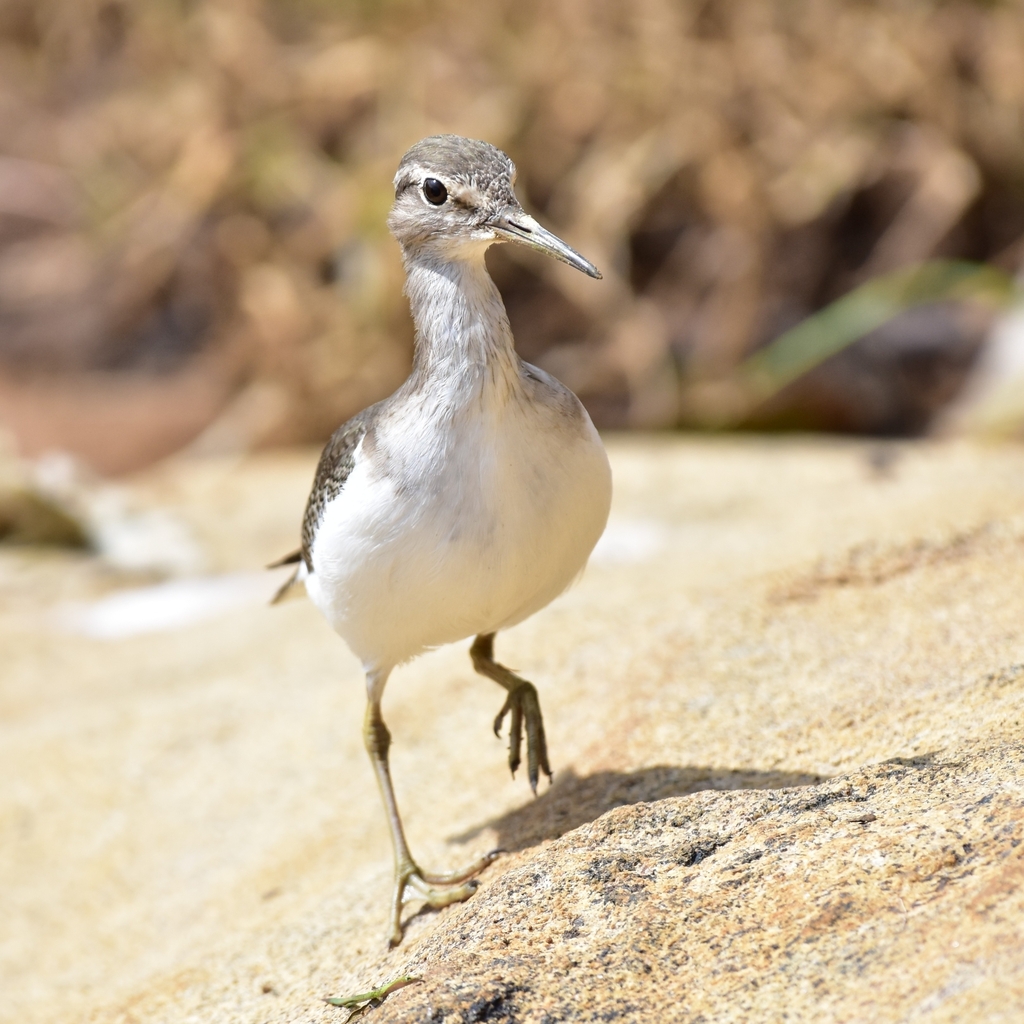
Common Sandpiper
Photo © Renjith Jacob Mathews
Photo © Renjith Jacob Mathews — CC BY 4.0 — Source: iNaturalist #190760668Identification
The common sandpiper is a small wader measuring 18–20 cm long with a 32–35 cm wingspan. Adults are distinguished by greyish-brown upperparts contrasting with white underparts, short dark-yellowish legs and feet, and a bill with a pale base and dark tip. In winter plumage, birds become duller with more conspicuous barring on the wings, though this is only visible at close range. Juveniles are more heavily barred above with buff edges to their wing feathers.
This species is very similar to the slightly larger spotted sandpiper in non-breeding plumage, but darker legs and feet, along with a crisper wing pattern visible in flight, help distinguish it. Fortunately, the two species are only rarely found in the same location, as they replace each other geographically.
Range & Habitat
The common sandpiper breeds across most of temperate and subtropical Europe and Asia, undertaking impressive migrations to Africa, southern Asia and Australia in winter. The eastern edge of its migration route passes by Palau in Micronesia, where hundreds of birds may gather for stop-overs during migration, typically departing the Palau region for breeding grounds around the last week of April to the first week of May.
This species nests on the ground near freshwater habitats, making freshwater lakes, rivers, and streams its preferred breeding and wintering areas.
Behaviour & Diet
The common sandpiper is usually encountered alone or in small groups, though larger flocks may form during migration or at breeding-season roosts. It seldom joins multispecies flocks. This wader has a distinctive stiff-winged flight, characteristically flying low over the water. The species is notable for its pumping tail and thrusting head movements during foraging, giving it local cultural significance in some Pacific island communities.
It forages by sight on the ground or in shallow water, picking up small food items including insects, crustaceans and other invertebrates. It even catches insects in flight. When threatened, young birds may cling to their parent's body to be flown away to safety.
Best Time & Places to See It
The common sandpiper is widespread and common throughout its range. Spring and autumn migrations offer excellent opportunities to observe this species, particularly in traditional stop-over areas. The Palau region in Micronesia is renowned for hosting hundreds of birds during migration periods, making it a notable destination for seeing large concentrations. However, the species is best encountered around freshwater habitats during breeding season in temperate Europe and Asia, or in African and Asian wintering grounds.
Photography Tips
Photographers should watch for the species' distinctive stiff-winged, low flight over water—a characteristic that makes it recognizable even in flight. The crisper wing pattern is particularly visible when the bird is airborne, so flight photography can be particularly rewarding. Close-range photography of winter-plumage birds may reveal the subtle barring on wings that becomes more conspicuous in the colder months. The bird's habit of foraging alone or in small groups means patient, careful approach is necessary to capture good images without disturbing it.
Bwindi Impenetrable National Park
Kanha Tiger Reserve
Lake Mburo National Park
Mabamba Swamp
Minneriya National Park
Murchison Falls National Park
Queen Elizabeth National Park
Aberdare National Park
Abijata-Shalla Lakes National Park
Nothing matches these filters.
No community photos yet. Log in to add the first one.
No community observations of this species yet.