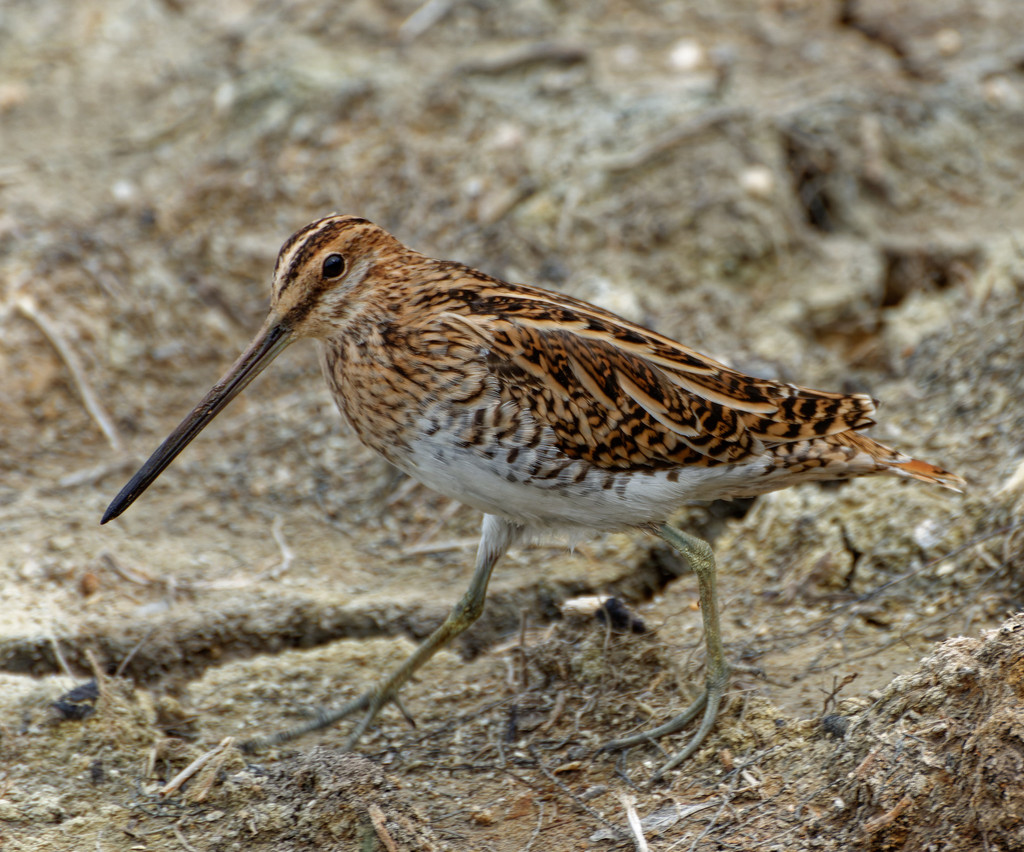
Common Snipe
Photo © Donald Davesne
Photo © Donald Davesne — CC BY 4.0 — Source: iNaturalist #73231186Identification
The common snipe is a small, stocky wader measuring 25–27 cm in length with a wingspan of 44–47 cm. Its most distinctive feature is an exceptionally long, straight dark bill (5.5–7 cm), which it uses to probe soft mud for food. The plumage is mottled brown with straw-yellow stripes on the upperparts and pale underparts, featuring a characteristic dark stripe through the eye with lighter stripes above and below. Short greenish-grey legs and pointed wings complete the profile. The bird is highly camouflaged, which helps it blend seamlessly into its wetland environment.
Distinguishing the common snipe from similar species requires careful observation. It most closely resembles the North American Wilson's snipe, though they differ in tail-feather count: the common snipe has seven pairs while Wilson's snipe has eight. The subspecies faeroeensis, found in Iceland and British islands, typically displays richer toning on the breast and head than the nominate subspecies.
Range & Habitat
The common snipe is native to the Old World, with a breeding range extending across the Palearctic from Iceland and the British Isles through northern Fennoscandia and European Russia to Siberia, reaching as far north as 74°N on the Taymyr Peninsula's east coast. Southern breeding populations occur from northern Portugal through central France, northern Italy, Bulgaria and Ukraine, extending into Asia through Afghanistan, the Altai region, Manchuria and the Ussuri.
This migratory species favours marshes, bogs, tundra and wet meadows for breeding. European populations winter in southern and western Europe and Africa as far south as the Equator, while Asian birds migrate to tropical southern Asia. The bird's preference for soft, muddy terrain in these habitats makes wetland areas critical for its survival and feeding.
Behaviour & Diet
The common snipe is notoriously shy and well-camouflaged, remaining concealed close to ground vegetation and flushing only when closely approached. When disturbed, it utters a sharp "scape, scape" call and flies off in distinctive aerial zig-zags to evade predators. The bird forages in soft mud by probing and picking up food by sight, feeding primarily on insects and earthworms, supplemented with plant material.
During courtship, males perform a remarkable "winnowing" display: flying high in circles before taking shallow dives and vibrating their tail feathers to produce an unusual "drumming" sound. This distinctive sound, often compared to the bleating of a sheep or goat, has earned the snipe names like "flying goat" and "heaven's ram" across various cultures. Breeding birds nest in well-hidden ground locations, laying four dark olive eggs blotched with brown, incubated by females for 18–21 days; both parents care for the young, which fledge in 10–20 days.
Best Time & Places to See It
Finding common snipes requires patience and careful habitat selection. Target marshes, bogs, wet meadows and other waterlogged areas throughout the Palearctic breeding range during spring and summer. The species is most active during dawn and dusk when it forages in soft mud. In winter, focus on southern and western European wetlands and African sites where European populations congregate.
Listen for the characteristic "scape, scape" call when birds flush, or watch for the spectacular winnowing display during breeding season—the unusual drumming sound produced by vibrating tail feathers is a remarkable natural phenomenon to witness. Patient observers who remain still near suitable wetland habitat have the best chance of observing this shy and well-camouflaged species.
Photography Tips
Photographing common snipes demands patience, concealment and an understanding of their behaviour. Use natural cover or a hide positioned near muddy areas where snipes forage. Early morning and late evening light are ideal, casting warm tones across the mottled plumage and revealing the bird's subtle striping and markings. A telephoto lens is essential, as snipes are wary and will flush if approached directly.
For action shots, try to capture the distinctive aerial zig-zag escape flight or the dramatic winnowing display during courtship season. The bird's long bill and pointed wing profile are key identifying features worth emphasizing. Muddy foreground details can add context to environmental portraits, while overcast conditions help avoid harsh shadows on the well-camouflaged plumage. Patience and multiple visits to favoured wetland sites will yield the best results.
Kanha Tiger Reserve
Lake Mburo National Park
Mabamba Swamp
Murchison Falls National Park
Queen Elizabeth National Park
Aberdare National Park
Abijata-Shalla Lakes National Park
Alaska Maritime National Wildlife Refuge
Alpilles Regional Nature Park
Nothing matches these filters.
No community photos yet. Log in to add the first one.
No community observations of this species yet.