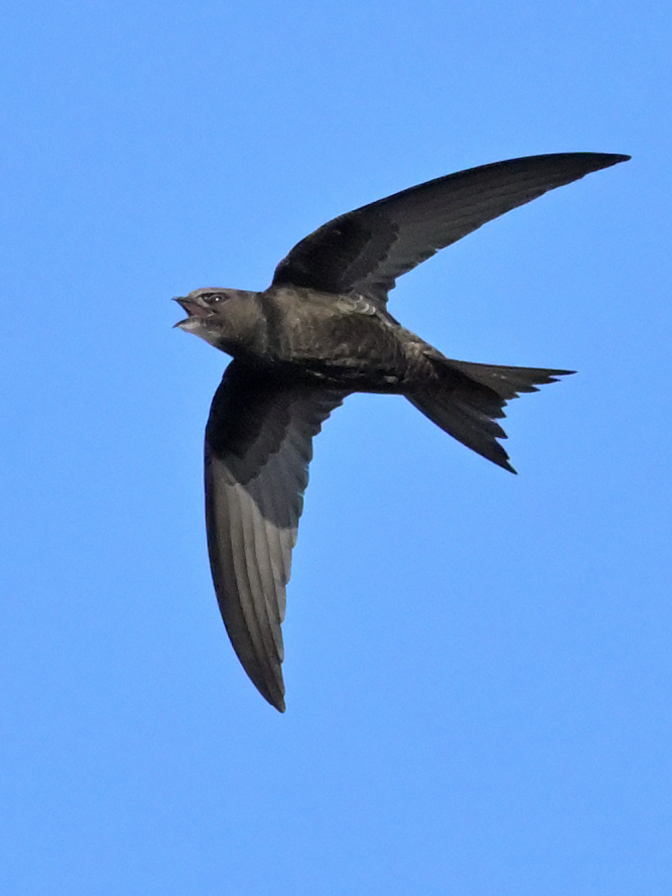
Common Swift
Photo © Luis Ferreira
Photo © Luis Ferreira — CC0 1.0 — Source: iNaturalist photo #382277341Identification
The common swift is a medium-sized bird measuring 16–17 cm long with a wingspan of 38–40 cm. It is entirely blackish-brown in plumage except for a small white or pale grey patch on its chin, which is not visible from a distance. The most distinctive feature is its long, swept-back wings that resemble a crescent or boomerang, combined with a short forked tail. Though superficially similar to barn swallows and house martins, swifts are not closely related to these passerines; rather, their nearest relatives are hummingbirds and Southeast Asian treeswifts. The resemblance reflects convergent evolution rather than common ancestry.
Swifts possess very short legs adapted primarily for clinging to vertical surfaces rather than perching. Their loud, distinctive call consists of a two-tone scream, with the higher pitch coming from females. During summer evenings, they often form "screaming parties" of 10–20 individuals or more, particularly at higher altitudes during late breeding season, making them unmistakable to the ear.
Range & Habitat
Common swifts are migratory birds with a breeding range spanning from Portugal and Ireland in the west to China and Siberia in the east. They breed as far south as northern Africa, including Morocco and Algeria, and across the Mediterranean region through the Middle East to Turkey. Their range extends throughout Europe, reaching Norway, Finland, and sub-Arctic Russia in the north. They do not breed on the Indian Subcontinent but migrate to equatorial and sub-equatorial Africa during winter months.
Historically, swifts nested in tree holes within ancient forests and cliff crevices. The removal of ancient forests from their nesting range has led to remarkable adaptation to human-made structures, where they now nest under roof tiles, within gaps beneath window sills, and most typically under eaves and within building gables. Some populations still use natural sites, such as woodpecker holes in ancient forests like Białowieża Forest in northeastern Poland.
Behaviour & Diet
Swifts are the most aerial of all birds, spending their entire lives in flight except during the nesting period. Non-breeding individuals may remain in continuous flight for up to ten months without landing. They drink, feed, hunt for insects, and often sleep and mate on the wing, never settling voluntarily on the ground where they would be vulnerable. Their maximum horizontal flying speed reaches 111.6 km/h, and over their lifetimes they cover millions of miles. Swifts feed exclusively on insects caught in flight, with feeding parties sometimes exceeding 2,000 individuals in insect-rich areas such as wetlands and flooded gravel pits.
Swifts form long-term pair bonds, often returning to the same nesting site and partner year after year. They construct nests from air-borne material caught in flight and bonded with saliva. Young swifts possess a remarkable survival mechanism: when food becomes scarce, they can drop their body temperature and metabolic rate, entering a torpid state that allows them to survive several days without feeding. Radar studies reveal that swifts move together in flocks during evening ascents and dawn descents, suggesting communication and information exchange benefit the group.
Best Time & Places to See It
Common swifts are present during the breeding season, typically summer months, when they are highly vocal and active around their nesting sites. The early evening hours are best for observation, as swifts gather in "screaming parties" around breeding colonies, creating spectacular aerial displays and producing their distinctive loud calls. Larger and more dramatic parties form at higher altitudes, especially late in the breeding season.
Urban and suburban areas with suitable nesting buildings offer excellent viewing opportunities, particularly where swift populations have adapted to human structures. Wetland areas, lakes, and flooded gravel pits provide prime locations to observe large feeding congregations. Insect-rich locations such as Lough Neagh in Northern Ireland are known to attract swifts from a considerable radius, making them reliable hotspots for observation and photography.
Photography Tips
Photographing swifts presents a rewarding but challenging endeavour. Their aerial prowess and continuous movement demand fast shutter speeds to freeze motion in flight. Early evening provides the best light, coinciding with the formation of "screaming parties" when swifts gather in greater concentrations around nesting areas. Focus on these gathering moments, particularly during late breeding season when larger parties form at higher altitudes with clearer skies behind them.
Position yourself near known nesting sites, such as buildings with suitable eaves and gables, where swifts make characteristic direct-flight approaches and free-fall takeoffs. Photographing swifts entering or leaving nesting holes captures dramatic action and behaviour. Wetland habitats and flooded areas attract feeding aggregations, offering opportunities to capture multiple birds in frame. A telephoto lens is essential, and patience with camera settings will yield the most compelling images of these remarkable aerial masters.
Bwindi Impenetrable National Park
Lake Mburo National Park
Mabamba Swamp
Murchison Falls National Park
Queen Elizabeth National Park
Aberdare National Park
Abijata-Shalla Lakes National Park
Abruzzo, Lazio and Molise National Park
Addo Elephant National Park
Nothing matches these filters.
No community photos yet. Log in to add the first one.
No community observations of this species yet.