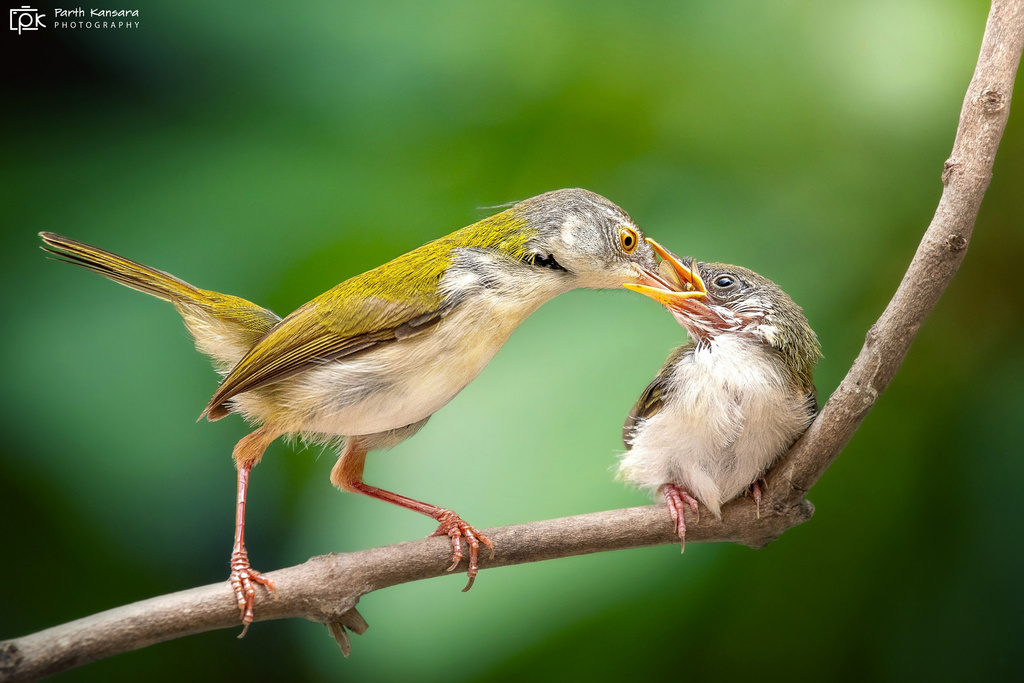
Common Tailorbird
Photo © Parth Kansara
Photo © Parth Kansara — CC BY 4.0 — Source: iNaturalist photo #237857636Identification
The common tailorbird is a small, brightly coloured songbird measuring 10 to 14 centimetres in length and weighing just 6 to 10 grams. Its most distinctive features are its long, upright tail—often held prominently and moved around frequently—and its vibrant plumage: olive-green upperparts contrasting with creamy-white underparts. The crown and forehead are distinctly rufous (rust-coloured), while the bill is sharp and slightly curved. The bird is wren-like in appearance, with short rounded wings and strong legs built for hopping through dense vegetation. Both sexes are identical, though males develop longer central tail feathers during breeding season. Young birds appear duller than adults. When calling, dark patches become visible on the sides of the neck, sometimes creating the appearance of a dark gorget.
Range & habitat
The common tailorbird is found across tropical Asia, with numerous subspecies distributed from Sri Lanka and Pakistan throughout the Indian peninsula, the Himalayan foothills, Nepal, Myanmar, Northeast India, Southeast Asia, and south China including Hainan. This species favours open farmland, scrub, forest edges, and gardens, and has become a common resident in urban gardens throughout its range. Despite their preference for human-modified landscapes, they typically remain hidden within dense vegetation, relying on their loud calls rather than visibility to announce their presence.
Behaviour & diet
Like most warblers, common tailorbirds are insectivorous, foraging for beetles, bugs, and other small insects—often attracted to flowers where they may feed on nectar from species such as mango, Bombax, and Salmalia. During these visits they sometimes become covered in pollen, earning a golden-headed appearance. They are typically found singly or in pairs, moving low through undergrowth and trees or hopping on the ground. Their loud song is a distinctive cheeup-cheeup-cheeup with variations across different populations. During the non-breeding season they roost alone, but may roost side-by-side with partners and fledged juveniles during breeding season, selecting thin twigs with protective cover above them, often near human habitation.
Best time & places to see it
The breeding season extends from March to December, peaking from June to August in India during the wet season, while in Sri Lanka the main periods are March to May and August to September. The birds are shy and usually hidden within vegetation, so listening for their loud, repetitive calls is often the best way to locate them. Urban gardens, farmland, scrub, and forest edges offer the most accessible viewing opportunities. Early morning when birds are most vocal provides the best chance of detecting their presence.
Photography tips
Photographing tailorbirds requires patience and an understanding of their secretive nature. Focus on listening for their distinctive loud calls to pinpoint their location before attempting to photograph. Since they favour dense vegetation and typically remain low in undergrowth, use longer lenses to avoid disturbing the birds. The rufous crown and green upperparts provide striking colour contrasts that photograph well in good light. Capturing the characteristic upright tail posture, which the bird moves around frequently, makes for distinctive images. Early morning light in gardens or forest edges will best showcase the bird's vibrant plumage.
Kanha Tiger Reserve
Minneriya National Park
Bandhavgarh National Park
Bandipur National Park
Banke National Park
Bardiya National Park
Chitwan National Park
Eravikulam National Park
Gaoligong Mountain National Nature Reserve
Nothing matches these filters.
No community photos yet. Log in to add the first one.
No community observations of this species yet.