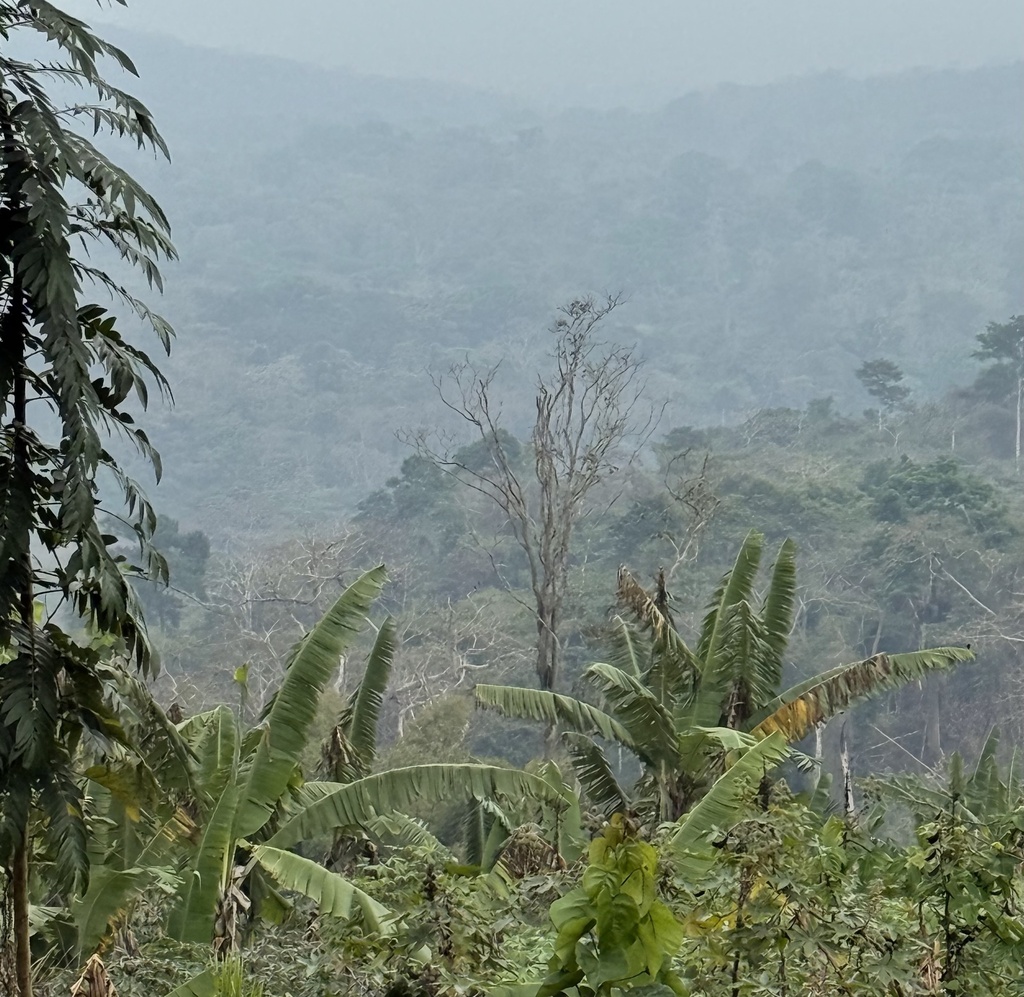
Congo Pied Hornbill
Photo © Irene
Photo © Irene — CC0 1.0 — Source: iNaturalist #330402312Identification
The Congo pied hornbill is a large, striking bird measuring 54 centimetres in length. It is predominantly black with a distinctive white belly and white tail tip, making it relatively easy to identify in forest canopies. The most prominent feature is its long, curved black and yellow bill, topped with a medium-sized casque. The sexes are similar in appearance, though females have a noticeably smaller casque than males. Immature birds are duller overall, possess smaller bills, and lack the casque entirely, which can make them challenging to distinguish from other hornbill species. In flight, this bird displays an undulating pattern characteristic of many hornbill species.
Range & Habitat
This species is native exclusively to the Congo Basin, where it inhabits mainly forest environments. The Congo pied hornbill is particularly attracted to oil palms, making these areas productive locations for observation. Its preference for forest habitats means it is encountered primarily in canopy and mid-storey levels rather than ground level, requiring patience and positioning beneath fruiting trees to observe effectively.
Behaviour & Diet
The Congo pied hornbill is an omnivorous species with a diverse diet comprising both fruit and insects, which it forages primarily within trees. This conspicuous and gregarious bird is highly vocal, advertising its presence with a distinctive, repetitive whistling call—a series of 'pii-pii-pii-pii' notes that can be heard from considerable distances through the forest. During breeding season, females lay up to four white eggs in tree holes, which are then sealed with a remarkable natural cement made from mud, droppings, and fruit pulp. This sealed nest has only a single narrow aperture, just large enough for the male to pass food to his mate and the developing chicks. As the chicks and female grow, the female eventually breaks out of the sealed nest and rebuilds the wall, after which both parents work together to feed the increasingly demanding chicks.
Best Time & Places to See It
The Congo pied hornbill's conspicuous nature and gregarious habits make it relatively straightforward to locate once you are in suitable habitat. Listen for its distinctive whistling call, which often betrays the bird's presence before visual contact is made. Focus your search in forested areas of the Congo Basin, particularly where oil palms are present. Patient observation beneath fruiting trees during daylight hours offers the best chance of sightings, as the bird's preference for arboreal foraging means it spends most time in the canopy.
Photography Tips
The Congo pied hornbill's striking black and white plumage and distinctive bill make it a rewarding photographic subject. Position yourself early in the morning or late afternoon when light filters through the canopy to best capture the contrast between its dark plumage and white markings. Because the bird feeds primarily in trees, telephoto lenses (400mm or longer) are essential to obtain frame-filling images from ground level. Use the bird's vocalisations to locate individuals, then position yourself with good light angles before the bird departs. The undulating flight pattern can produce dynamic images if you anticipate movement between fruiting trees.
Bwindi Impenetrable National Park
Kanyashogi, Uganda
+603 birds+26 mammals
Steep ridges cloaked in montane forest rise from Uganda's southwestern borderlands, where the landscape grows so dense and tangled that early explorers named it impenetrable. At…
VIEW NATIONAL PARKMurchison Falls National Park
Uganda
+608 birds+33 mammals
Where the Victoria Nile compresses through a narrow gorge and explodes across a 45-meter precipice, the landscape speaks in thunder. Murchison Falls National Park sprawls across…
VIEW NATIONAL PARKLake Mburo National Park
Uganda
+505 birds+24 mammals
Rolling acacia woodland and scattered lakes define this intimate savanna preserve in southwestern Uganda, where the rift valley's geological drama shapes every water source and grassland.…
VIEW NATIONAL PARKToro-Semliki Proposed National Park
Uganda
+474 birds+5 mammals
Where the Albertine Rift's western escarpment rises above the Semliki River valley, a vast mosaic of forest, savanna and wetland converges to create one of East…
VIEW NATIONAL PARKQueen Elizabeth National Park
Uganda
+672 birds+30 mammals
Across the southwestern escarpment of Uganda, where the Western Rift Valley descends through ancient volcanic terrain, Queen Elizabeth National Park sprawls across more than 8,300 square…
VIEW NATIONAL PARKMabamba Swamp
Memere, Uganda
+464 birds+2 mammals
Across the Central Region of Uganda spreads one of Africa's most biodiverse freshwater wetlands, a sprawling nature reserve of roughly 283 square kilometres where papyrus swamps…
VIEW NATURE RESERVEZiwa Rhino and Wildlife Ranch
Nakasongola, Uganda
+359 birds+11 mammals
Where papyrus wetlands merge into sprawling savanna, Uganda's central landscape opens into one of East Africa's most vital rhino recovery zones. Ziwa Rhino and Wildlife Ranch…
VIEW WILDLIFE SANCTUARYNo community photos yet. Log in to add the first one.
No community observations of this species yet.