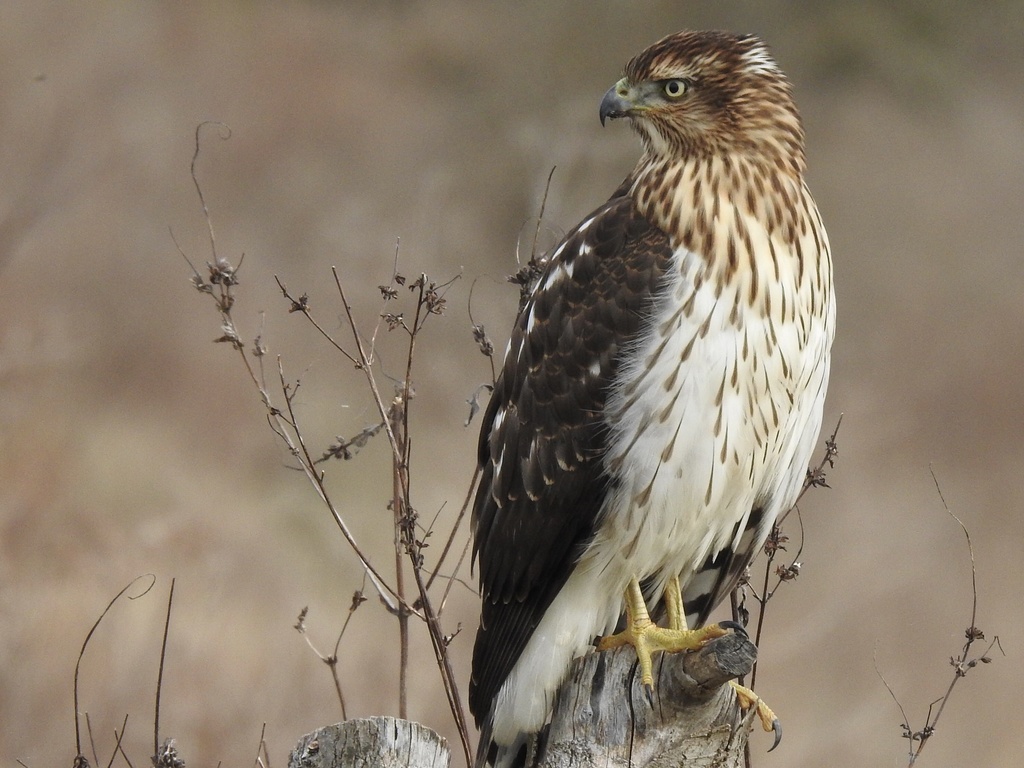
Cooper’s Hawk
Photo © danpatrick
Photo © danpatrick — CC BY 4.0 — Source: iNaturalist photo #106037372Identification
Cooper's hawk is a medium-sized raptor with distinctive proportions that make it recognizable to experienced birders. The species features a long, often graduated or wedge-shaped tail, moderate-length wings, and long legs with moderately thick toes. Its relatively large, squarish head (which can appear rounded depending on feather position) houses forward-set eyes and a short but robust, hooked bill perfectly adapted for tearing flesh. Sexual dimorphism is pronounced, with females notably larger than males. Birds east of the Mississippi River tend to be larger on average than their western counterparts. Cooper's hawk is frequently confused with the smaller sharp-shinned hawk, though genetic studies reveal these similarities stem from convergent evolution rather than close kinship.
Range & Habitat
This North American native ranges from southern Canada south through the United States to Mexico. The species prefers tall trees with extensive canopy cover for nesting, making mature forests and well-treed areas ideal habitat. Evidence from genetic markers and fossil records indicates Cooper's hawk populations were historically restricted to at least two separate Pleistocene glacial refugia, with the Rocky Mountains acting as a natural barrier between eastern and western populations. This deep evolutionary history—with fossil records dating back perhaps 0.5 to 1 million years—makes Cooper's hawk the earliest known Astur to colonize North America.
Behaviour & Diet
Cooper's hawks are adapted hunters of agile prey, reflected in their numerous evocative common names: big blue darter, flying cross, and swift hawk. They primarily hunt small-to-medium-sized birds but commonly take small mammals and occasionally reptiles. The species is generally secretive, often perching within dense canopy, though birds may use more open perches in western regions or during winter months. Like related hawks, they nest in tall trees with extensive canopy cover and can produce two to four fledglings depending on environmental conditions. Breeding success may be compromised by poor weather, predators, and anthropogenic factors such as pesticide use and chemical pollution. Despite historic population declines during the 20th century, Cooper's hawk populations have been increasing as of 2024.
Best Time & Places to See It
Look for Cooper's hawks in mature forests and well-treed habitats throughout their North American range. The species can be found year-round across much of its distribution, though some populations shift seasonally. Winter months may offer better viewing opportunities, as birds are less confined to dense canopy and may use more open perches. Wooded areas near the Mississippi River and throughout the continent, from southern Canada to Mexico, offer potential sightings. Patient observation in appropriate habitat, particularly near tall trees suitable for nesting, increases chances of encountering this secretive predator.
Photography Tips
Photographing Cooper's hawks requires patience, as they often remain hidden within dense canopy. Position yourself in suitable habitat and watch for movement among treetops. The bird's preference for elevated perches within thick foliage can make photography challenging, but winter visits to more open perches provide opportunities. The long, graduated tail and distinctive head shape are key identifying features to capture. Early morning and late afternoon light works well for woodland photography. Look for birds hunting in open areas or perching conspicuously in winter, when canopy cover is reduced and birds may be more visible.
Banff National Park
Improvement District No. 9, Canada
+264 birds+33 mammals
Where the Canadian Rockies thrust skyward in a cathedral of limestone and ice, Banff National Park preserves a wilderness of astounding vertical drama. Glacier-carved valleys cradle…
VIEW NATIONAL PARKMont-Saint-Bruno National Park
Saint-Bruno-de-Montarville, Canada
+200 birds+13 mammals
Hardwood forests rise steeply from the suburbs of Montreal to crown a distinctive peak in the Monterégian Hills, their ancient geology pushing through mixed deciduous woodland…
VIEW NATIONAL PARKLassen Volcanic National Park
Shasta County, United States
+239 birds+18 mammals
Volcanic peaks and geothermal upheaval have sculpted 545 square kilometers of Northern California into a landscape where fire and water engage in perpetual dialogue. Lassen Peak…
VIEW NATIONAL PARKPinnacles National Park
San Benito County, United States
+197 birds+33 mammals
Jagged volcanic spires thrust from chaparral-covered ridges across 222 square kilometers of central California's inner Coast Ranges, their pale stone crowns catching the afternoon light like…
VIEW NATIONAL PARKJoshua Tree National Park
Riverside County, United States
+221 birds+23 mammals
Across 5,610 square kilometers of Riverside County's high desert, a landscape of geological drama unfolds where granite monoliths pierce through bajadas of creosote scrub and Joshua…
VIEW NATIONAL PARKGreat Basin National Park
White Pine County, United States
+170 birds+19 mammals
Where the Great Basin's high desert plateaus rise above 10,000 feet, ancient bristlecone pines endure on moonscape ridges of limestone and quartzite, creating one of North…
VIEW NATIONAL PARKZion National Park
Washington County, United States
+244 birds+30 mammals
Towering sandstone cliffs in shades of crimson, rust, and cream rise abruptly from the Virgin River's winding canyon floor, their sculpted faces bearing witness to millions…
VIEW NATIONAL PARKMesa Verde National Park
Montezuma County, United States
+166 birds+10 mammals
Across the high desert plateau of southwestern Colorado, where sandstone mesas rise abruptly from piñon-juniper scrubland, Mesa Verde National Park preserves one of North America's most…
VIEW NATIONAL PARKNo community photos yet. Log in to add the first one.
No community observations of this species yet.