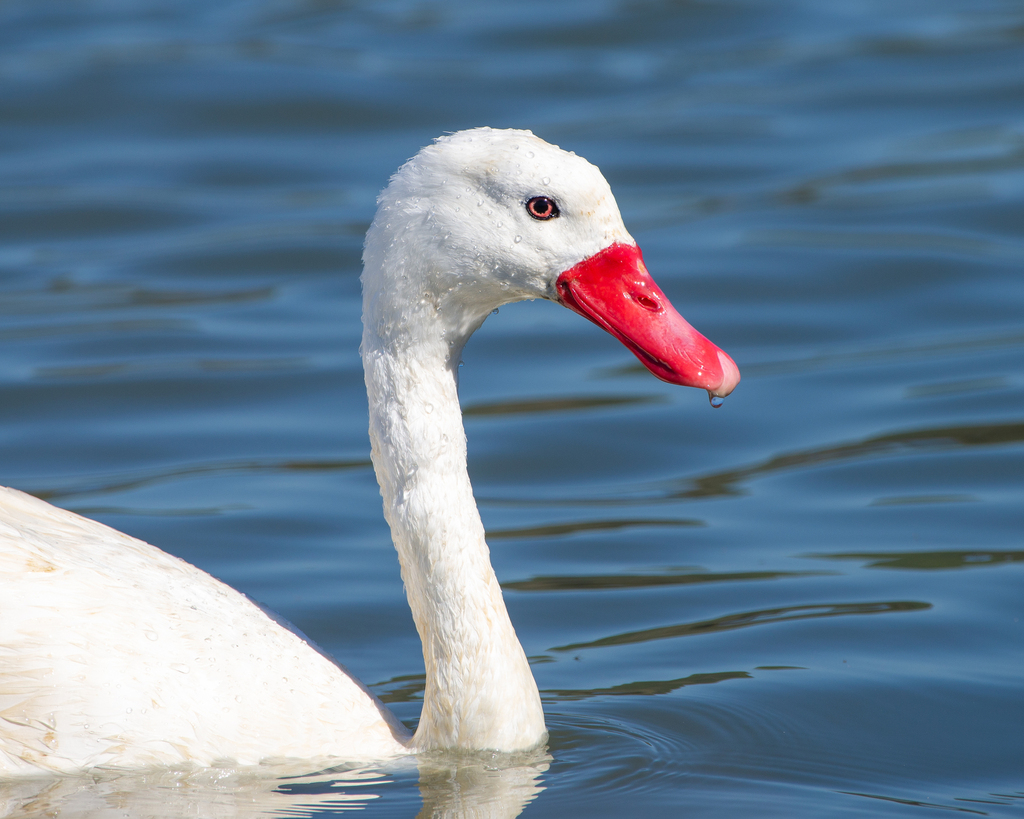
Coscoroba Swan
Photo © Nicolás Villaseca Merino
Photo © Nicolás Villaseca Merino — CC BY-SA 4.0 — Source: iNaturalist #203174016Identification
The coscoroba swan is a medium-large waterfowl, smaller than true swans, measuring 90 to 115 cm in length with a wingspan of about 155 cm. Males weigh 3.8 to 5.4 kg and females 3.1 to 4.5 kg. Their appearance is distinctive and somewhat unusual, intermediate between geese and true swans. Adults are completely white except for black tips on the outer six primary feathers, which are often barely visible on the closed wing unless the bird is in flight. Unlike true swans, coscoroba swans have completely feathered faces and feet positioned directly under their bodies, enabling them to walk more efficiently than most other waterfowl. Both sexes have identical plumage. Their bills and feet are darker and redder than those of similar-sized ducks. Young chicks are born with blue-grey bills and feet and black striping along their bodies for camouflage, fading by about eight months of age.
Range & Habitat
The coscoroba swan is found throughout South America, with a year-round resident population in central Argentina and along the Uruguay-southern Brazil coast. The species breeds in southern Chile and Argentina south to Tierra del Fuego and occasionally the Falkland Islands, then migrates north in winter to central Chile, northern Argentina, Paraguay, Uruguay, and southern Brazil. It has been recorded as a vagrant in Bolivia and at various locations in Brazil beyond its usual range. These swans inhabit well-vegetated lagoons, freshwater swamps, and human-made reservoirs, primarily in lowland areas, though scattered records exist at elevations up to 1,300 m, with at least one record at 2,000 m.
Behaviour & Diet
Coscoroba swans feed on aquatic and terrestrial plants, small aquatic invertebrates, and small fish. They forage while swimming or wading in shallow water and, unusually among swans, rarely upend to feed. They also graze on land and often feed alongside black-necked swans. The species forms long-term pair bonds and breeds during the local spring—May to October in northern Argentina, July to December in Chile, and July to August in southern Brazil. Both partners construct a nest of vegetation lined with soft grass on small islets or in reedbeds close to water. Clutches typically contain four to nine eggs with an incubation period of about 35 days. Both parents care for young through fledging at 14 weeks and often beyond, sometimes until the chicks are a year old. Their vocalizations include an onomatopoeic "cos-cor-oo" call as a threat, a monosyllabic hooting note as contact between mates, and immature birds produce loud chirps and trills.
Best Time & Places to See It
Coscoroba swans are fairly common in Argentina, making it the most reliable location for sightings. They are uncommon in Paraguay and Uruguay, rare in Chile, and uncertain in Brazil. The species is a year-round resident in central Argentina and along the Uruguay-southern Brazil coast, so these areas offer consistent viewing opportunities. Winter months (June to August in the Southern Hemisphere) may concentrate birds in northern parts of their range as populations migrate from southern breeding grounds. Well-vegetated lagoons, freshwater swamps, and reservoirs are the best habitats to search.
Photography Tips
The coscoroba swan's pure white plumage makes it visually striking but challenging for exposure metering—be prepared to compensate to avoid underexposure of the white feathers. The black wingtips are subtle and often invisible on perched birds, so capture the birds in flight to showcase this identifying feature. Their upright posture and efficient walking gait offer good opportunities for full-body shots on land. Look for family groups during breeding season, as both parents actively tend young, providing dynamic compositional possibilities. The distinctive feathered face and darker red bill and feet are diagnostic features worth highlighting in close-up shots. Early morning light at lagoons and swamps will enhance the contrast between their white plumage and surrounding vegetation.
Peixe National Park Lagoon
Brazil
+293 birds+4 mammals
Where the coastal plains of Rio Grande do Sul meet the Atlantic, Peixe National Park Lagoon sprawls across nearly 2,200 square kilometres of shallow waters, reed…
VIEW NATIONAL PARKChiloé National Park
Dalcahue, Chile
+122 birds+6 mammals
Temperate rainforest cloaks the Chiloé archipelago's northwestern reaches, where granite ridges thrust through dense, moisture-laden canopy and freshwater streams carve ravines toward the Pacific. Across approximately…
VIEW NATIONAL PARKPan de Azúcar National Park
Chañaral, Chile
+74 birds+4 mammals
Where the Atacama Desert plunges toward the Pacific, Pan de Azúcar National Park sprawls across 727 square kilometres of one of Earth's most extreme transitions—a landscape…
VIEW NATIONAL PARKTorres del Paine National Park
Torres del Paine, Chile
+143 birds+10 mammals
Where granite spires pierce the Patagonian sky, Torres del Paine commands one of South America's most dramatic landscapes. Across 4,106 square kilometres of southern Chile, jagged…
VIEW NATIONAL PARKVicente Pérez Rosales National Park
Puerto Varas, Chile
+109 birds+8 mammals
Where the Andes descend toward the temperate rainforests of Chile's Lake District, nearly 4,641 square kilometers of pristine wilderness unfolds across Vicente Pérez Rosales National Park.…
VIEW NATIONAL PARKCerro Castillo National Park
Coyhaique, Chile
+89 birds+3 mammals
Granite peaks and windswept steppe converge across this vast Patagonian landscape, where the Andes' eastern flank drops into terrain sculpted by ice age glaciers and relentless…
VIEW NATIONAL PARKPatagonia National Park
Cochrane, Chile
+133 birds+8 mammals
Where the Andes meet the Patagonian steppe, vast grasslands and shrublands sweep across rolling terrain carved by ancient glaciation, their contours softened by distance and dramatic…
VIEW NATIONAL PARKReserva Nacional Magallanes
Punta Arenas, Chile
+78 birds+2 mammals
Where windswept steppe meets sub-Antarctic forest near the southern tip of continental South America, Reserva Nacional Magallanes unfolds across roughly 352 square kilometres of profound ecological…
VIEW NATIONAL PARKParque Provincial Península de Magallanes
Argentina
+125 birds+4 mammals
Granite peaks and windswept steppe converge across this 415-square-kilometre peninsula jutting into the cold Atlantic waters of southern Patagonia, where the Magallanes landscape embodies the raw,…
VIEW NATIONAL PARKMonte León National Park
Argentina
+100 birds+4 mammals
Where the Patagonian steppe meets the Atlantic, Monte León National Park protects a landscape of windswept coastal cliffs, rocky outcrops, and semi-arid grassland spanning over 1,200…
VIEW NATIONAL PARKLos Glaciares National Park
Argentina
+121 birds+3 mammals
Where granite peaks and sprawling ice fields dominate the landscape, Los Glaciares National Park encompasses over ten thousand square kilometres of Patagonian wilderness in southern Argentina.…
VIEW NATIONAL PARKEl Palmar National Park
Distrito Sexto, Argentina
+244 birds+14 mammals
Across the Paraná River floodplain in northeastern Argentina, palms rise from wetland and grassland in a landscape shaped by water and time. El Palmar National Park…
VIEW NATIONAL PARKCampos del Tuyú National Park
Argentina
+169 birds+5 mammals
Subtropical forest graces the borderlands where Misiones Province meets Paraguay, a landscape shaped by the Paraná Plateau's weathered topography and the warm, humid climate of northeastern…
VIEW NATIONAL PARKPerito Moreno National Park
Argentina
+78 birds
Where the Patagonian steppe descends into a landscape carved by ancient ice, Perito Moreno National Park sprawls across nearly 1,590 square kilometres of some of South…
VIEW NATIONAL PARKLos Cardones National Park
Argentina
+193 birds+6 mammals
Where the Andes descend into northwestern Argentina, Los Cardones National Park sprawls across nearly 1,200 square kilometres of one of South America's most distinctive high-altitude desert…
VIEW NATIONAL PARKEl Rey National Park
Municipio de Las Lajitas, Argentina
+317 birds+4 mammals
Where the eastern slopes of the Andes descend into northwestern Argentina's subtropical transition zone, El Rey National Park unfolds across 841 square kilometers of dramatically varied…
VIEW NATIONAL PARKNahuel Huapi National Park
Argentina
+124 birds+11 mammals
Where the Andes descend toward Patagonia, vast glacial lakes cut through a landscape of southern beech forest and granite peaks, creating one of South America's most…
VIEW NATIONAL PARKLanín National Park
Argentina
+128 birds+7 mammals
Where the volcanic spine of the Andes plunges into Patagonian steppe, Lanín National Park sprawls across nearly 4,700 square kilometers of one of Argentina's most visually…
VIEW NATIONAL PARKLos Alerces National Park
Argentina
+84 birds+3 mammals
Where the temperate rainforests of southern Patagonia sweep down towards crystalline lakes, Los Alerces National Park unfolds across nearly 3,000 square kilometres of one of South…
VIEW NATIONAL PARKArchipiélago Juan Fernández National Park
San Juan Bautista, Chile
+31 birds+2 mammals
Granite peaks rise abruptly from the South Pacific off the Chilean coast, their weathered slopes studded with native woodland and sweeping down to coves where seabirds…
VIEW NATIONAL PARKNo community photos yet. Log in to add the first one.
No community observations of this species yet.