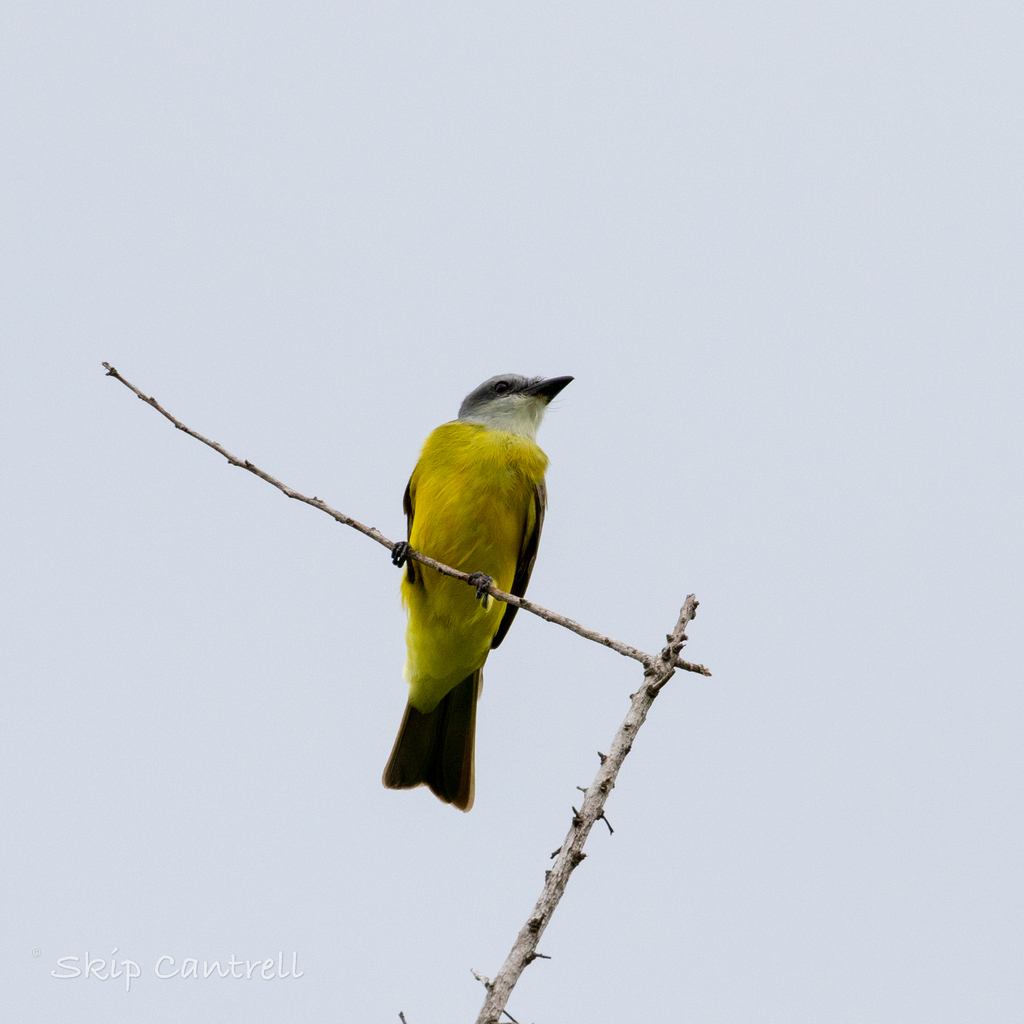
Couch’s Kingbird
Photo © tcantrell52
Photo © tcantrell52 — CC BY 4.0 — Source: iNaturalist #141324094Identification
Couch's kingbird is a compact tyrant flycatcher approximately 7 inches long, distinguished by a notably large head and bill paired with a dark, deeply forked tail. The plumage is characteristically pale gray on the head with contrasting darker cheeks, grayish-olive on the upperparts, and a pale throat that transitions to a darker breast. The most striking feature is the bright yellow lower breast and belly, creating a distinctive two-toned underside. Juveniles appear browner overall with pale wing edges.
Couch's kingbird bears a striking resemblance to several congeners, most notably the tropical kingbird, which was considered the same species until 1979. The most reliable distinction is vocal: Couch's kingbird produces a raspier, more complex call with greater pitch variation. Habitat preference also helps—Couch's inhabits more wooded environments, while tropical kingbirds favor open areas. From Cassin's kingbird, Couch's can be distinguished by its paler head and lack of white tail tips. Western kingbirds show a gray chest patch extending from the head, which Couch's lacks.
Range & Habitat
This species is endemic to the Gulf Coast region, occurring from southern Texas through eastern Mexico, Belize, and into northeastern Guatemala. Notable populations persist in the lower Rio Grande Valley. The bird shows a marked preference for lightly wooded environments including sparse forests, suburban areas, thorn scrub, and the edges of wooded streams. Proximity to water is essential to this species, particularly rivers, and birds are frequently encountered along roadsides and forest margins.
Couch's kingbird remains poorly studied across much of its range, and vagrant individuals occasionally appear far north of normal range, as exemplified by a remarkable sighting in New York City during December 2014. Population trends vary geographically: Texas populations remain stable, though Mexican populations fluctuate significantly in response to urbanization and deforestation.
Behaviour & Diet
Couch's kingbird is predominantly insectivorous, specializing in larger prey items including beetles, grasshoppers, wasps, and large flies, though it supplements its diet with small berries and seeds. The species employs typical kingbird foraging techniques: perching alertly while scanning for insect movement, then either hawking prey in mid-air with hovering flight or executing rapid swoops from its perch. After capturing prey, the bird returns to a branch to feed.
Breeding biology remains incompletely documented but appears similar to the tropical kingbird. Nesting occurs in lightly wooded areas, with birds showing preference for sugar hackberry, cedar elm, Texas ebony, and Mexican ash trees. Females construct flat, cup-shaped nests from twigs, leaves, weeds, moss, and bark, lined with finer materials including rootlets, plant down, and Spanish moss. Nests are positioned 8–25 feet high on horizontal branches and fiercely defended by adults. Clutches typically contain three to four pinkish-buff eggs marked with brown and lavender spotting. Incubation lasts approximately two weeks and is performed by the female, while both parents feed fledglings, which leave the nest around 2–3 weeks of age.
Best Time & Places to See It
The lower Rio Grande Valley of southern Texas represents the most accessible location for observing Couch's kingbird within United States territory. Throughout its broader range in Mexico, Belize, and Guatemala, the species is most readily found by searching lightly wooded habitats near water sources, particularly along rivers and streams. Look for the bird perched prominently on dead branches or exposed snags where it hunts passing insects. Roadside vegetation, forest edges, and suburban areas with scattered trees also provide reliable viewing opportunities.
Couch's kingbird is typically encountered as solitary individuals or in pairs rather than flocks. Early morning hours often provide optimal viewing conditions when insect activity peaks and birds are actively foraging. The rasping, complex vocalizations are frequently the first indication of the bird's presence, making careful listening an essential field technique.
Photography Tips
The bright yellow breast provides excellent contrast for photography and should be clearly visible in well-composed images. Position yourself to capture the distinctive pale head and darker cheeks in adequate light, which accentuates these key identification features. The forked tail and large bill are equally important diagnostic elements worth emphasizing in photographs.
Patient perch-watching typically yields the best photographic opportunities, as the bird's habit of returning to favored branches allows photographers to predict and prepare for shots. Early morning light is particularly flattering for capturing the yellow underparts and subtle plumage details. Since Couch's kingbird is often confused with similar species in the field, comprehensive images showing the overall plumage pattern, head markings, and ventral coloration are valuable for documentation and identification verification.
Big Bend National Park
Brewster County, United States
+345 birds+34 mammals
Where the Chisos Mountains rise abruptly from the Sonoran Desert floor, Big Bend National Park spans over 7,300 square kilometers of one of North America's most…
VIEW NATIONAL PARKDzibilchantún National Park
Barcelona, Mexico
+144 birds+2 mammals
Across the limestone plains of Yucatán, where cenotes pierce the bedrock and tropical forest clings to shallow soils, lies Dzibilchantún—a modest yet ecologically vital national park…
VIEW NATIONAL PARKLagunas de Montebello National Park
Laguna de Montebello, Mexico
+360 birds+2 mammals
Where turquoise lagoons pierce the limestone plateau of southeastern Chiapas, the Lagunas de Montebello National Park unfolds across roughly 174 square kilometers of spectral water and…
VIEW NATIONAL PARKArrecifes de Cozumel National Park
San Miguel de Cozumel, Mexico
+112 birds+4 mammals
Beneath the turquoise shallows of the western Caribbean, Arrecifes de Cozumel National Park protects a sprawling marine realm across 484 square kilometres off the Quintana Roo…
VIEW NATIONAL PARKSian Ka’an
Chunyaxché, Mexico
+350 birds+16 mammals
Where the Yucatán Peninsula dissolves into wetland and mangrove, a vast mosaic of forest, lagoon, and coastal margin creates one of Mexico's most biodiverse strongholds. Across…
VIEW BIOSPHERE RESERVEMontes Azules
Candelaria, Mexico
+395 birds+47 mammals
Where jungle-clad limestone plateaus plunge into canyon systems carved by the Usumacinta River, Mexico's most pristine rainforest reserve unfolds across the Lacandón region of Chiapas. Montes…
VIEW BIOSPHERE RESERVETikal National Park
Tikal, Guatemala
+399 birds+16 mammals
Dense rainforest canopy rises above the limestone plateau of Petén, where archaeological wonder and ecological richness merge seamlessly across one of Central America's most biodiverse landscapes.…
VIEW NATIONAL PARKLaguna del Tigre National Park
Petén, Guatemala
+399 birds+29 mammals
Where the Petén lowlands dissolve into wetland and forest, Laguna del Tigre National Park protects one of Guatemala's most ecologically vital landscapes. This sprawling reserve encompasses…
VIEW NATIONAL PARKSierra del Lacandón National Park
Petén, Guatemala
+348 birds+7 mammals
Where the Petén rainforest rises into limestone ridges and deep ravines, Sierra del Lacandón National Park protects one of Central America's most intact tropical wilderness zones.…
VIEW NATIONAL PARKWhite Sands National Park
Otero County, United States
+178 birds+6 mammals
Across the Tularosa Basin in south-central New Mexico sprawls an otherworldly landscape of gypsum dunes—the largest gypsum field on Earth and a stark desert playground shaped…
VIEW NATIONAL PARKBosque del Apache National Wildlife Refuge
Socorro County, United States
+345 birds+17 mammals
Where the Rio Grande emerges from its desert canyon in central New Mexico, a narrow ribbon of riparian woodland defies the arid landscape that surrounds it.…
VIEW WILDLIFE SANCTUARYChincoteague National Wildlife Refuge
Chincoteague, United States
+362 birds+16 mammals
Across the barrier islands and salt marshes of Virginia's Eastern Shore, where Atlantic tides sculpt an intricate mosaic of sandy spits and tidal flats, lies one…
VIEW WILDLIFE SANCTUARYLaguna Atascosa National Wildlife Refuge
Cameron County, United States
+365 birds+19 mammals
Where coastal prairie meets shallow lagoon along the southernmost tip of Texas, Laguna Atascosa National Wildlife Sanctuary sprawls across a landscape sculpted by salt spray and…
VIEW WILDLIFE SANCTUARYSanta Ana National Wildlife Refuge
Hidalgo County, United States
+349 birds+12 mammals
Where the Rio Grande delta meets the semi-arid scrublands of South Texas, Santa Ana National Wildlife Sanctuary preserves a rare mosaic of wetland and thornforest habitat…
VIEW WILDLIFE SANCTUARYLower Rio Grande Valley National Wildlife Refuge
Starbase, United States
+311 birds+11 mammals
Where the Rio Grande delta spreads across the coastal plain of South Texas, a sanctuary of subtropical wetlands and riparian corridors creates a landscape that pulses…
VIEW WILDLIFE SANCTUARYNo community photos yet. Log in to add the first one.
No community observations of this species yet.