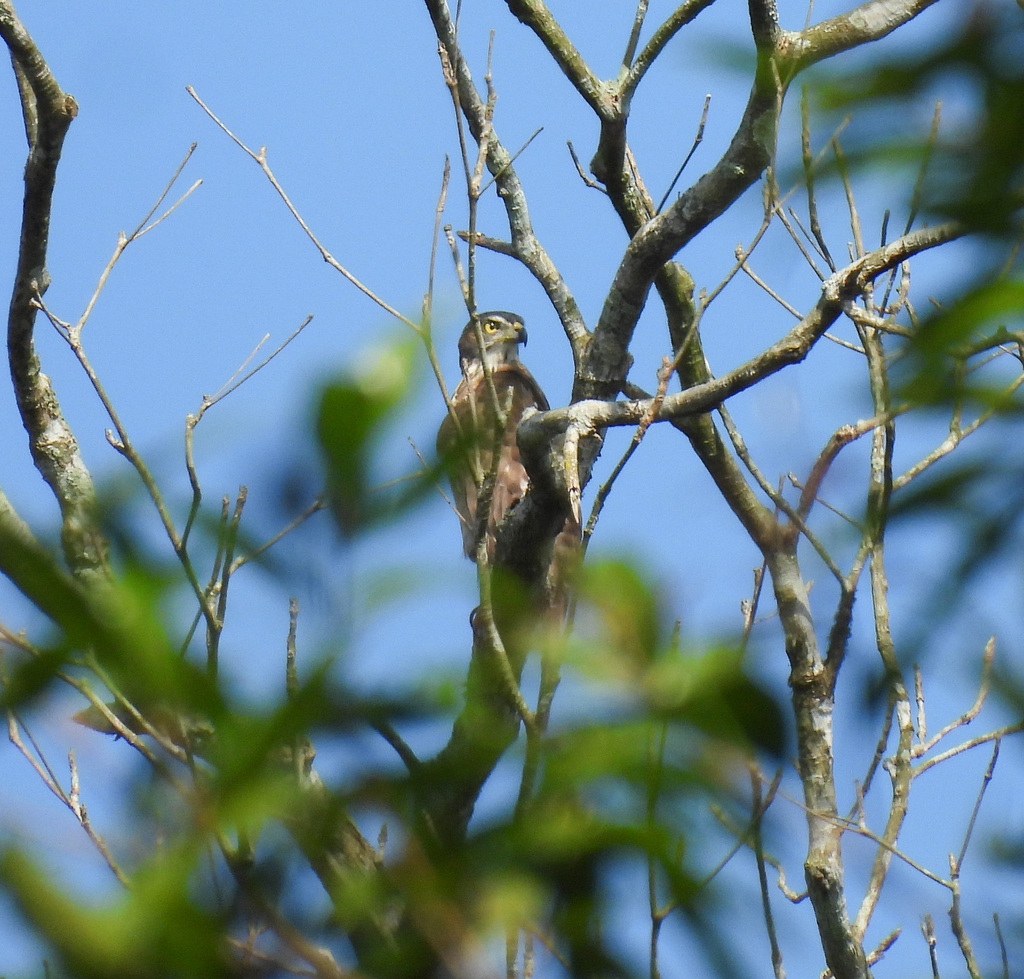
Crested Goshawk
Photo © Rejoice Gassah
Photo © Rejoice Gassah — CC BY 4.0 — Source: iNaturalist #296460898Identification
The crested goshawk is a compact raptor measuring 30–46 cm in length, with females substantially larger than males. Its most distinctive feature is a short crest, clearly visible when seen in profile, which separates it from its close relative, the besra. The species has short broad wings and a long tail—both adaptations for agile maneuvering through dense forest canopy.
Males display a dark brown crown with grey head sides, marked by black moustachial and throat stripes. Their pale underparts feature rufous streaks on the breast and barring on the belly. Females are larger and browner overall, with brown rather than rufous streaking and barring on the underparts. Juveniles show pale fringes to their head feathers and buff-colored underpart backgrounds. In flight, the species exhibits the characteristic "slow flap, slow flap, straight glide" pattern typical of Accipiter hawks.
Range & Habitat
The crested goshawk is widely distributed across tropical Asia, breeding from India and Sri Lanka eastward to southern China, Indonesia, Taiwan, and the Philippines. Eleven subspecies are recognized across this range. The species is primarily a lowland bird and an all-year resident throughout its range, though it becomes increasingly rare toward the northern limits of its distribution in places like the Himalayan foothills of Bhutan and India's Dehradun district.
This is fundamentally a tropical and warm subtropical species, restricted to such climatic zones. Notably, in Malaysia and Singapore there is growing evidence of populations adapting to urban centers, suggesting some flexibility in habitat use despite their traditional forest preference.
Behaviour & Diet
As a secretive forest bird, the crested goshawk hunts birds, mammals, and reptiles in woodland habitats. It employs a hunting strategy relying on surprise, launching from a perch to catch prey unaware. The species builds stick nests in trees and typically lays two or three eggs per breeding season.
Like other raptors, this goshawk hosts various parasitic lice species. Notably, Degeeriella storeri is a specialized parasite found exclusively on the crested goshawk and no other host species, while Kurodaia fulvofasciata, a more generalist louse parasite, is widely distributed across birds of prey throughout the Holarctic region.
Best Time & Places to See It
Since the crested goshawk is an all-year resident throughout its range, it can be encountered in any season. However, as a secretive forest species, it requires patience to locate. Forested areas across its tropical Asian range offer the best opportunities, particularly in lowland woodland habitats. In Hong Kong, Kam Shan Country Park is a known location where this protected species can be found under the Wild Animals Protection Ordinance.
The species' increasing adaptation to urban environments in Malaysia and Singapore means that travelers in these regions may encounter crested goshawks in city parks and gardens, expanding opportunities for observation beyond remote forest locations.
Photography Tips
Photographing the crested goshawk presents challenges typical of forest raptors. The species' secretive nature and preference for dense woodland means patient observation from suitable vantage points is essential. Look for perching birds scanning for prey from mid-canopy heights, where you may have brief opportunities for shots.
The bird's distinctive short crest is best captured in profile views, so position yourself to obtain side-on angles when possible. The characteristic slow, deliberate flight pattern offers opportunities for flight photography. Early morning hours, when the bird is most active, provide the best light for capturing detail in its plumage, particularly the subtle rufous and black markings that distinguish males from females.
Eravikulam National Park
Devikulam, India
+192 birds+7 mammals
High in the Western Ghats of Kerala, where monsoon mists cling to slopes that rise above 2,000 metres, Eravikulam National Park preserves one of South India's…
VIEW NATIONAL PARKHat Noppharat Thara-Mu Ko Phi Phi National Park
Ao Nang, Thailand
+253 birds+9 mammals
Where limestone karsts rise dramatically from turquoise waters, Hat Noppharat Thara-Mu Ko Phi Phi National Park unfolds across a mosaic of beach, mangrove forest, and island…
VIEW NATIONAL PARKKhao Yai National Park
Prachantakham District, Thailand
+377 birds+46 mammals
Evergreen dipterocarp forest blankets the rolling terrain of this national park in eastern Thailand, where limestone hills rise abruptly from the forest floor and seasonal streams…
VIEW NATIONAL PARKKaziranga National Park
Kohora, India
+422 birds+26 mammals
Dawn breaks over the floodplains of the Brahmaputra, where tall grasslands stretch endlessly beneath monsoon-heavy skies. This sprawling wilderness of northeastern Assam is a mosaic of…
VIEW NATIONAL PARKNagarahole Tiger Reserve
Nalkeri Forest, India
+323 birds+23 mammals
Where granite escarpments rise above dense deciduous forests and the Kabini River carves through pristine wilderness, one of India's most biodiverse landscapes unfolds across the Western…
VIEW NATIONAL PARKNo community photos yet. Log in to add the first one.
No community observations of this species yet.