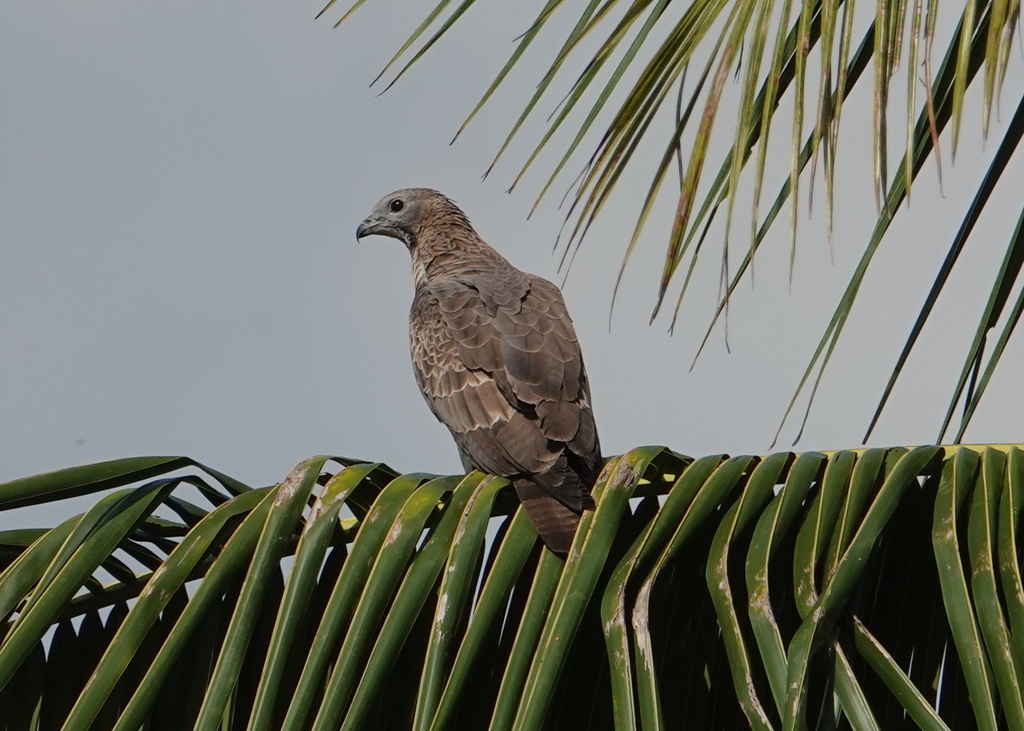
Crested Honey Buzzard
Photo © Matthew Blissett
Photo © Matthew Blissett — CC BY 4.0 — Source: iNaturalist photo #31966297Identification
The crested honey buzzard is a fairly large raptor, measuring 57–60 cm in length and weighing 750 to 1,490 g. Despite its name, it is not closely related to Buteo buzzards but is taxonomically closer to the kites. Its most distinctive feature is an unusually raptor-unlike facial appearance: a long neck, small head resembling a pigeon's, and a short head crest. The bird is brown above (though paler than the European honey buzzard) and paler below, with a characteristic dark throat stripe.
Sexual dimorphism is marked and unusual for large birds of prey. Males display a blue-grey head with brown iris, while females are brown-headed with a yellow iris and are slightly larger and darker overall. Males show two black tail bands and three black underwing bands, whereas females have three tail bands and four narrower underwing bands. Juveniles display extensive black primary tips with narrower underwing bands, a yellow cere at the bill's base, and dark iris. In flight, it may be confused with the short-toed snake-eagle, but can be distinguished by its slimmer head and longer neck. The bird has deep elastic wing beats, high upstrokes, and glides on flat or slightly arched wings.
Range & Habitat
The crested honey buzzard follows a migratory pattern across Asia. It summers in Siberia, Korea, and Japan, departing Siberia in late August and returning in May. In Japan, birds are present from April–May through mid-September. The species winters in tropical Southeast Asia and the Indian subcontinent, and is also a year-round resident in these latter regions. Remarkably, migrating birds from Japan to Southeast Asia complete a nonstop 700 km flight over the East China Sea, assisted by favourable autumn winds.
The species prefers well-forested areas with open spaces and is found from sea level up to 1,800 m elevation. Vagrant records have occurred in Europe, including Italy (2011), Cyprus (2012), the Strait of Messina, and Lesvos, Greece (2018). The species comprises six subspecies across its range.
Behaviour & Diet
The crested honey buzzard is a specialist in an unusual and challenging diet: it feeds mainly on bee and wasp larvae extracted from honeycombs. To exploit this food source, the species has evolved remarkable adaptations. It possesses an elongated head for foraging on underground nests and a groove in its tongue that allows it to extract wasp grubs from their comb cells. A striking protective feature is a mass of short, dense feathers covering the head and neck, which shield against stinging attacks by social wasps.
In behaviour, the bird is generally quiet, even while nesting, though it occasionally utters a single high-pitched screaming whistle. It is usually observed soaring singly or in pairs, or perched on tree tops. Juveniles may exhibit Batesian mimicry—resembling the more heavily protected Nisaetus hawk-eagles—as a defence against predation by larger raptors, a strategy also employed by juvenile European honey buzzards.
Best Time & Places to See It
Timing depends on location. In breeding areas such as Siberia and Japan, the best viewing window is May through mid-September. In wintering areas of Southeast Asia and the Indian subcontinent, the species is present during winter months and year-round as residents. Migration periods (late August departures and May returns) may offer viewing opportunities along flyways, particularly over the East China Sea where large-scale movements occur.
Seek the species in well-forested areas with open clearings, scanning at elevation from sea level to 1,800 m. Look for birds soaring singly or in pairs, or perched prominently on tree tops. The bird's distinctive silhouette in flight—with its long neck, slimmer head, and characteristic wing and tail patterns—will aid identification among soaring raptors.
Photography Tips
Photograph this species in flight whenever possible to capture its distinctive silhouette and wing pattern. The sexual dimorphism offers excellent opportunities: photograph males and females together to showcase the contrasting head colours (blue-grey versus brown) and iris colours (brown versus yellow). The dark throat stripe and overall proportions—particularly the long neck and small head—are key diagnostic features worth documenting.
When birds are perched, focus on capturing the head crest and facial expression. The variable plumage colouration across subspecies and individuals means that documenting variations is valuable. In flight shots, the wing and tail banding patterns are diagnostic: ensure adequate resolution to distinguish the differing band counts between sexes and the distinctive black primary tips of juveniles. Early morning and midday light will best reveal the subtle brown tones and plumage details.
Kanha Tiger Reserve
Altai Tavan Bogd National Park
Arusha National Park
Baikal National Park
Baima Snow Mountain National Nature Reserve
Bandhavgarh National Park
Banke National Park
Berbak National Park
Chitwan National Park
Nothing matches these filters.
No community photos yet. Log in to add the first one.
No community observations of this species yet.