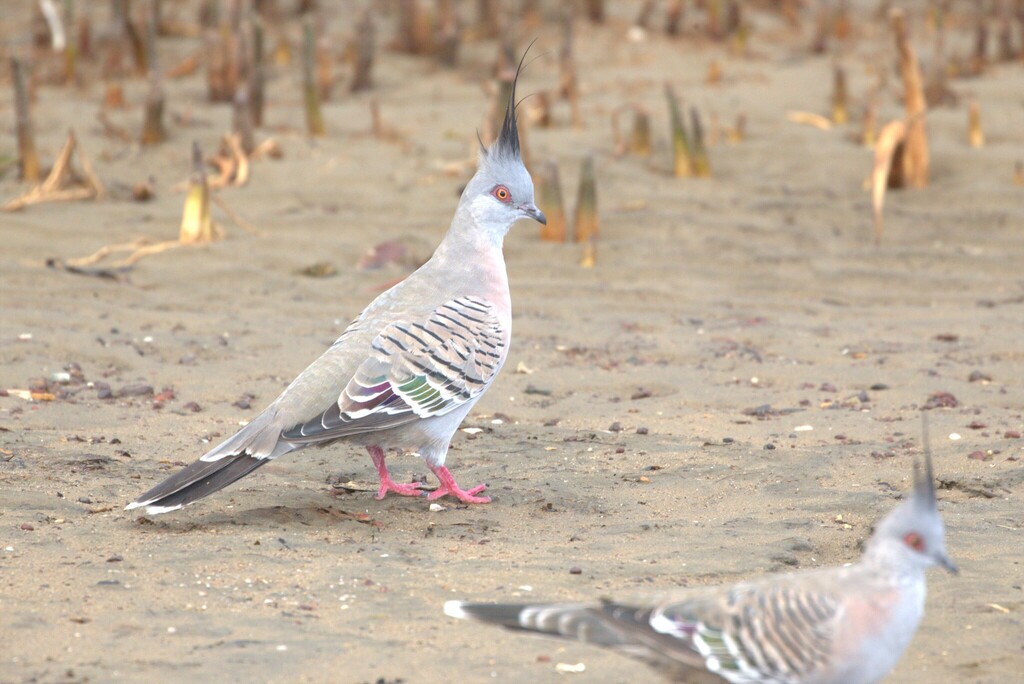
Crested Pigeon
Photo © Martin Rady
Photo © Martin Rady — CC BY 4.0 — Source: iNaturalist photo #476652067Identification
The crested pigeon is a medium-sized pigeon measuring 30 to 34 centimetres in length, distinguished by its most striking feature: a slender, feathered black spike crowning the head. The bird's plumage is predominantly grey with subtle tinges of brown, pink, and green. Its wings are bronzed with bold black stripes, and the primary feathers display iridescent patches of brown, purple, blue, and green that catch the light in flight. The periorbital skin—the bare skin around the eye—is bright orange, providing a vivid accent to the face. Immature birds are duller in overall coloration with no bronzing on the wings. Males and females are virtually indistinguishable, sharing identical plumage patterns. One of only two Australian pigeon species with an erect crest, the crested pigeon is the larger of the two, the other being the spinifex pigeon.
Range & Habitat
The crested pigeon is found widely throughout mainland Australia, absent only from the far northern tropical areas. Two subspecies are recognized: the nominate form occurs across the southern continent, while a second subspecies inhabits central and northern Western Australia. The species favours lightly wooded grasslands in both rural and urban settings, and has shown remarkable adaptability to human-modified landscapes since European settlement. Today, crested pigeons are commonly seen at watercourses, homestead gardens, pastoral areas, sports grounds, and golf courses. Their range has expanded dramatically with the creation of pastoral lands and grain farming areas, where they forage for cereals and feed on the invasive weed Echium plantagineum.
Behaviour & Diet
The crested pigeon's most distinctive behaviour is the loud whistling sound produced by its wings during takeoff. This acoustic display, generated as air rushes over a specially modified primary feather, functions as both an alarm call to other pigeons and a predator-distraction strategy, drawing attention away from grounded birds. The birds are highly gregarious, often seen in flocks of varying sizes and becoming particularly sociable in areas with human activity. When landing, they characteristically tilt their tails upwards, with flight patterns resembling those of the spotted turtle dove.
Breeding occurs year-round but peaks during warmer months. Males perform elaborate courtship displays, bobbing their bodies rhythmically while opening and closing their wings fan-like, accompanied by soft hooting synchronized with their movements. Nests are simple platforms of twigs constructed in shrubs or trees. Females typically lay two oval, white, glossy eggs that hatch after approximately three weeks, with both parents sharing incubation duties.
Best Time & Places to See It
Crested pigeons are widespread and commonly encountered throughout mainland Australia outside tropical regions. They thrive in agricultural and pastoral landscapes, making rural grain-farming areas particularly productive for sightings. Urban parks, golf courses, and gardens also host regular populations. The warmer months offer increased breeding activity and potentially more dynamic behaviour to observe. Their highly social nature means they are often seen in flocks, increasing your chances of observation in suitable habitats.
Photography Tips
The crested pigeon's bold head crest and iridescent wing feathers offer rewarding photographic subjects. Position yourself to capture the distinctive bright orange periorbital skin and the intricate black-and-bronze patterning on the wings. Photograph birds in flight when possible to showcase the iridescent primary feathers with their shimmering blues, purples, and greens. Early morning or late afternoon light will enhance the subtle metallic sheen of the plumage. Flock behaviour provides opportunities for dynamic group compositions, while perched individuals allow detailed shots of the characteristic erect crest and facial features.
Bald Rock National Park
Barrington Tops National Park
Belair National Park
Ben Boyd National Park
Blue Mountains National Park
Boodjamulla National Park
Bouddi National Park
Bribie Island National Park
Budj Bim National Park
Nothing matches these filters.
No community photos yet. Log in to add the first one.
No community observations of this species yet.