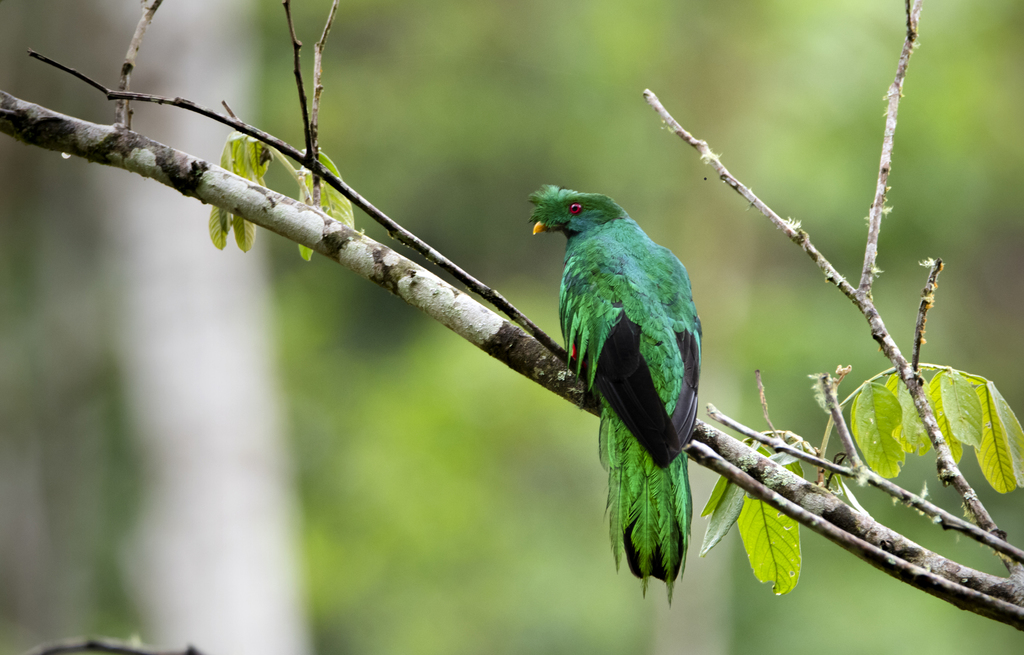
Crested Quetzal
Photo © David F. Belmonte
Photo © David F. Belmonte — CC BY 4.0 — Source: iNaturalist photo #113305432Identification
The crested quetzal is a striking mid-sized trogon measuring 33–34 cm in length. Males are unmistakable, with metallic green head and upperparts contrasting dramatically against a bright red breast and belly. The most distinctive feature is the short crest above the bill—unique among quetzal species—which gives the bird its common name. Males also display an orange bill and white vent. Females are considerably duller, with brown heads and upper breast plumage and lack the prominent crest of males, making them more challenging to identify in the field.
Range & Habitat
This South American endemic is found along the Andes mountain chain, with its range extending from Bolivia northward through Peru, Ecuador, and Colombia to Venezuela. The species is restricted to subtropical and tropical moist montane forests, typically between 1,200 and 3,000 metres in altitude. The crested quetzal favours pristine primary forest but will also occupy mature second-growth woodland, suggesting some adaptability to forest regeneration. Its large geographic range and stable population have earned it a "least concern" conservation status on the IUCN Red List.
Behaviour & Diet
The crested quetzal is primarily frugivorous, feeding on fruits throughout the year. However, diet shifts seasonally when breeding demands arise. Adults raising nestlings supplement their fruit intake with more protein-rich prey, actively hunting arthropods and small vertebrates. This dietary flexibility is essential for chick-rearing: documented prey items include even small frogs, such as the glassfrog species Hyalinobatrachium pallidum, revealing the bird's opportunistic hunting behaviour during breeding season.
Best Time & Places to See It
Travellers seeking the crested quetzal should focus on montane forest habitats along the Andean chain, particularly in areas with undisturbed primary forest between 1,200 and 3,000 metres elevation. The species' presence across multiple Andean countries—Bolivia, Colombia, Ecuador, Peru, and Venezuela—provides several geographic options for birdwatchers and nature enthusiasts. Its stable population and preference for intact forests suggest that protected montane reserves throughout this range offer the best opportunities for encounters.
Photography Tips
The male crested quetzal's brilliant metallic green and red plumage presents excellent photographic opportunities, particularly when the bird is perched in good light where its iridescent upperparts can be properly captured. The distinctive crest and orange bill are key identifying features worth documenting clearly. The bird's montane forest habitat often presents dense vegetation and challenging lighting conditions typical of cloud forest environments, so photographers should prepare for lower light situations and bring appropriate equipment for working in shaded understory settings. Female birds, though less colourful, offer valuable documentation of sexual dimorphism within the species.
Sumaco Napo-Galeras National Park
Loreto, Ecuador
+563 birds+4 mammals
Where Ecuador's Amazon transitions into cloud forest, a massive shield volcano rises from the emerald lowlands of Orellana Province, anchoring one of the continent's most biodiverse…
VIEW NATIONAL PARKAntisana National Park
Quijos, Ecuador
+432 birds+21 mammals
Where the eastern Andean slopes descend into the Amazon basin, Antisana National Park sprawls across roughly 2,500 square kilometers of some of South America's most dramatic…
VIEW NATIONAL PARKNatural Serranía de los Yariguíes National Park
El Carmen de Chucurí, Colombia
+320 birds+3 mammals
Where the northern cordilleras of Colombia rise toward cloud forest, the Serranía de los Yariguíes unfolds across nearly 1,820 square kilometers of some of the most…
VIEW NATIONAL PARKNatural Farallones de Cali National Park
Buenaventura, Colombia
+733 birds+27 mammals
Where the Pacific coastal plain meets the western slopes of the Andes, Farallones de Cali National Park sprawls across nearly 3,500 square kilometers of dramatic topography…
VIEW NATIONAL PARKGuácharos Cave National Natural Park
Acevedo, Colombia
+359 birds
High in the Andean foothills of southern Huila, where mist-laden slopes rise above 1,600 metres, lies a landscape carved by underground rivers and crowned by karst…
VIEW NATIONAL PARKYanachaga–chemillén National Park
Palcazu, Peru
+639 birds+6 mammals
Where the eastern slopes of Peru's central cordillera plunge into cloud forest, Yanachaga–Chemillén National Park protects nearly three thousand square kilometres of montane wilderness that few…
VIEW NATIONAL PARKManu National Park
Manu, Peru
+892 birds+26 mammals
Across the eastern slopes of the Peruvian Andes, tropical rainforest descends into the Amazon basin with a complexity that few terrestrial ecosystems match. Manu National Park…
VIEW NATIONAL PARKNo community photos yet. Log in to add the first one.
No community observations of this species yet.