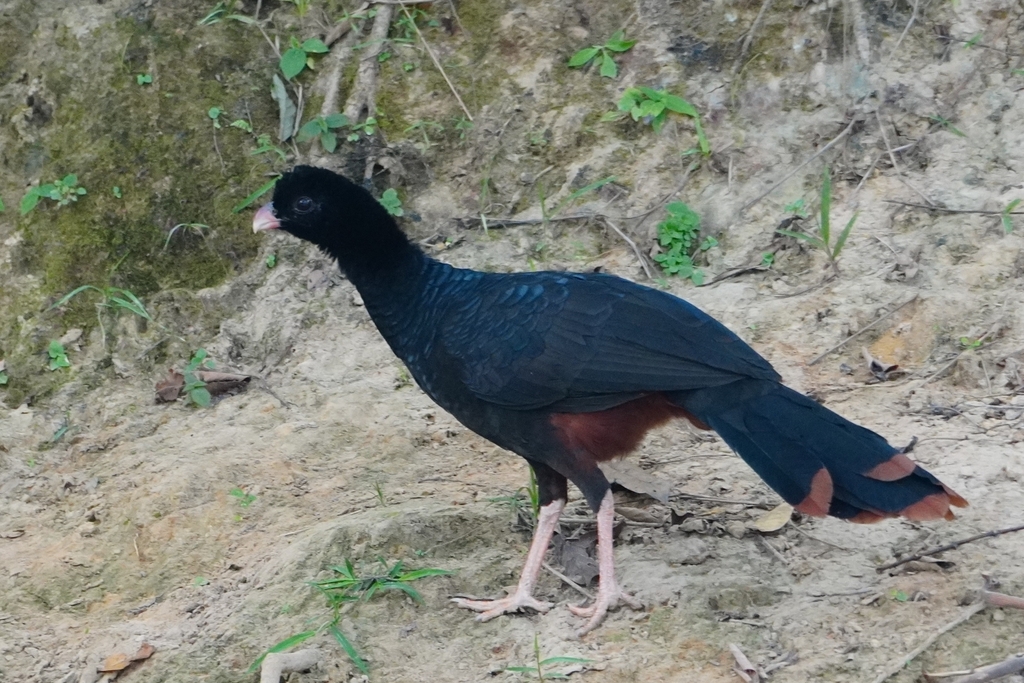
Crestless Curassow
Photo © Ben Costamagna
Photo © Ben Costamagna — CC BY 4.0 — Source: iNaturalist photo #464800505Identification
The crestless curassow is a large, distinctive game bird measuring 75 to 85 centimeters in length. Males are noticeably heavier than females, weighing 2,300 to 3,050 grams compared to females at 1,300 to 2,425 grams. The bird is predominantly black with a striking dark blue to purplish gloss across its plumage. Its most distinctive field marks are its rich chestnut belly and chestnut-tipped tail, which contrast sharply with the dark upperparts. Unlike most other curassow species, the crestless curassow lacks a prominent head crest and has no swelling on its red bill—characteristics that make it relatively easy to distinguish from its relatives within the Mitu genus.
Range & habitat
This species is found in northwestern South America, with a range spanning eastern Colombia, southern Venezuela, northwestern Brazil, and southwestern Guyana. It is primarily a lowland bird, occurring up to 500 meters elevation in Colombia and 600 meters in Venezuela. The crestless curassow shows a strong preference for rainforest habitats, particularly along riverine corridors where it can find the dense undergrowth it favors. It also inhabits gallery forests within the llanos grasslands of Colombia and Venezuela, demonstrating some habitat flexibility while maintaining its preference for areas with thick ground-level vegetation.
Behaviour & diet
The crestless curassow is primarily a ground forager, usually seen singly or in pairs, though groups of up to ten have been recorded very rarely. Its diet consists almost entirely of fallen fruits, which it searches for on the forest floor. The species produces a distinctive vocalization described as "a low humming or booming 'uuut ... uu-UU-uu-uhoot'", which is performed throughout the year but becomes more frequent during breeding season. When alarmed, it utters a "series of sharp, reedy whistles, 'queet'". Breeding appears to be timed with the rainy season, and the bird nests low in trees, typically laying two eggs per clutch.
Best time & places to see it
The breeding season, which coincides with local rainy seasons, offers the best opportunity to encounter this species, as vocalizations become more frequent then. Riverine rainforest habitats in the bird's range—particularly in northwestern Brazil, southern Venezuela, and eastern Colombia—are the most productive areas to search. Dense undergrowth in lowland forests should be thoroughly scanned, as this is where the crestless curassow spends most of its time foraging for fallen fruits. Early morning hours are typically most productive for observing curassows.
Photography tips
The crestless curassow's mostly dark plumage and preference for dense undergrowth can make photography challenging. The bird's contrasting chestnut belly and tail tip should be prioritized as key identification features to capture. Ground-level or low-angle perspectives will help convey the bird's ground-feeding behavior. Early morning light filtering through the forest canopy can help illuminate the subtle blue-purple gloss of the plumage. Patience and stillness are essential, as the bird's wariness and tendency to forage quietly on the forest floor demand careful approach and positioning.
Natural Sierra de Chiribiquete National Park
Solano, Colombia
+359 birds+27 mammals
Massive table-top mountains rise abruptly from the lowland rainforest of southeastern Colombia, their sheer sandstone cliffs and isolated summits creating some of the most dramatic topography…
VIEW NATIONAL PARKNatural Sierra de la Macarena National Park
Vista Hermosa, Colombia
+566 birds+15 mammals
Across nearly 20,000 square kilometres of Colombia's Meta Department, the terrain rises from lowland savanna into Andean foothills through a mosaic of gallery forests, palm-fringed wetlands,…
VIEW NATIONAL PARKViruá National Park
Brazil
+389 birds+6 mammals
Across the northern frontier of Roraima, where the forest canopy rises from ancient Amazonian lowlands, Viruá National Park protects nearly 3,700 square kilometres of terra firme…
VIEW NATIONAL PARKJaú National Park
Brazil
+354 birds+3 mammals
Vast floodplain forests and blackwater rivers define this remote corner of western Amazonas, where the Rio Negro and its tributaries have carved an intricate mosaic of…
VIEW NATIONAL PARKAnavilhanas National Park
Brazil
+468 birds+8 mammals
Across the Rio Negro in central Amazonas, an archipelago of over a thousand islands rises from the world's largest rainforest river system, creating a labyrinth of…
VIEW NATIONAL PARKNo community photos yet. Log in to add the first one.
No community observations of this species yet.