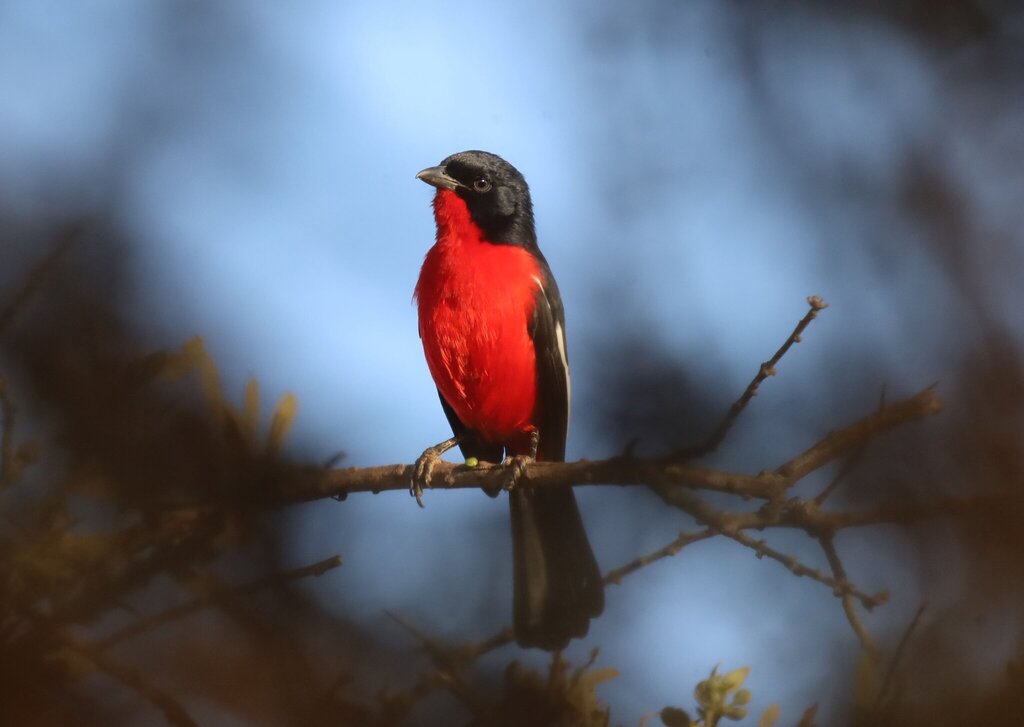
Crimson-breasted Shrike
Photo © Paul Hoekman
Photo © Paul Hoekman — CC BY 4.0 — Source: iNaturalist photo #555492515Identification
The crimson-breasted shrike is one of southern Africa's most striking birds, instantly recognizable by its bold colour contrast. Adults display black upper parts across the wings, tail, and back, interrupted by a broad white flash on the wing that provides useful field identification. The underparts are a vivid, brilliant scarlet—a colour combination so remarkable that early European settlers in South West Africa named it the Reichsvogel, or "Empire bird," after their homeland flag. The sexes are indistinguishable in plumage. An uncommon yellow-breasted form occasionally occurs in the wild and was historically mistaken for a separate species. Young birds are considerably duller, showing mottled and barred buff-brown plumage with a pale bill, making them challenging to identify in the field.
Range & Habitat
This non-migratory species occupies a broad swathe across southern Africa, from southern Angola southward to the Free State province and Northern Cape in South Africa. The crimson-breasted shrike favours drier thornbush areas, particularly thickets and riparian scrub where acacia and other thorny vegetation provides cover and foraging opportunities. Although the species is primarily resident, it makes small seasonal migrations in response to temperature changes, preferring lower altitudes during cold periods. This habitat preference means that observers should search along watercourse margins and in scattered bushveld regions rather than dense forests or open grasslands.
Behaviour & Diet
The crimson-breasted shrike is extremely nimble and restless, constantly moving through vegetation as it hunts. Its presence is often first detected not by sight but by sound—penetrating whistles that carry well across thornbush habitats. Despite being vocal and active, it is not a shy species and may be observed relatively closely by patient observers. Like other members of the genus Laniarius, this shrike has "butcher-like habits," reflecting the generic name that alludes to the group's predatory behaviour, though detailed dietary information is not extensively documented.
Best Time & Places to See It
The crimson-breasted shrike's preference for lower altitudes during colder months suggests that late autumn and winter may offer better viewing opportunities at lower elevations within its range. The bird's restless, active nature and loud vocalizations mean that listening carefully while moving slowly through thornbush habitat and riparian scrub significantly improves detection rates. Its broad distribution across southern Africa from Angola to South Africa means it is relatively accessible within suitable habitat throughout its range.
Photography Tips
The crimson-breasted shrike's vivid scarlet underparts and contrasting black upperparts make it highly photogenic, though the bird's restless and nimble nature demands patience and quick reflexes. The broad white wing bar provides an excellent focusing point and field marker. Early morning light will best render the brilliant scarlet colouration, while back-lit or side-lit shots can enhance the contrast between dark and bright plumage. Since the bird favours thornbush and riparian scrub, position yourself with clear sight lines through vegetation, and use the bird's own vocalizations to pinpoint its location before attempting to frame shots.
Mapungubwe National Park
Musina Local Municipality, South Africa
+358 birds+29 mammals
Where the Limpopo River cuts through sandstone ridges at the convergence of South Africa, Botswana, and Zimbabwe, Mapungubwe National Park preserves a landscape of profound ecological…
VIEW NATIONAL PARKChobe National Park
Botswana
+446 birds+45 mammals
Where the Chobe River cuts a sinuous path through northern Botswana, the landscape transforms into one of Africa's most dynamic wetland-savanna mosaics. This national park encompasses…
VIEW NATIONAL PARKNxai Pan National Park
Botswana
+226 birds+16 mammals
Across the northwestern reaches of Botswana stretches a landscape of profound seasonal transformation—a sprawling pan system where shallow depressions fill and empty with the rains, creating…
VIEW NATIONAL PARKKhaudum National Park
Botswana
+213 birds+13 mammals
Where the Okavango's northern tributaries meander through miombo woodland and riverine forest, Khaudum National Park unfolds across a landscape of profound ecological richness and isolation. This…
VIEW NATIONAL PARKPilanesberg National Park
Moses Kotane Local Municipality, South Africa
+364 birds+49 mammals
Granite peaks and volcanic ridges rise unexpectedly from the savanna floor across this 734-square-kilometre expanse in the North West province, creating a landscape of profound ecological…
VIEW NATIONAL PARKMokala National Park
Siyancuma Local Municipality, South Africa
+246 birds+35 mammals
Across the semi-arid savanna of the Northern Cape, where red earth meets sparse acacia woodland and open grassland punctuated by rocky outcrops, lies a landscape shaped…
VIEW NATIONAL PARKKruger National Park
Ba-Phalaborwa Local Municipality, South Africa
+540 birds+91 mammals
Across the low-lying savanna of northeastern South Africa unfolds one of Africa's largest and most ecologically intact protected areas, where acacia woodlands merge into mopane scrub…
VIEW NATIONAL PARKMarakele National Park
Modimolle Local Municipality, South Africa
+341 birds+36 mammals
Granite ridges and sprawling grasslands dominate this 1,176-square-kilometre reserve in Limpopo's heartland, where bushveld transitions between rocky outcrops and open savanna. The park's rugged topography creates…
VIEW NATIONAL PARKKhaudum National Park
Namibia
+221 birds+13 mammals
Where the Kavango River flows through northeastern Namibia, vast miombo woodlands and riverine forests create one of southern Africa's most remote and biodiverse wilderness corridors. Khaudum…
VIEW NATIONAL PARKNamib-Naukluft National Park
Namibia
+217 birds+33 mammals
Across nearly 94,000 square kilometers of southwestern Namibia, a landscape of extremes unfolds where towering sand dunes meet rugged mountain ranges, and ancient riverbeds carve through…
VIEW NATIONAL PARKNkasa Rupara National Park
Namibia
+283 birds+17 mammals
Where the Zambezi's floodplains spill across the border between Namibia and Botswana, Nkasa Rupara National Park unfolds across 518 square kilometers of wetland and woodland mosaic.…
VIEW NATIONAL PARKBwabwata National Park
Namibia
+377 birds+35 mammals
Where the Kavango River winds through northeastern Namibia, vast floodplains and dense riparian woodland create one of southern Africa's most ecologically dynamic protected landscapes. Spanning 14,249…
VIEW NATIONAL PARKEtosha National Park
Namibia
+356 birds+58 mammals
Across northern Namibia's stark semi-arid plateau, a vast shallow depression transforms seasonally into one of Africa's most dramatic wildlife theaters. Etosha National Park, encompassing more than…
VIEW NATIONAL PARKNamibRand Nature Reserve
Hammerstein, Namibia
+107 birds+12 mammals
Where rust-coloured dunes surrender to sculpted granite outcrops and vast plains stretch toward an endless horizon, one of southern Africa's most pristine wilderness areas unfolds. The…
VIEW NATURE RESERVEWaterberg Plateau National Park
Okambukonde, Namibia
+198 birds+27 mammals
Where ancient sandstone cliffs rise 200 metres above the surrounding bushveld, a fortress of geology creates one of southern Africa's most compelling ecosystems. The plateau's steep…
VIEW NATIONAL PARKMakgadikgadi Pans National Park
Gucta, Botswana
+272 birds+27 mammals
Where salt-crusted flatlands stretch endlessly toward a shimmering horizon, one of Africa's most extraordinary ecosystems awakens with the rains. The Makgadikgadi Pans comprise vast mineral-rich basins…
VIEW NATIONAL PARKNo community photos yet. Log in to add the first one.
No community observations of this species yet.