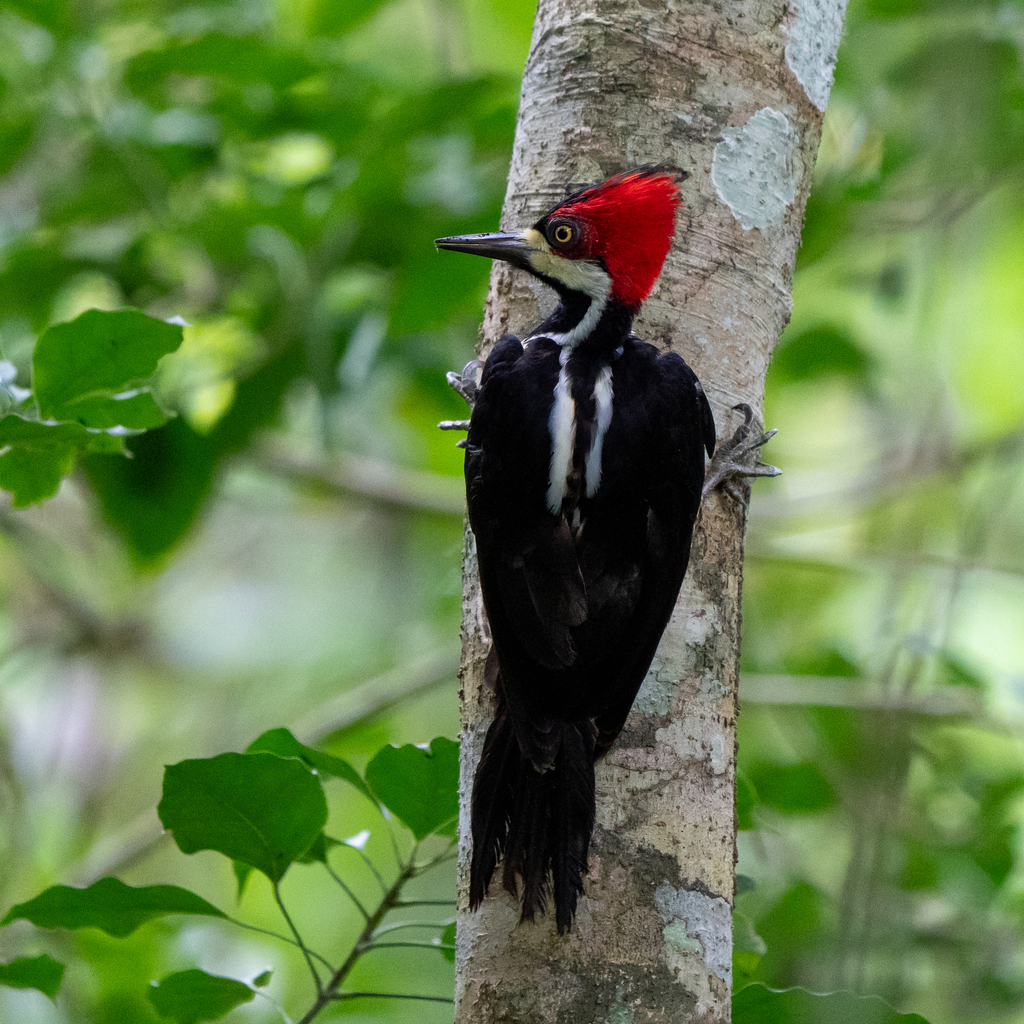
Crimson-crested Woodpecker
Photo © Anthony Batista
Photo © Anthony Batista — CC BY 4.0 — Source: iNaturalist #291108533Identification
The Crimson-crested Woodpecker is among the largest woodpeckers in South America, measuring 33–36 cm long and weighing 225–281 g. Both sexes display striking black upperparts with distinctive white vertical stripes on the sides of the neck that extend onto the back, forming a characteristic "V" pattern. The lower breast and belly are pale cinnamon-buff with bold black barring, while undertail coverts are pale yellow to yellowish-white. The bill is a long ivory chisel, and the iris ranges from white to yellow.
Sexual dimorphism is evident in head plumage: adult males sport a mostly red head with a white to pale yellow patch at the bill's base, while females are black around the eye and crest with a distinctive white stripe edged in black running from the bill through the ear coverts. Subspecies C. m. malherbii shows a gray rather than ivory bill and more extensive cinnamon-buff underparts, while C. m. cearae is slightly smaller with a proportionally shorter tail.
Range & Habitat
This species is found across a vast range including Panama, Trinidad, Colombia, Venezuela, the Guianas, eastern Ecuador, Peru, northern Bolivia, northern Paraguay, Amazonian Brazil, and northeastern Argentina's Misiones Province. The nominate subspecies occupies the most extensive distribution, while subspecies malherbii inhabits Panama and northern Colombia, and cearae is restricted to northeastern Brazil.
The Crimson-crested Woodpecker favors large tracts of humid lowland forest, including terra firme, riverine forest, and mature secondary growth. It adapts to somewhat more open areas such as plantations provided that tall trees remain available, demonstrating considerable habitat flexibility across forested landscapes.
Behaviour & Diet
This woodpecker forages at all forest levels, with a preference for mid-story heights. It employs a combination of pecking, probing, digging, and bark-scaling to access prey. Its diet consists primarily of insects—beetles, butterflies, moths, ants (both adult and larval), and termites—supplemented by small berries and seeds. Notably, it often feeds on smaller branches than other similar-sized woodpeckers, and pairs typically forage together, sometimes separated by several meters.
Breeding occurs from November–January in Panama, February–April in Suriname, and includes April in Trinidad and February in Colombia. Both sexes excavate nest cavities in large-diameter trees, drumming and calling to one another during this period. Known clutches contain two eggs, with both parents sharing incubation and provisioning duties. The species is not highly vocal but produces a variety of calls, including a characteristic hollow popping series during breeding season and a distinctive drum described as "DA-drrr."
Best Time & Places to See It
Target the breeding season in your desired region: November–January in Panama, February–April in Suriname and Colombia, and April in Trinidad. The species is most conspicuous when pairs engage in territorial drumming and calling. Look for them in humid lowland forests with large emergent trees, particularly in terra firme and riverine forest habitats where the canopy remains intact.
The vast Amazonian range across Brazil, Peru, Ecuador, and the Guianas offers extensive opportunities for observation. River valleys and forest reserves that retain mature secondary growth provide excellent vantage points. Early morning hours are typically most productive for locating these large, active woodpeckers.
Photography Tips
The Crimson-crested Woodpecker's large size and bold plumage pattern make it relatively approachable for photography. The contrasting red-and-black head of males and the white facial stripe of females provide striking subjects. Position yourself in mid-story observation points to capture birds as they forage on medium-sized branches, where they often work more deliberately than other large woodpeckers.
Listen for drumming and calls to locate individuals, then move slowly and quietly to secure sightlines. Early morning and late afternoon light will best showcase the red and white head markings. In flight, the heavy wing sound signals opportunity—watch for the characteristic silhouette and dark brown-black wings to anticipate good photographic moments.
Amacayacu National Park
Amazônia National Park
Anavilhanas National Park
Bahuaja Sonene National Park
Brasília National Park
Campos Amazónicos National Park
Cantão State Park
Carlos Botelho State Park
Chagres National Park
Nothing matches these filters.
No community photos yet. Log in to add the first one.
No community observations of this species yet.