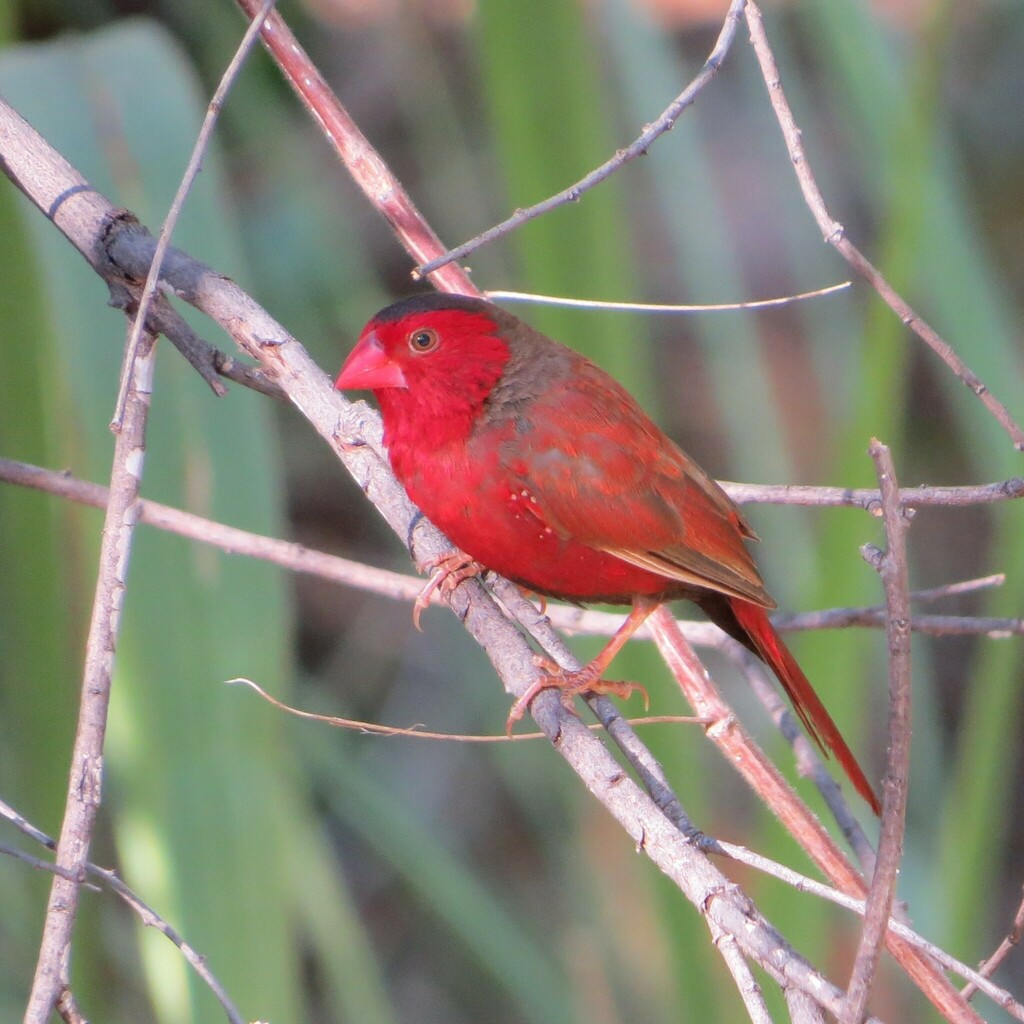
Crimson Finch
Photo © pimelea
Photo © pimelea — CC BY 4.0 — Source: iNaturalist #208214576Identification
The Crimson Finch is a small passerine, measuring just 13 cm in length and weighing a mere 13 grams. Its most striking feature is its brilliantly bright crimson plumage, which earned it alternative nicknames such as "blood finch" and "killer finch"—names reflecting both its vibrant coloring and notorious aggressive temperament. White specks speckle the sides of the body, while grey shading appears around the neck area, creating subtle contrast against the dominant red coat.
Sexual dimorphism is evident in this species, though both males and females share similar plumage patterns. Males are noticeably larger and heavier than females, with longer tails and bills. The Crimson Finch bears a close resemblance to the firefinches of the genus Lagonosticta, sharing their characteristic red head and bright crimson coat. Two subspecies are recognized: the black-bellied Crimson Finch (Neochmia p. phaeton) and the white-bellied Crimson Finch (Neochmia p. evangelinae).
Range & Habitat
Crimson Finches are distributed throughout Northern Australia, with populations also present in parts of southern New Guinea. Within Australia, they are particularly common in the Kimberley region of the northwest, though they are less widespread in the northeastern Queensland area. These birds show a strong preference for areas characterized by tall, dense grasses, especially in proximity to wetlands and riparian vegetation dominated by Pandanus trees.
For nesting, Crimson Finches exhibit a remarkable behavior: they establish their nests in close proximity to other birds' nests while remaining non-territorial. They utilize shrubs and dry brush to construct nests at the base of Pandanus trees, as well as within hollow tree limbs. This gregarious nesting pattern, with approximately 4 to 5 breeding pairs per 100 meters, centers around riparian vegetation and river systems.
Behaviour & Diet
The Crimson Finch has earned a reputation for aggressive behavior that is remarkable among small passerines. Males display aggression toward both same-species and different-species birds, with no apparent consideration for the age, coloration, or body size of their opponents. Females similarly exhibit aggressive defense of nests when serving as primary nest defenders, though their overall aggression patterns remain less well-studied.
Crimson Finches are primarily monogamous breeders with notably large clutch sizes compared to other southern passerines—an adaptation likely linked to high reptilian nest predation rates. These birds sustain themselves chiefly on grass seeds, including Xerochloa imberbis (rice grass), supplemented by insects. They demonstrate impressive survival rates ranging from 70 to 96 percent, with documented lifespans extending to 5 years and beyond.
Best Time & Places to See It
Northern Australia provides the most accessible opportunities to observe Crimson Finches in their natural habitat. The Kimberley region of Western Australia offers the highest probability of encounters, while Queensland's northeast holds smaller populations. Search for these birds in wetland areas with tall, dense grasses and prominent Pandanus trees, particularly near riparian zones and river systems where their preferred vegetation concentrates.
The gregarious nesting behavior of Crimson Finches means that locating one breeding site may yield views of multiple pairs in close proximity. Focus your efforts on riparian vegetation during breeding season, when birds are actively defending nests and establishing breeding territories.
Photography Tips
The brilliant crimson plumage of this species provides excellent photographic potential, particularly in strong natural light that accentuates the vibrant red coloration. However, approach carefully and maintain respectful distances, as Crimson Finches are known for their aggressive temperament and may become defensive if threatened. Photograph during early morning or late afternoon when light is warm and directional, enhancing the richness of the crimson tones.
Given the birds' preference for tall, dense grasses and riparian vegetation, positioning yourself with clear sightlines to water sources and feeding areas will improve your chances of capturing clean, unobstructed images. The distinctive white specks along the body sides and grey neck markings are worthwhile details to capture, providing context for identification and demonstrating the species' subtle plumage complexity.
Kakadu National Park
Kakadu, Australia
+273 birds+46 mammals
Kakadu National Park is Australia’s largest national park and one of the world’s most remarkable protected areas, covering nearly 20,000 square kilometres in the tropical north…
VIEW NATIONAL PARKDaintree National Park
Dedin, Australia
+362 birds+37 mammals
Daintree National Park is one of the world’s oldest and most biologically diverse tropical rainforests, protecting an extraordinary landscape where ancient forests meet the Great Barrier…
VIEW NATIONAL PARKRinyirru National Park
Lakefield, Australia
+258 birds+7 mammals
Where the savanna grasslands of far north Queensland meet seasonal wetlands and eucalypt woodlands, Rinyirru National Park sprawls across more than 12,500 square kilometres of rugged,…
VIEW NATIONAL PARKLitchfield National Park
Australia
+175 birds+15 mammals
Where weathered sandstone plateaus rise above the savanna woodlands of Australia's Top End, Litchfield National Park unfolds as a landscape of dramatic contrasts shaped by a…
VIEW NATIONAL PARKNitmiluk National Park
Australia
+186 birds+27 mammals
Dramatic sandstone gorges carved by the Katherine River slice through the tropical savanna of Australia's Top End, creating a landscape where escarpments tower above crystalline pools…
VIEW NATIONAL PARKGirringun National Park
Australia
+231 birds+10 mammals
Where granite gorges cleave through subtropical woodland in North Queensland, Girringun National Park unfolds across rugged terrain shaped by millions of years of weathering and erosion.…
VIEW NATIONAL PARKWooroonooran National Park
Australia
+240 birds+28 mammals
Where the Great Dividing Range rises sharply inland from Queensland's tropical coast, Wooroonooran National Park encompasses a landscape of steep, forested gorges and cascading waterways carved…
VIEW NATIONAL PARKBoodjamulla National Park
Australia
+142 birds+3 mammals
Where red sandstone gorges carve through the semi-arid interior of far north Queensland, Boodjamulla National Park reveals a landscape shaped by seasonal water availability and ancient…
VIEW NATIONAL PARKPurnululu National Park
Australia
+114 birds
Towering sandstone domes and dramatic gorges carved by seasonal watercourses define this remote corner of the Kimberley, where ancient rock formations create a maze of narrow…
VIEW NATIONAL PARKNo community photos yet. Log in to add the first one.
No community observations of this species yet.