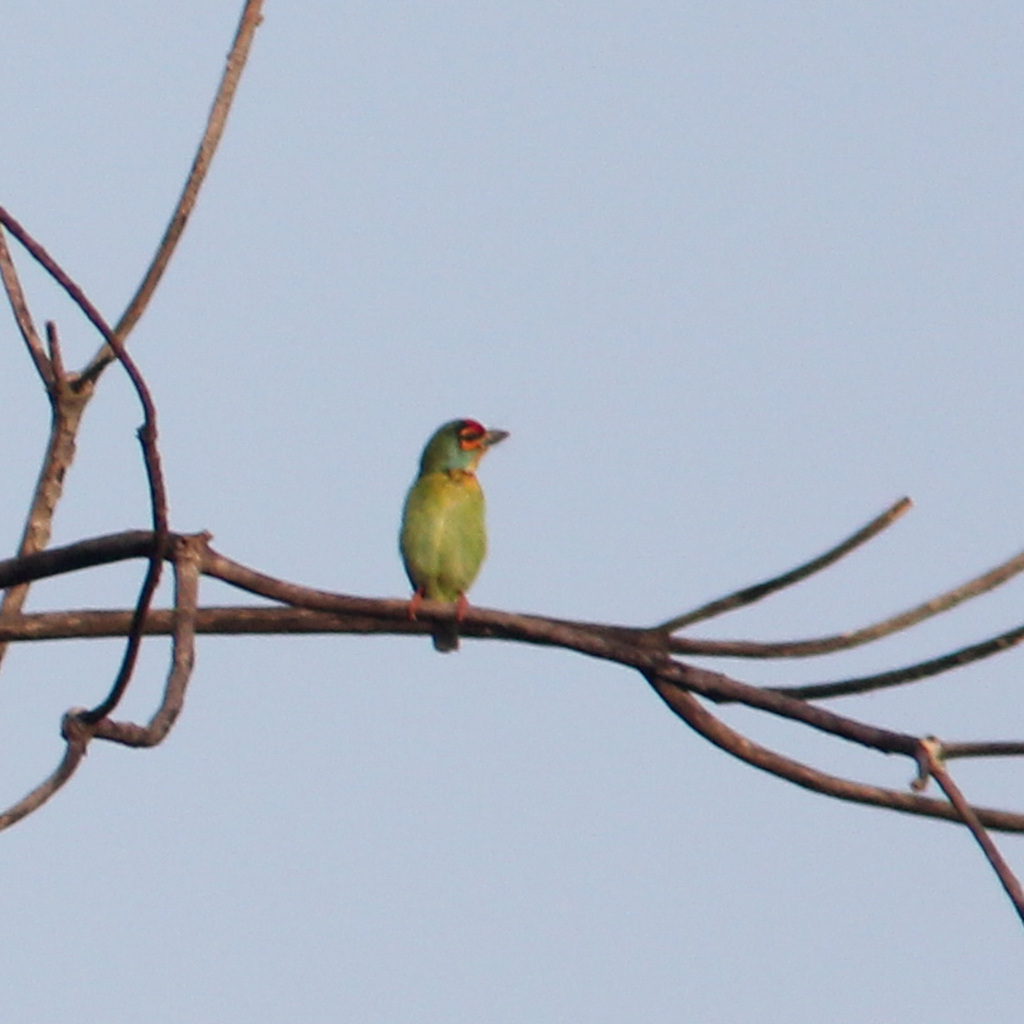
Crimson-fronted Barbet
Photo © Tero Linjama
Photo © Tero Linjama — CC0 1.0 — Source: iNaturalist #250263574Identification
The Crimson-fronted Barbet is a compact bird measuring 15 cm in length, easily recognized by its distinctive plumage pattern. Its predominantly green body and wings provide excellent camouflage in forest canopies, but several striking facial markings make identification straightforward. A vivid crimson crown gives the species its name, while a bright blue band runs down the side of the head and neck. A black crescent marks the area behind the eye, creating a bold facial pattern. The bird has the characteristic barbet proportions: a short neck, oversized head, and abbreviated tail.
Range & Habitat
The Crimson-fronted Barbet is endemic to Sri Lanka, occurring nowhere else in the world. This makes the island nation a priority destination for birders seeking this exclusive species. The bird inhabits tropical moist lowland forests, with its range extending from sea level up to 1,300 metres elevation. This habitat preference means that lowland forest reserves across the country offer the best opportunities for encountering this striking endemic.
Behaviour & Diet
Like other barbets, this species is primarily frugivorous, foraging actively for fruit among the canopy and mid-storey vegetation, though it also supplements its diet with insects. It is a cavity nester, excavating or utilizing tree holes for breeding. The species lays clutches of 2–4 eggs per breeding cycle. These habits tie the Crimson-fronted Barbet closely to mature forests with adequate dead wood and fruiting trees, making habitat quality crucial for population health.
Best Time & Places to See It
Sri Lanka's tropical climate means the Crimson-fronted Barbet can be encountered year-round, though seasonal fruit availability may influence local movements. Birders and nature travellers should focus on protected lowland forest reserves and national parks across the island. Early morning visits tend to be most productive, as the birds are more vocal and active at dawn. Listening for their calls while scanning the upper and middle canopy layers is often more effective than silent observation, given the birds' preference for the forest interior.
Photography Tips
Photographing the Crimson-fronted Barbet presents both challenges and rewards. The species' predominantly green plumage demands patience and good lighting conditions to render colours accurately; overhead sun can wash out the subtle hues. The bird's preference for dense canopy and mid-storey foliage means that dappled light is often unavoidable—a fast lens and higher ISO may be necessary. Focus on capturing the striking facial pattern: the crimson crown, blue head stripe, and black eye-crescent are the key field marks that will make your images identifiable and compelling. Early morning light filtering through the forest canopy offers the most flattering conditions for this endemic species.
Lunugamvehera National Park
Sri Lanka
+204 birds+14 mammals
Dry scrubland and shallow wetlands converge in Sri Lanka's southeastern lowlands, where Lunugamvehera National Park anchors one of the island's most ecologically vital landscapes. The park's…
VIEW NATIONAL PARKMinneriya National Park
Sri Lanka
+158 birds+9 mammals
Across the dry zone of Sri Lanka's North Central Province spreads a landscape of shallow tanks, grassland margins, and scattered dry forest—a mosaic of water and…
VIEW NATIONAL PARKWasgamuwa National Park
Sri Lanka
+156 birds+8 mammals
Dry deciduous forest and open grassland sweep across the North Central lowlands where Wasgamuwa National Park protects one of Sri Lanka's largest remaining tracts of this…
VIEW NATIONAL PARKAngamedilla National Park
Polonnaruwa, Sri Lanka
+40 birds+2 mammals
Ancient tanks and sal forests define this water-rich sanctuary in Sri Lanka's North Central heartland, where seasonal wetlands and dry deciduous woodland create a mosaic of…
VIEW NATIONAL PARKMaduru Oya National Park
Sri Lanka
+74 birds+1 mammals
Granite ridges rise abruptly from the humid lowlands of Sri Lanka's Uva Province, their weathered slopes clothed in dry monsoon forest and scattered woodland where deciduous…
VIEW NATIONAL PARKNo community photos yet. Log in to add the first one.
No community observations of this species yet.