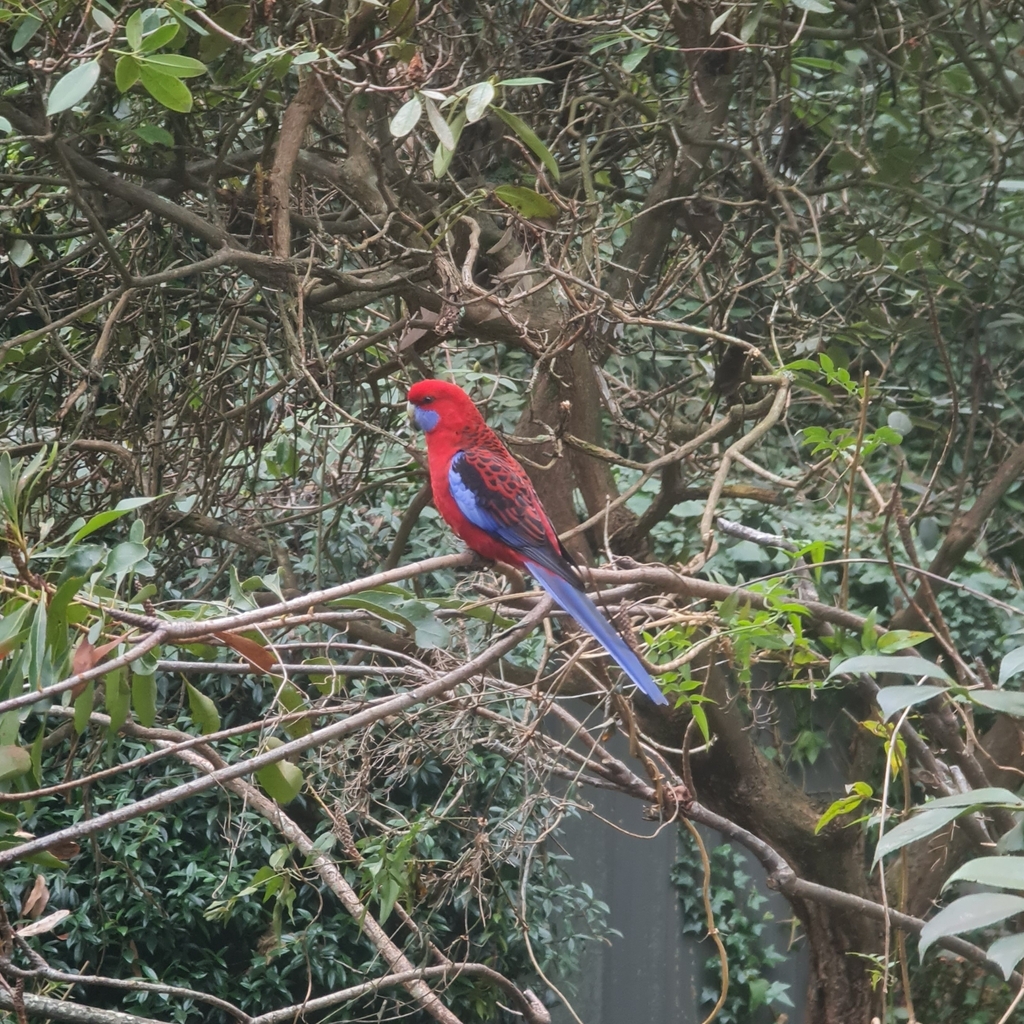
Crimson Rosella
Photo © Musa Fletcher
Photo © Musa Fletcher — CC BY 4.0 — Source: iNaturalist #230697139Identification
The Crimson Rosella is a striking medium-sized parrot, measuring 36 cm (14 in) in length with much of that comprising the tail. The most distinctive features are its brilliant crimson plumage on the body, striking blue cheeks, and predominantly blue tail with red coloration. All races possess black-scalloped blue-margined wings and a pale grey bill with dark brown iris. A particularly notable feature is that juveniles display predominantly greenish-olive plumage, which gradually transforms to red as they mature—a process locals call 'ripening'. The blue tail feathers are so prized that they are among the favourite decorations of satin bowerbirds.
Sexual dimorphism is minimal, though males are noticeably larger, reaching up to 15% bigger than females, with a relatively larger and wider beak. The species includes three red-coloured subspecies as well as the yellow rosella (with light yellow replacing crimson areas) and the Adelaide rosella, which displays a spectrum from dark orange-red to pale orange-yellow depending on location. The Adelaide rosella is believed to be a hybrid swarm resulting from interbreeding between the crimson and yellow forms.
Range & Habitat
The Crimson Rosella is native to eastern and southeastern Australia, with populations ranging from southeastern South Australia through Tasmania and Victoria into eastern New South Wales and northeastern Queensland. The species has also been introduced to New Zealand and Norfolk Island, where it is simply called the red parrot. Three subspecies comprise the red-coloured birds: the nominate race across Victoria and eastern New South Wales, P. e. nigrescens on Queensland's northeastern coast, and P. e. melanoptera on Kangaroo Island, which vary subtly in size and darkness of plumage.
These parrots are commonly found in mountain forests and gardens, though they are not restricted to such habitats. The yellow rosella subspecies inhabits areas along the Murray River and its tributaries, while the Adelaide rosella occupies Adelaide and surrounding regions. Where the ranges of different forms overlap, interbreeding occurs, demonstrating the species' adaptability across diverse environments.
Behaviour & Diet
The source material provided does not contain specific information about the Crimson Rosella's behaviour and diet. To learn about feeding habits, social structure, vocalisation, and other behavioural characteristics, readers are encouraged to consult additional ornithological references.
Best Time & Places to See It
The source material provided does not contain specific information about seasonal patterns or optimal viewing times for the Crimson Rosella. However, given the species' preference for mountain forests and gardens across its extensive range in southeastern Australia, opportunities for observation exist throughout the year across Victoria, New South Wales, Queensland, South Australia, and Tasmania. The introduced populations on Norfolk Island and New Zealand may also offer viewing opportunities for travellers visiting those regions.
Photography Tips
The Crimson Rosella's vivid colouration makes it a rewarding photographic subject. The brilliant crimson body plumage, electric blue cheeks, and predominantly blue tail with red accents provide striking colour contrasts that photograph well in natural light. The species' size and visibility in gardens and mountain forest habitats make it more accessible than many parrot species. Photographing juveniles offers the additional challenge and interest of capturing the distinctive greenish-olive immature plumage before their transformation to adult red colouration.
Alpine National Park
Bald Rock National Park
Barrington Tops National Park
Belair National Park
Ben Boyd National Park
Blue Mountains National Park
Bouddi National Park
Bribie Island National Park
Budawang National Park
Nothing matches these filters.
No community photos yet. Log in to add the first one.
No community observations of this species yet.