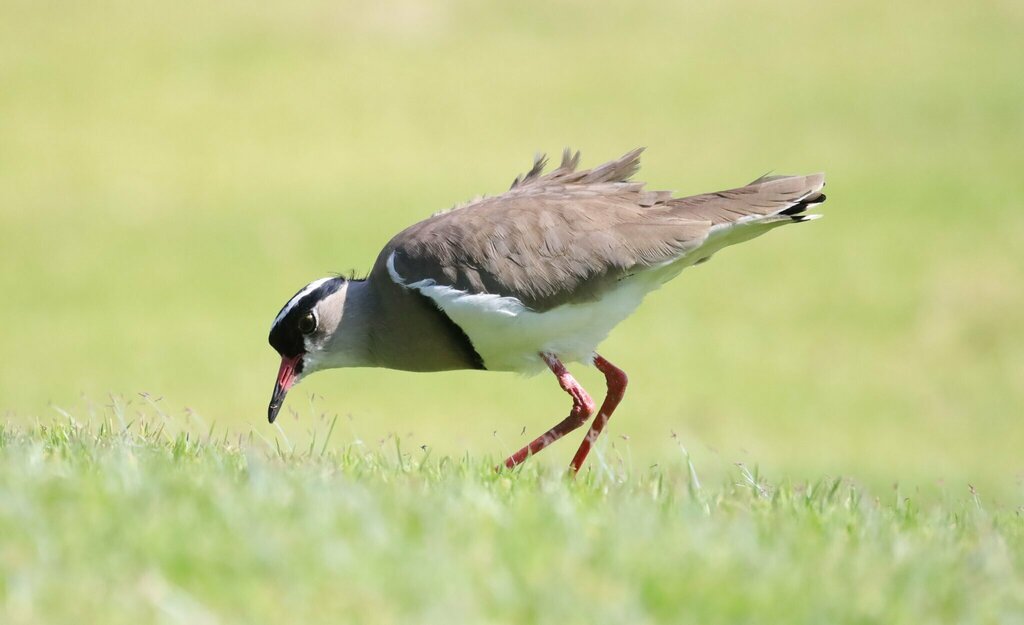
Crowned Lapwing
Photo © Paul Hoekman
Photo © Paul Hoekman — CC BY 4.0 — Source: iNaturalist photo #284099485Identification
The crowned lapwing is easily recognized by its striking and distinctive plumage. The bird's most characteristic feature is a black crown intersected by an annular white halo, combined with brown and white coloration throughout the body. Adults are noisy and conspicuous birds, making them relatively straightforward to identify in the field. Males are on average 3% larger than females. Juveniles are duller versions of adults, with vermiculated (finely barred) wings and mantle, yellowy rather than red legs, and a bill lacking the red base seen in adults.
Range & Habitat
The crowned lapwing occurs contiguously from the Red Sea coast of Somalia through to southern and southwestern Africa, with three recognized subspecies distributed across this range. The species is adaptable and numerous throughout its distribution, making it the most widespread and locally the most numerous lapwing species in its area.
These lapwings prefer short, dry grassland that may be overgrazed or burnt, actively avoiding mountainous terrain. In higher-rainfall areas such as parts of Zambia and Zimbabwe, they appear mainly as dry-season visitors, whereas in dry regions of northern Botswana they congregate in large numbers when good rainfall occurs. Their highest concentrations in southern Africa are found in the dry central Kalahari region. Notably, their numbers have increased significantly in the latter part of the 20th century, benefiting from various human activities.
Behaviour & Diet
Crowned lapwings are bold and noisy birds with distinctive territorial and breeding behaviors. Different males posture aggressively when establishing nesting territories, with losers adopting a special posture to signal defeat. Interestingly, crowned lapwings sometimes associate with the more localized black-winged lapwing without showing mutual aggression, even within breeding territories. During the breeding season, bare-part colors in males brighten, and males perform different types of display flights to lure females to their defended territories. Mates may be retained for life, and egg-laying is timed to precede the rainy season, with the female doing most incubation. The male assists only on hot days, when he either incubates or shades the nest.
Their diet consists of a variety of insects, with termites and ants forming an important component. These insects are often extracted from the dung of large mammals. Crowned lapwings feed mainly by surface pecking rather than digging.
Best Time & Places to See It
The crowned lapwing is an adaptable and numerous species throughout its range, making it relatively accessible to wildlife travellers. The dry central Kalahari region of southern Africa holds the highest concentrations. In higher-rainfall areas, the dry season is the best time to encounter them, while in drier regions they may appear in large numbers following good rainfall events. These birds can live up to 20 years, indicating stable populations in suitable habitats.
Photography Tips
The crowned lapwing's bold and conspicuous nature makes it a rewarding subject for photographers. The distinctive black crown with white halo provides excellent contrast for clear identification shots. Look for birds in open, short grassland habitats where they are most visible. Their noisy habits mean they often draw attention to themselves, and territorial males performing display flights offer dynamic photography opportunities. The bright bare-part colors of breeding males, particularly their red legs and bill base, are worth capturing during the breeding season.
Bwindi Impenetrable National Park
Lake Mburo National Park
Mabamba Swamp
Murchison Falls National Park
Queen Elizabeth National Park
Aberdare National Park
Abijata-Shalla Lakes National Park
Addo Elephant National Park
Agulhas National Park
Nothing matches these filters.
No community photos yet. Log in to add the first one.
No community observations of this species yet.