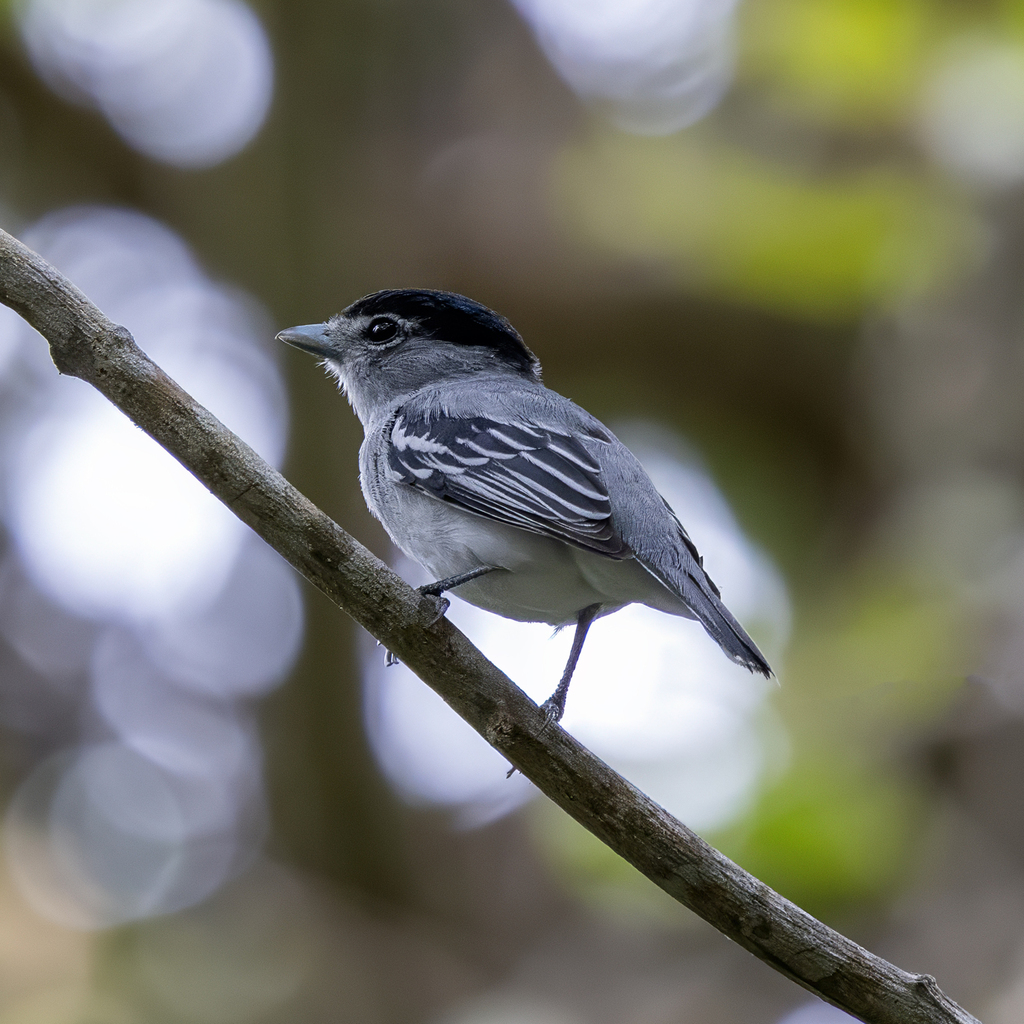
Cryptic Becard
Photo © Dan Vickers
Photo © Dan Vickers — CC BY 4.0 — Source: iNaturalist #310058406The cryptic becard (Pachyramphus salvini) is a species of bird in the family Tityridae, the tityras, becards, and allies. It is found in Colombia, Ecuador, and Peru. == Taxonomy and systematics == The cryptic becard was originally called Pachyramphus similis but in 1899 Richmond noted that the binomial had earlier been used for a different species. Following the principle of priority he assigned its current binomial Pachyramphus salvini. The genus Pachyramphus has variously been assigned to the tyrant flycatcher family Tyrannidae and the cotinga family Cotingidae. Several early twenty-first century studies confirmed the placement of Pachyramphus in Tityridae and taxonomic systems made the reassignment. The cryptic becard's further taxonomy is unsettled. Until publication of a 2023 study it was treated as a subspecies of the black-and-white becard (P. albogriseus). Following that study the IOC, the Clements taxonomy, AviList, the North American Classification Committee of the American Ornithological Society (NACC), and the independent South American Classification Committee (SACC) split it as a monotypic species. However, as of late 2025 BirdLife International's Handbook of the Birds of the World (HBW) retains it as a subspecies of the black-and-white becard. == Description == The cryptic becard is about 14 cm (5.5 in) long…
Cerros de Amotape National Park
District of San Jacinto, Ecuador
+246 birds+1 mammals
Arid mountains rise abruptly from Peru's northwestern frontier, their slopes clothed in xerophytic scrubland and seasonal deciduous forest that transforms these Andean foothills into one of…
VIEW NATIONAL PARKPodocarpus National Park
Zamora, Ecuador
+496 birds+6 mammals
Where the Andes descend toward the Amazon basin, Podocarpus National Park sprawls across nearly 2,800 square kilometres of the most biodiverse terrain in Ecuador's southern highlands.…
VIEW NATIONAL PARKNo community photos yet. Log in to add the first one.
No community observations of this species yet.