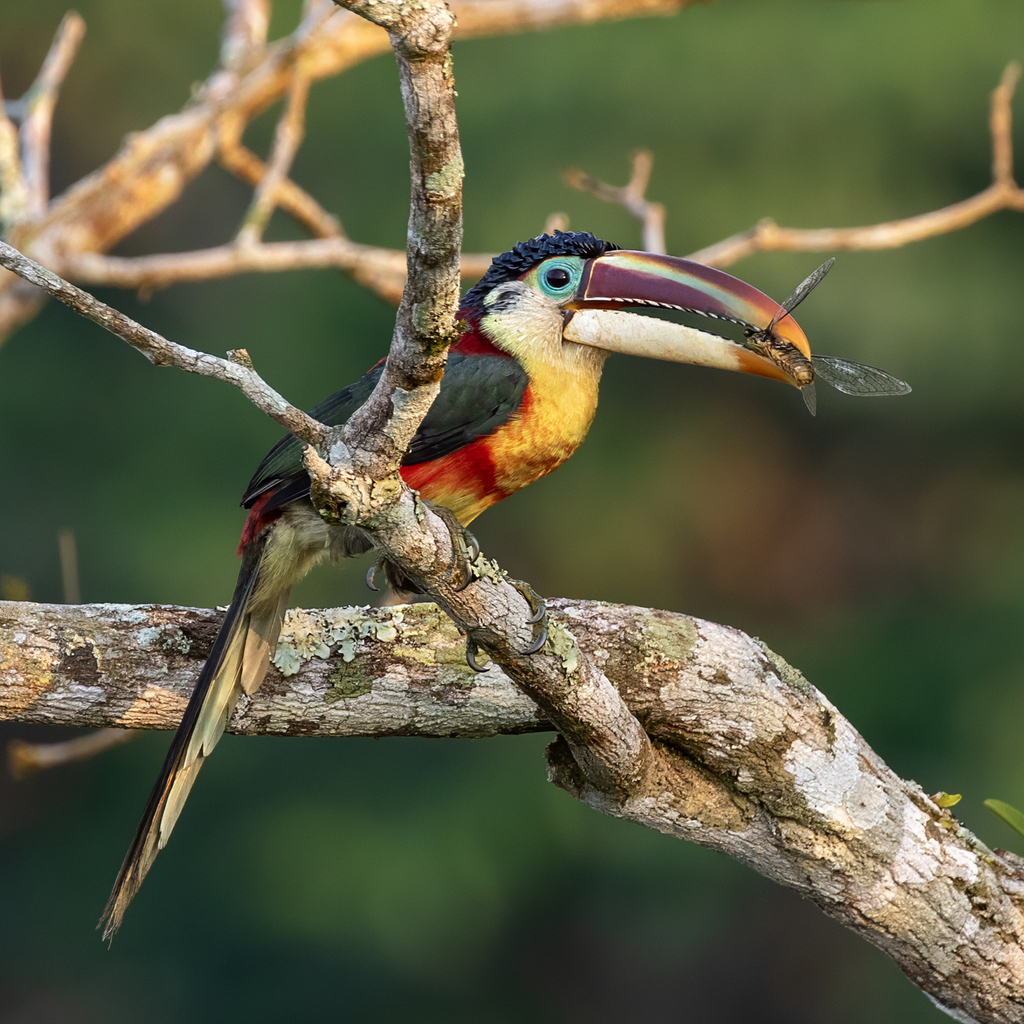
Curl-crested Aracari
Photo © Dan Vickers
Photo © Dan Vickers — CC BY 4.0 — Source: iNaturalist #260925814Identification
The curl-crested aracari is a medium-sized toucan measuring 42 to 46 cm long and weighing 164 to 280 grams. Its most distinctive feature is the unique crown of curly, shiny black feathers atop its head and nape that resemble pieces of plastic or enamel—the source of its common name. Males and females are similar in plumage, though females have a noticeably shorter bill. The bill itself is a complex palette of colours: the mandible is primarily ivory, becoming orange at the tip, while the maxilla displays an orange culmen with a maroon stripe along its lower edge, and green or bluish colouration between. Indistinct ivory-coloured "teeth" mark the bill's cutting edges. Bare blue skin encircles each eye, and the cheeks and throat are whitish with black speckles. The back and rump are striking red, contrasting with dark green upperparts, while the underparts are bright yellow interrupted by a wide red band across the lower breast. Immature birds are duller versions of adults.
Range & Habitat
The curl-crested aracari inhabits the southwestern Amazon Basin south of the Amazon River, with a range extending from northern Peru south of the Marañón River eastward through western Brazil to the Madeira and Xingu rivers. Its distribution also encompasses northern and central Bolivia and parts of Brazil as far south as northern Mato Grosso. This toucan favours the interior, clearings, and edges of wet forest—both well-drained and swampy habitats. While it typically occurs below 500 metres elevation, it has been recorded as high as 900 metres in areas near the Andes.
Behaviour & Diet
Curl-crested aracaris are social foragers, typically gathering in groups of up to twelve individuals, usually hunting for food in the forest canopy though they occasionally descend to feed at fruiting bushes near ground level. Their diet consists primarily of fruit, supplemented by eggs and nestlings of other bird species. They are known to destroy the nests of yellow-rumped caciques to access eggs and young. The species appears to be a year-round resident with only short-distance or local movements. Their breeding season spans mostly May to August, though it may start earlier and extend longer. The species produces a variety of calls, including deep "rrek" notes, soft to hard grunting "grenk" sounds, and a softer "et-et" when settling into roosts. A more complex vocalization has been described as a "low, raucous 'cha-cha-cha cha wruh cha-'."
Best Time & Places to See It
The curl-crested aracari is a resident species found year-round across its range, so it can be encountered at any season. However, the breeding season from May to August may offer additional opportunities to observe breeding-related behaviour. The species occurs in protected areas including Peru's Tambopata National Reserve, making this an excellent destination for viewing. Look for them in the canopy of wet forests throughout the southwestern Amazon Basin in Peru, Brazil, and Bolivia.
Photography Tips
The distinctive curled crown feathers and colourful bill make this species a rewarding photographic subject. Position yourself to capture the head-on view where the unique black curly feathers are most apparent. Early morning canopy foraging offers the best light, though you'll need good reach and patience given their preference for the forest canopy. When they descend to fruiting bushes closer to ground level, this presents an excellent opportunity for more accessible photography. Their social nature—foraging in groups—provides opportunities to capture multiple individuals, though the dappled forest light will challenge your exposure settings.
Mapinguari National Park
Brazil
+354 birds
Vast tracts of western Amazonian rainforest blanket the remote terrain of this 56,827 square kilometre national park in Amazonas state, where seasonal rivers wind through dense…
VIEW NATIONAL PARKSerra do Divisor National Park
Brazil
+448 birds+10 mammals
Where the western Amazon meets the Andes foothills, Serra do Divisor National Park sprawls across one of South America's most biodiverse and least accessible frontiers. Spanning…
VIEW NATIONAL PARKYanachaga–chemillén National Park
Palcazu, Peru
+639 birds+6 mammals
Where the eastern slopes of Peru's central cordillera plunge into cloud forest, Yanachaga–Chemillén National Park protects nearly three thousand square kilometres of montane wilderness that few…
VIEW NATIONAL PARKManu National Park
Manu, Peru
+892 birds+26 mammals
Across the eastern slopes of the Peruvian Andes, tropical rainforest descends into the Amazon basin with a complexity that few terrestrial ecosystems match. Manu National Park…
VIEW NATIONAL PARKBahuaja Sonene National Park
San Pedro de Putina Punco, Peru
+602 birds+8 mammals
Where the Madre de Dios and Heath rivers converge in southeastern Peru rises one of South America's most biodiverse wilderness regions: a vast protected realm of…
VIEW NATIONAL PARKCordillera Azul National Park
Pampa Hermosa, Peru
+322 birds+1 mammals
Where the eastern Andes descend into the western Amazon basin, Cordillera Azul National Park sprawls across nearly 38,000 square kilometres of some of Peru's most pristine…
VIEW NATIONAL PARKNo community photos yet. Log in to add the first one.
No community observations of this species yet.