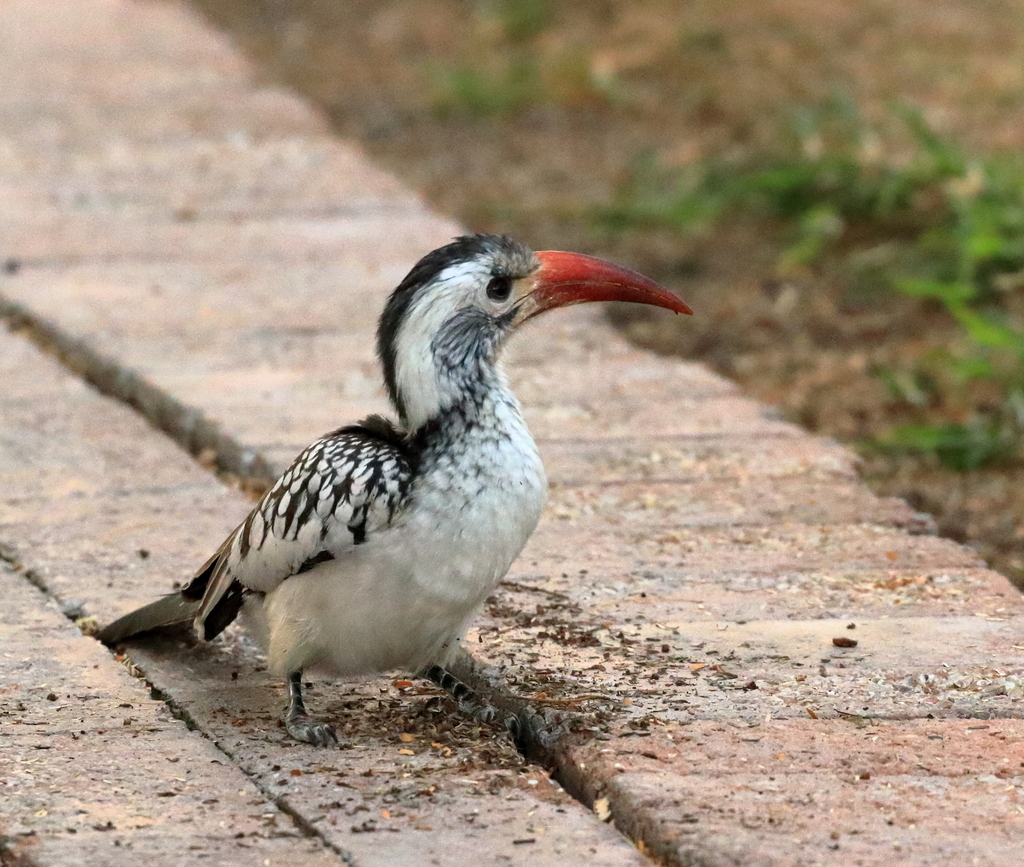
Damara Red-billed Hornbill
Photo © Darren Obbard
Photo © Darren Obbard — CC BY 4.0 — Source: iNaturalist #313286571The Damara red-billed hornbill (Tockus damarensis) is a species of hornbill in the family Bucerotidae. It is found in southwest Angola and northern Namibia. All five red-billed hornbills were formerly considered conspecific. == Description == Damara red-billed hornbills are small species of African hornbills. They have curved dark to bright red bills with their nostrils on the upper beak close to their eyes. Their heads are covered in greyish-white feathers with dark grey feathers running along the back of their heads and upper half of the neck. Like all red-billed hornbills, Damara red-billed hornbills have wings covered in circles of white feathers surrounded by black or dark brown feathers. Their tail feathers are black on the exterior and white on the interior and their legs are short and grey with small semi-sharp claws at the end. Their bellies are usually greyish white but can also be pure white. == Distribution == Damara red-billed hornbills can be found in southwestern Angola and northern Namibia. They can be found nesting or resting in local trees in grasslands or savannahs.
Skeleton Coast Park
Barcelona, Namibia
+143 birds+7 mammals
Where the Atlantic's cold Benguela Current collides with one of Africa's most hostile coastlines, the Skeleton Coast Park sprawls across more than 104,000 square kilometres of…
VIEW OBSERVATION POINTEtosha National Park
Namibia
+356 birds+58 mammals
Across northern Namibia's stark semi-arid plateau, a vast shallow depression transforms seasonally into one of Africa's most dramatic wildlife theaters. Etosha National Park, encompassing more than…
VIEW NATIONAL PARKWaterberg Plateau National Park
Okambukonde, Namibia
+198 birds+27 mammals
Where ancient sandstone cliffs rise 200 metres above the surrounding bushveld, a fortress of geology creates one of southern Africa's most compelling ecosystems. The plateau's steep…
VIEW NATIONAL PARKNo community photos yet. Log in to add the first one.
No community observations of this species yet.