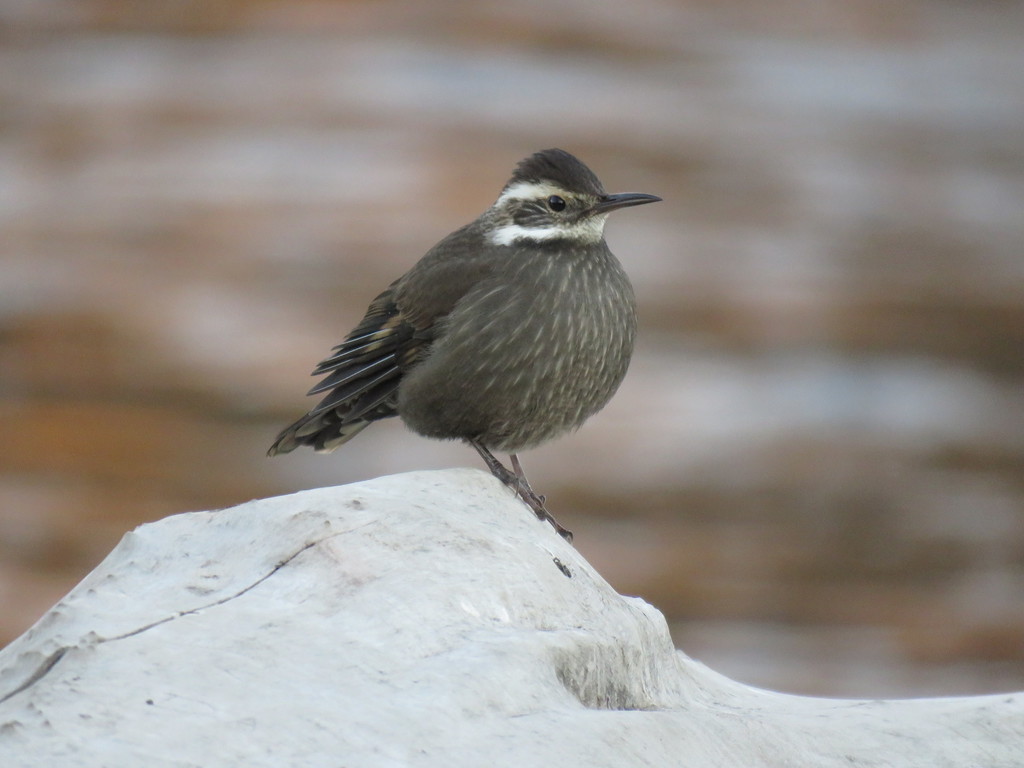
Dark-bellied Cinclodes
Photo © Nicolas Olejnik
Photo © Nicolas Olejnik — CC BY 4.0 — Source: iNaturalist photo #76352337Identification
The dark-bellied cinclodes is a largish member of the cinclodes genus, measuring 18 to 20 cm in length and weighing about 36 to 50 g. It is characterized by a distinctive long, decurved bill. Adults display a white supercilium beginning at the forehead, dark brown lores and ear coverts, and a white malar area with faint darker flecks. The crown, nape, and upperparts are dark brown, with the wings darker still and marked by pale rufous-tinged white bands on the primary coverts and flight feathers. The tail is dark brown with the outer feathers showing progressively more tawny-whitish on their tips. The throat is whitish with faint specks, while the underparts are mostly dull dark brown with pale spots on the upper breast that become streaks through the lower breast and belly. The sexes are identical in plumage. Two subspecies are recognized: the nominate C. p. patagonicus and the slightly smaller, buffier C. p. chilensis, which shows less streaking on the belly.
Range & Habitat
The dark-bellied cinclodes is endemic to the southern cone of South America, found in both Argentina and Chile. The more northerly subspecies C. p. chilensis inhabits south-central Chile between the Atacama and Aysén regions, extending into adjacent western Argentina from Mendoza Province to Santa Cruz Province. The nominate subspecies occurs further south, reaching Tierra del Fuego. The species is strongly associated with water and inhabits rocky coastal beaches, lakesides, river and stream banks, and wet forest edges. Even in semi-arid areas, it remains near water sources. In the northern part of its range it typically stays inland, whereas southern populations are found at sea level. In the Andes, the species reaches elevations of approximately 3,500 m.
Behaviour & Diet
The dark-bellied cinclodes appears largely resident throughout most of its range, though some populations show seasonal altitudinal movements and southern birds may migrate north and south. It feeds exclusively on marine and terrestrial invertebrates always obtained near water, typically foraging singly or in pairs by gleaning prey from the ground, rocks, beach debris, and water's edge. Breeding occurs during the local austral spring and summer, with timing varying by latitude—beginning in October in the far south but as early as August in the north. Males perform an elaborate courtship display from a perch, flapping both wings, shaking the tail up and down, and singing. Nests are built in protected chambers such as rock crevices, stone walls, burrows, tree holes, or ledges on human structures, constructed as cups of grass and feathers with clutch sizes of two to four eggs.
Best Time & Places to See It
The dark-bellied cinclodes is considered fairly common throughout its range and occurs in several protected areas. Its association with water makes it relatively predictable—search rocky coastlines, riverbanks, stream edges, and lakeshores within its range in Argentina and Chile. The breeding season (August to December, depending on latitude) is the best time to observe this species, as it becomes very vocal and males perform conspicuous courtship displays. The species is adaptable to human-modified landscapes and will nest in human structures, making it potentially accessible to travellers even near settlements.
Photography Tips
Look for this species along water edges where it forages on rocks and debris—patience and stillness will reward you as birds forage in pairs or singly. The long decurved bill and dark plumage with subtle pale markings require good light to capture well. During breeding season, males sing from exposed perches and perform wing-flapping displays, offering excellent photographic opportunities. Early morning light along coastal or riverside habitats will best render the bird's dark brown tones and highlight the pale supercilium and breast streaking. The species' habit of frequenting human structures means some populations may be more habituated to observers, potentially allowing closer approach.
Chiloé National Park
Dalcahue, Chile
+122 birds+6 mammals
Temperate rainforest cloaks the Chiloé archipelago's northwestern reaches, where granite ridges thrust through dense, moisture-laden canopy and freshwater streams carve ravines toward the Pacific. Across approximately…
VIEW NATIONAL PARKCabo de Hornos National Park
Cape Horn, Chile
+88 birds+9 mammals
Where the Andes plunge into the Southern Ocean and the Drake Passage churns between two continents, Cabo de Hornos National Park sprawls across one of Earth's…
VIEW NATIONAL PARKCorcovado National Park
Chaitén, Chile
+39 birds+1 mammals
Where temperate rainforest meets the raw Pacific coastline of Chilean Patagonia, Corcovado National Park sprawls across 6,585 square kilometres of some of South America's most pristine…
VIEW NATIONAL PARKLaja National Park Lagoon
Antuco, Chile
+123 birds+1 mammals
Where the Andes descend into the Biobío Region's temperate forests, a vast lagoon fills the caldera of the extinct Antuco volcano, cradled by steep native woodland…
VIEW NATIONAL PARKPuyehue National Park
Puyehue, Chile
+110 birds+4 mammals
Across the volcanic spine of the Los Lagos Region, where the Andes descend toward temperate rainforest, Puyehue National Park encompasses nearly 2,600 square kilometers of one…
VIEW NATIONAL PARKVicente Pérez Rosales National Park
Puerto Varas, Chile
+109 birds+8 mammals
Where the Andes descend toward the temperate rainforests of Chile's Lake District, nearly 4,641 square kilometers of pristine wilderness unfolds across Vicente Pérez Rosales National Park.…
VIEW NATIONAL PARKCerro Castillo National Park
Coyhaique, Chile
+89 birds+3 mammals
Granite peaks and windswept steppe converge across this vast Patagonian landscape, where the Andes' eastern flank drops into terrain sculpted by ice age glaciers and relentless…
VIEW NATIONAL PARKPatagonia National Park
Cochrane, Chile
+133 birds+8 mammals
Where the Andes meet the Patagonian steppe, vast grasslands and shrublands sweep across rolling terrain carved by ancient glaciation, their contours softened by distance and dramatic…
VIEW NATIONAL PARKReserva Nacional Magallanes
Punta Arenas, Chile
+78 birds+2 mammals
Where windswept steppe meets sub-Antarctic forest near the southern tip of continental South America, Reserva Nacional Magallanes unfolds across roughly 352 square kilometres of profound ecological…
VIEW NATIONAL PARKParque Provincial Península de Magallanes
Argentina
+125 birds+4 mammals
Granite peaks and windswept steppe converge across this 415-square-kilometre peninsula jutting into the cold Atlantic waters of southern Patagonia, where the Magallanes landscape embodies the raw,…
VIEW NATIONAL PARKParque Municipal Llao Llao
San Carlos de Bariloche, Argentina
+73 birds+1 mammals
Where the Andes meet the Patagonian lakes, granite peaks rise above temperate rainforest in a landscape of startling contrasts. Parque Municipal Llao Llao, sprawling across 23…
VIEW NATIONAL PARKLos Glaciares National Park
Argentina
+121 birds+3 mammals
Where granite peaks and sprawling ice fields dominate the landscape, Los Glaciares National Park encompasses over ten thousand square kilometres of Patagonian wilderness in southern Argentina.…
VIEW NATIONAL PARKPerito Moreno National Park
Argentina
+78 birds
Where the Patagonian steppe descends into a landscape carved by ancient ice, Perito Moreno National Park sprawls across nearly 1,590 square kilometres of some of South…
VIEW NATIONAL PARKNahuel Huapi National Park
Argentina
+124 birds+11 mammals
Where the Andes descend toward Patagonia, vast glacial lakes cut through a landscape of southern beech forest and granite peaks, creating one of South America's most…
VIEW NATIONAL PARKLanín National Park
Argentina
+128 birds+7 mammals
Where the volcanic spine of the Andes plunges into Patagonian steppe, Lanín National Park sprawls across nearly 4,700 square kilometers of one of Argentina's most visually…
VIEW NATIONAL PARKLago Puelo National Park
Argentina
+109 birds+1 mammals
Where temperate forests descend to crystalline waters in the foothills of the Andes, Lago Puelo National Park sprawls across nearly 300 square kilometers of pristine wilderness…
VIEW NATIONAL PARKLos Alerces National Park
Argentina
+84 birds+3 mammals
Where the temperate rainforests of southern Patagonia sweep down towards crystalline lakes, Los Alerces National Park unfolds across nearly 3,000 square kilometres of one of South…
VIEW NATIONAL PARKNo community photos yet. Log in to add the first one.
No community observations of this species yet.