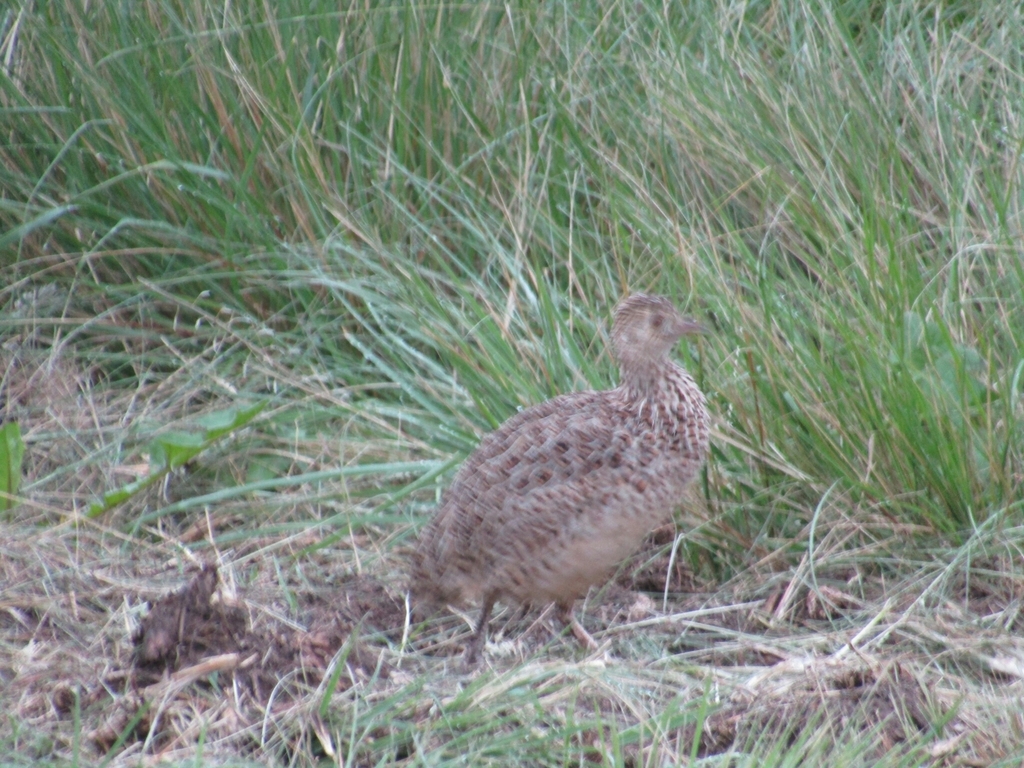
Darwin’s Nothura
Photo © Ezequiel Vera
Photo © Ezequiel Vera — CC BY 4.0 — Source: iNaturalist #7462242Identification
Darwin's nothura is a small tinamou measuring approximately 26 cm (10 in) in length. It is more rufous in plumage than its close relative, the spotted nothura, and features broader streaking on its underparts. The bird's upper parts are brown and streaked with buff, while its lower parts are distinctly streaked with chestnut. A black breast, barred flanks, and a black crown with buff streaks are key field marks, contrasting with its white throat.
Range & Habitat
Darwin's nothura is commonly found in high-altitude grasslands throughout the southern Andes of South America. Four subspecies occupy distinct regions: the nominate N. d. darwinii inhabits the Patagonian steppes of south-central Argentina; N. d. peruviana occurs in southern Peru's Urubamba Valley in Cusco Region; N. d. agassizii is found across the altiplano of southeastern Peru and western Bolivia; N. d. boliviana inhabits the highlands of western Bolivia across Cochabamba, Chuquisaca, Potosí, Oruro, and Tarija Departments; and N. d. salvadorii occurs in western Argentina. The species has a substantial occurrence range of 1,100,000 km² (420,000 sq mi) and is classified as Least Concern by the IUCN.
Behaviour & Diet
Like all tinamous, Darwin's nothura forages on or near the ground, feeding primarily on fallen fruit from low-lying bushes and the ground itself. The bird supplements this diet with small amounts of invertebrates, flower buds, tender leaves, seeds, and roots. Darwin's nothura exhibits a remarkable breeding system in which males bear full responsibility for incubation and chick-rearing. Males may incubate and raise eggs from multiple females, a polyandrous arrangement unusual among birds. The nest is constructed on the ground in dense brush or sheltered between raised root buttresses, providing protection during the incubation period and early chick development.
Best Time & Places to See It
For travellers seeking Darwin's nothura, the high-altitude grasslands of the southern Andes offer the best opportunities. The Patagonian steppes of south-central Argentina, the Urubamba Valley region of Peru, and the altiplano of Bolivia and Peru are key destinations. The species' association with dense grassland habitat means patient observation during early morning or late afternoon hours will yield the best results, as the birds are often inconspicuous despite their relatively large range.
Photography Tips
Photographing Darwin's nothura requires patience and an appreciation for grassland habitats at high altitude. The bird's preference for dense brush and ground-level foraging means slow, careful approach is essential. Early morning light in the Andean grasslands can be exceptional, providing clear illumination of the bird's distinctive plumage patterns—particularly the black breast, chestnut streaking, and buff-streaked crown. Wide-angle habitat shots incorporating the high-altitude landscape context can complement close-up portraits of this elusive tinamou.
Manu National Park
Manu, Peru
+892 birds+26 mammals
Across the eastern slopes of the Peruvian Andes, tropical rainforest descends into the Amazon basin with a complexity that few terrestrial ecosystems match. Manu National Park…
VIEW NATIONAL PARKLos Cardones National Park
Argentina
+193 birds+6 mammals
Where the Andes descend into northwestern Argentina, Los Cardones National Park sprawls across nearly 1,200 square kilometres of one of South America's most distinctive high-altitude desert…
VIEW NATIONAL PARKNo community photos yet. Log in to add the first one.
No community observations of this species yet.