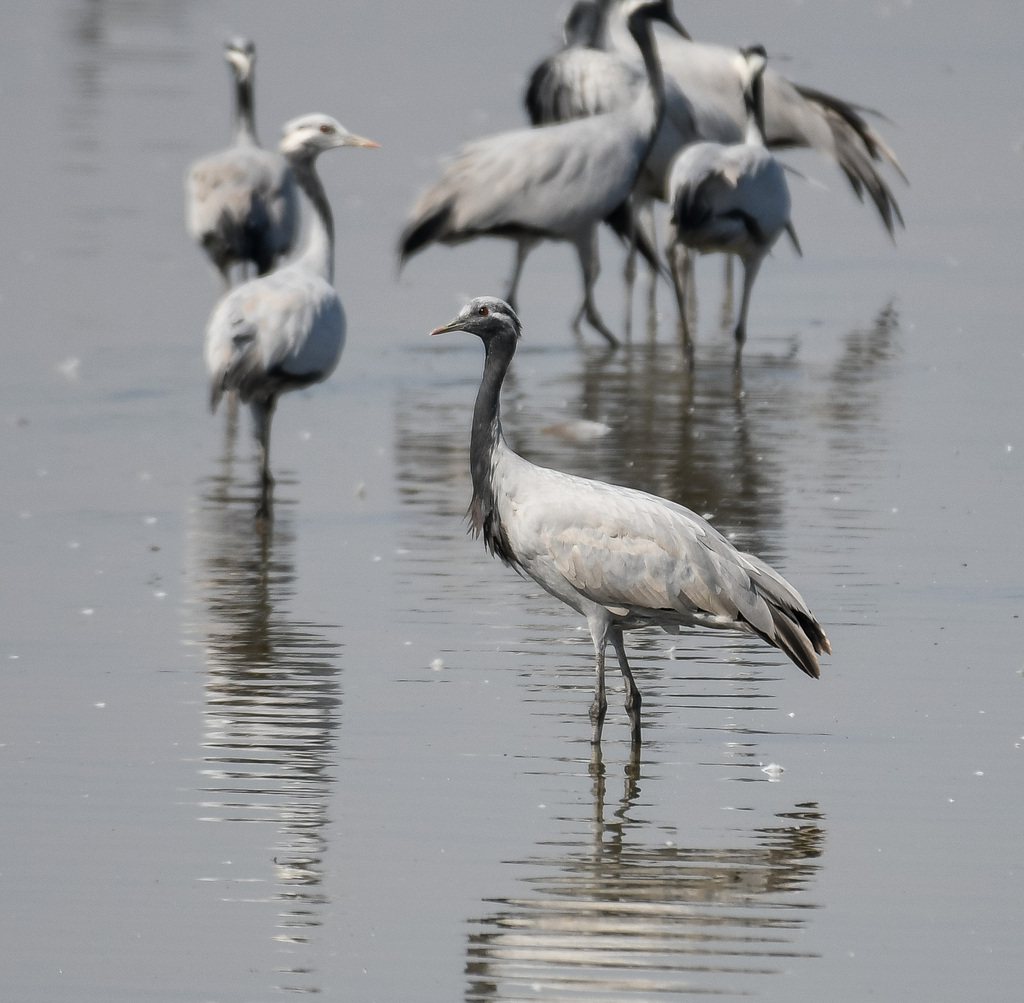
Demoiselle Crane
Photo © Rejoice Gassah
Photo © Rejoice Gassah — CC BY 4.0 — Source: iNaturalist #241404537Identification
The demoiselle crane is the smallest species of crane, measuring 85–100 cm in length with a wingspan of 155–180 cm and weighing just 2–3 kg. Despite its diminutive size, it is instantly recognizable by its distinctive plumage: a long white neck stripe contrasts sharply with black extending from the foreneck down over the chest in an elegant plume. The overall appearance is slightly more delicate than the closely related common crane, lending it an ethereal quality that inspired its evocative name—the word "demoiselle" refers to the bird's graceful, balletic bearing.
In flight and at rest, demoiselle cranes produce a loud, high-pitched trumpeting call that is noticeably shriller than that of the common crane. Their most captivating feature is their dancing display, which is notably more fluid and balletic than other crane species, characterized by graceful movements rather than the vigorous leaping seen in their relatives.
Range & Habitat
Demoiselle cranes breed across central Eurasia, from the Black Sea eastward through Mongolia to northeast China, with a small breeding population also present in Turkey. They favour open habitats with sparse vegetation, typically situated near water sources. These highly migratory birds follow two distinct migration routes: western populations winter in the Sahel region of Africa, ranging from Lake Chad eastwards to southern Ethiopia, while Asian populations migrate to the Indian subcontinent.
On their Indian wintering grounds, demoiselle cranes gather in large flocks across agricultural lands, roosting at night in shallow open water. Historical populations once existed in Turkey and as a resident population in the Atlas Mountains of northwest Africa, though both of these populations are now extinct.
Behaviour & Diet
Demoiselle cranes breed between April and May, constructing minimal nests on open grass or bare ground. Females typically lay a clutch of two eggs at daily intervals, with both parents sharing incubation duties, though the female does most of the work. Eggs hatch asynchronously after 27 to 29 days of incubation. The pale brown chicks with greyish-white underparts are fed and cared for by both parents throughout a fledgeling period of 55 to 65 days. These cranes reach sexual maturity at two years of age.
Best Time & Places to See It
The Indian subcontinent offers the most reliable opportunities to observe demoiselle cranes in large concentrations during the winter months, when birds from eastern Asia gather in impressive flocks on agricultural lands. Their breeding grounds across central Eurasia—from the Black Sea to Mongolia and northeast China—are more challenging to access but reward dedicated birdwatchers during the breeding season from April onwards. The Sahel region of Africa hosts western populations during winter, providing an alternative viewing destination.
Photography Tips
Capture the demoiselle crane's distinctive features by photographing the striking contrast between the white neck stripe and black chest plume. Winter aggregations on Indian agricultural lands offer excellent opportunities for flock photography and behaviour documentation. The bird's balletic dancing display is a photographer's dream—patience and positioning near roosting sites at dawn or dusk will reward you with shots of their graceful movements. The bird's relatively compact size compared to other cranes makes it essential to use appropriate focal lengths and to fill the frame to showcase its elegant proportions and fine plumage details.
No community photos yet. Log in to add the first one.
No community observations of this species yet.