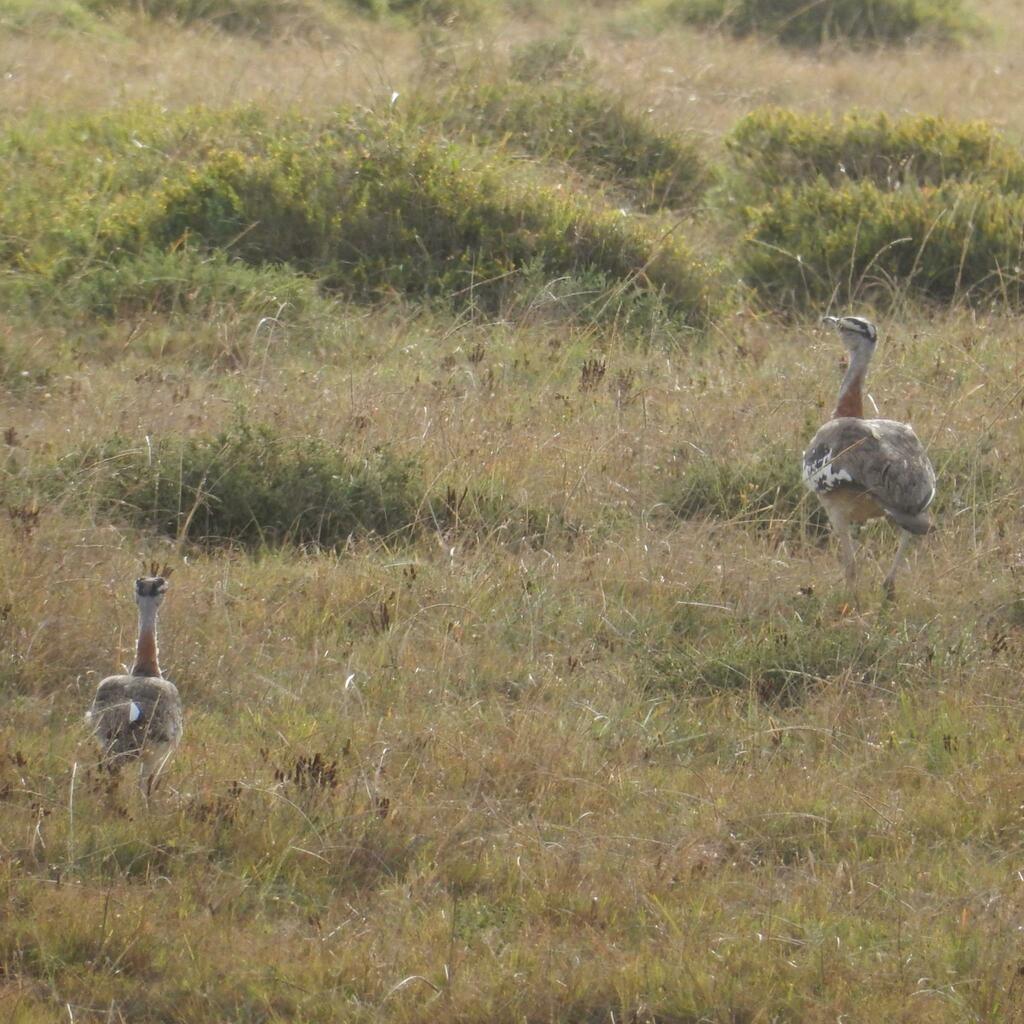
Denham’s Bustard
Photo © Henry de Lange
Photo © Henry de Lange — CC BY 4.0 — Source: iNaturalist #151818091Identification
Denham's bustard is the largest species within the genus Neotis, though it remains smaller than bustards in the genus Ardeotis. Males are substantially larger than females, weighing 9 to 10 kg and measuring 100–116 cm in length, while females are considerably more petite at 3 to 4 kg and 80–87 cm. Both sexes share distinctive plumage features: a brown back (darker and plainer in males), white underparts, a pale grey neck with an orange nape, and a grey crown bordered with black. A striking black line passes through the eye, contrasting with a white eyebrow stripe above. The long, pale yellow legs are particularly noticeable in the field. The wings display striking patterns of brown, white and black, with males showing notably more white in flight than females or younger birds. During courtship displays, males inflate their throat to reveal a conspicuous white feather balloon—a remarkable sight. The bill is whitish horn in colour. This species is typically silent.
Range & Habitat
Denham's bustard breeds throughout much of Sub-Saharan Africa, with three recognised subspecies each occupying distinct ranges. N. d. denhami inhabits southwestern Mauritania, Senegal, Gambia and extends eastward to Uganda and Ethiopia. N. d. jacksoni is found across Kenya, Tanzania, Zambia, Botswana, Zimbabwe, Angola and the Democratic Republic of Congo. N. d. stanleyi occurs in South Africa and Eswatini. The species is resident throughout most of its range, though some inland populations move to lower altitudes during winter.
These bustards favour open grassland habitats, particularly savanna, and are distributed at elevations up to 3,000 metres. They adapt readily to secondary habitats including dense shrubland, light woodland, agricultural land, dried marsh, flood-plains, arid plains and burnt fynbos.
Behaviour & Diet
Denham's bustards are typically solitary outside the breeding season, though they gather at abundant food sources and temporarily congregate during migratory movements. Migration follows rainfall in search of food. These omnivorous birds consume a diverse diet: insects, small snakes, rodents, nestlings of other bird species and green plant material. They employ a remarkable feeding strategy of following ungulate herds to extract dung beetles from their droppings.
Males perform elaborate courtship displays on traditional lek sites, puffing their head and chest while flaring their tail and calling loudly as they strut about. Breeding timing varies considerably, particularly in East Africa, and appears triggered by rainfall. Females lay one or two eggs in a shallow scrape and raise the young alone.
Best Time & Places to See It
Denham's bustard can be encountered across its extensive Sub-Saharan range in appropriate habitat. Open grassland and savanna regions offer the best opportunities for sightings. While the species is resident year-round in much of its range, visiting during wet seasons following rainfall may increase encounter rates, as birds concentrate around newly-available food sources and may be more active.
Photography Tips
Photograph these birds in open grassland or savanna habitats where their large size and striking plumage are fully visible. The pale yellow legs and distinctive head markings—the black eye-line and white eyebrow stripe—make good focal points. If fortunate enough to witness a male's courtship display, the inflated white throat balloon is a spectacular subject. Early morning or late afternoon light will enhance the contrast in their brown and white wing patterns. Given their size and preference for open ground, a telephoto lens will help capture detail while maintaining safe distance.
Serengeti National Park
Tanzania
+558 birds+57 mammals
Across Tanzania's northern plateau, where volcanic soils meet acacia woodland and open grassland, unfolds one of Earth's most dynamic ecosystems. The Serengeti National Park sprawls across…
VIEW NATIONAL PARKKidepo Valley National Park
Uganda
+478 birds+24 mammals
Where the Narus and Kidepo rivers carve through northeastern Uganda's semi-arid lowlands, a landscape of sparse acacia woodland, grassland, and riverine thickets creates one of East…
VIEW NATIONAL PARKMurchison Falls National Park
Uganda
+608 birds+33 mammals
Where the Victoria Nile compresses through a narrow gorge and explodes across a 45-meter precipice, the landscape speaks in thunder. Murchison Falls National Park sprawls across…
VIEW NATIONAL PARKLake Mburo National Park
Uganda
+505 birds+24 mammals
Rolling acacia woodland and scattered lakes define this intimate savanna preserve in southwestern Uganda, where the rift valley's geological drama shapes every water source and grassland.…
VIEW NATIONAL PARKKitulo National Park
Tanzania
+59 birds+1 mammals
Where the southern highlands of Tanzania rise above two thousand metres, rolling grasslands and montane meadows create a landscape rarely encountered in East Africa—a sweeping plateau…
VIEW NATIONAL PARKNgorongoro Conservation Area
Tanzania
+626 birds+55 mammals
Volcanic calderas and open grassland dominate this high plateau in northern Tanzania, where the landscape rises above 2,000 metres and ancient geological forces have shaped both…
VIEW WILDLIFE MANAGEMENT AREAQueen Elizabeth National Park
Uganda
+672 birds+30 mammals
Across the southwestern escarpment of Uganda, where the Western Rift Valley descends through ancient volcanic terrain, Queen Elizabeth National Park sprawls across more than 8,300 square…
VIEW NATIONAL PARKGarden Route National Park
George, South Africa
+353 birds+54 mammals
Sweeping across the Western Cape's coastal and mountainous terrain, this sprawling national park encompasses over five thousand square kilometers of extraordinarily diverse landscape—from coastal limestone cliffs…
VIEW NATIONAL PARKKruger National Park
Ba-Phalaborwa Local Municipality, South Africa
+540 birds+91 mammals
Across the low-lying savanna of northeastern South Africa unfolds one of Africa's largest and most ecologically intact protected areas, where acacia woodlands merge into mopane scrub…
VIEW NATIONAL PARKAgulhas National Park
Cape Agulhas Local Municipality, South Africa
+224 birds+13 mammals
Where the Atlantic and Indian Oceans meet at Africa's southernmost tip, Agulhas National Park stretches across 892 square kilometres of windswept coastal landscape and rugged limestone…
VIEW NATIONAL PARKSehlabathebe National Park
South Africa
+60 birds+1 mammals
Where the Drakensberg escarpment rises to meet the sky, Sehlabathebe National Park unfolds across a landscape of dramatic basalt cliffs, rolling alpine grassland, and crystal-clear mountain…
VIEW NATIONAL PARKMountain Zebra National Park
Inxuba Yethemba Local Municipality, South Africa
+265 birds+35 mammals
Across the windswept plateaus and deeply incised valleys of the Eastern Cape's interior, Mountain Zebra National Park unfolds as a landscape of geological drama and ecological…
VIEW NATIONAL PARKBontebok National Park
Swellendam Local Municipality, South Africa
+204 birds+11 mammals
Where the Cape Fold Mountains give way to coastal lowlands, a landscape of rolling sandstone hills and fynbos heathland creates one of South Africa's most compact…
VIEW NATIONAL PARKAddo Elephant National Park
Sundays River Valley Local Municipality, South Africa
+388 birds+55 mammals
Where the Eastern Cape's semi-arid scrublands meet transitional woodland, Addo sprawls across 13,478 square kilometres of one of southern Africa's most biodiverse landscapes. The terrain rises…
VIEW NATIONAL PARKMarakele National Park
Modimolle Local Municipality, South Africa
+341 birds+36 mammals
Granite ridges and sprawling grasslands dominate this 1,176-square-kilometre reserve in Limpopo's heartland, where bushveld transitions between rocky outcrops and open savanna. The park's rugged topography creates…
VIEW NATIONAL PARKCamdeboo National Park
Camdeboo Local Municipality, South Africa
+272 birds+24 mammals
Granite ridges and weathered sandstone cliffs rise across a semi-arid landscape where the Karoo transitions into the eastern escarpment of South Africa, creating Camdeboo National Park's…
VIEW NATIONAL PARKEtosha National Park
Namibia
+356 birds+58 mammals
Across northern Namibia's stark semi-arid plateau, a vast shallow depression transforms seasonally into one of Africa's most dramatic wildlife theaters. Etosha National Park, encompassing more than…
VIEW NATIONAL PARKNo community photos yet. Log in to add the first one.
No community observations of this species yet.