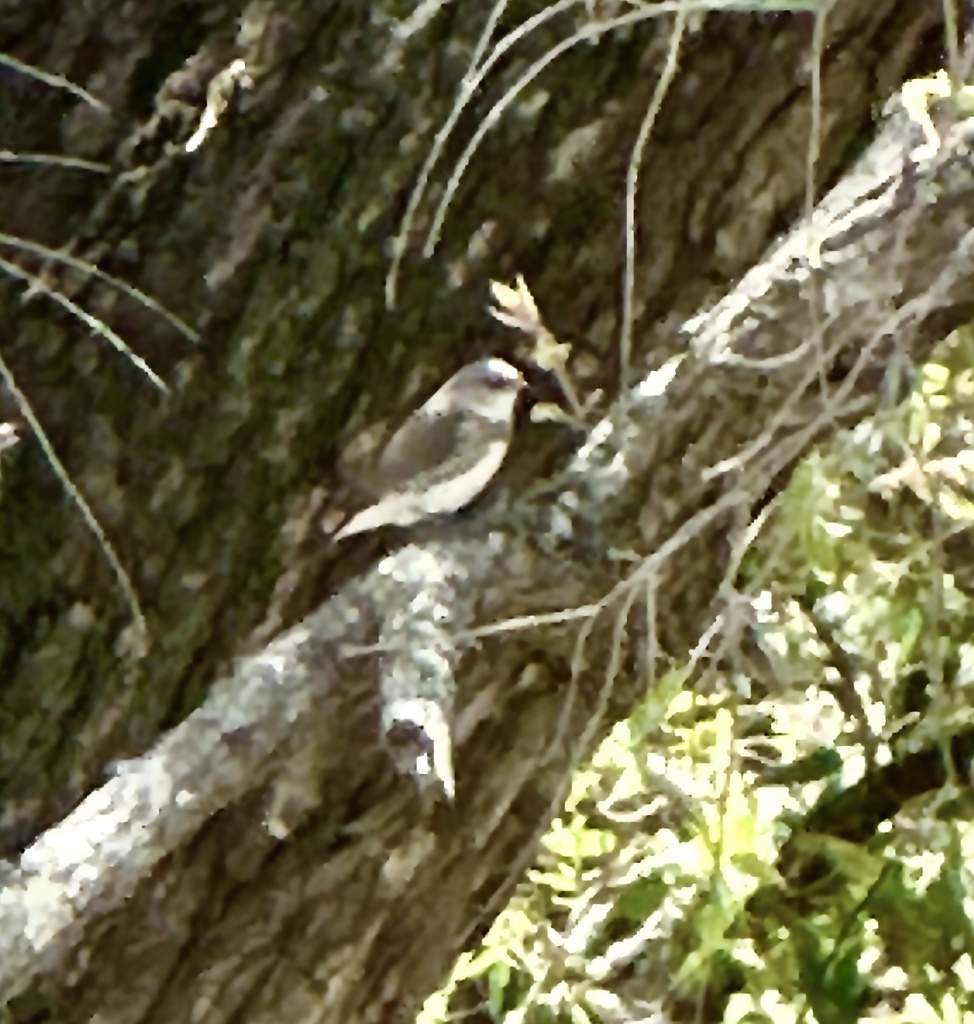
Diamond Firetail
Photo © prossington
Photo © prossington — CC BY 4.0 — Source: iNaturalist #147814980The diamond firetail (Stagonopleura guttata) is a species of estrildid finch that is endemic to Australia. It has a patchy distribution and generally occupies drier forests and grassy woodlands west of the Great Dividing Range from South East Queensland to the Eyre Peninsula in South Australia. While it is a small stocky bird it is one of the largest finches in Australia. The birds are very distinctive with a black breast-band on a white breast. The flanks are black with white spots and it has a scarlet rump (hence the name) and a black tail. == Taxonomy == The family Estrildidae (grass-finches) was named by Swainson in 1827 and "finch" can be traced back to the Old English finc but its origin is debated. Firetail is now used to describe the three species of Stagonopleura. The red-browed finch (Neochmia temporalis) is no longer considered a firetail even though it has a red rump. The diamond firetail has also been known as the "spotted finch (Lewin 1808), spotted grossbeak (Lewin 1822), spotted-sided grossbeak (Latham 1823), spotted-sided finch (Mathews 1927) and spotted- finch (Gould 1848)". The name diamond firetail was first used in the Royal Australian Ornithological Union (RAOU's) second official checklist…
Greater Bendigo National Park
Whipstick, Australia
+202 birds+8 mammals
Across the red volcanic plains of inland Victoria, Greater Bendigo National Park sprawls across more than 1,000 square kilometres of eucalyptus woodland, open grassland, and scattered…
VIEW NATIONAL PARKChiltern-Mt Pilot National Park
Australia
+229 birds+12 mammals
Granite ridges and eucalyptus woodlands define this 869-square-kilometre park straddling the border between Victoria and New South Wales, where rugged terrain rises sharply from gentler foothill…
VIEW NATIONAL PARKLittle Desert National Park
Australia
+200 birds+11 mammals
Across northwestern Victoria's semi-arid interior, sandstone ridges and heathland plateaus rise from red earth in a landscape sculpted by fire and drought rather than water. Little…
VIEW NATIONAL PARKLincoln National Park
Australia
+149 birds+5 mammals
Across the mid-north of South Australia, where the landscape transitions from coastal lowlands toward semi-arid interior plains, sprawls a wilderness of 2,671 square kilometres where red-earth…
VIEW NATIONAL PARKCoffin Bay National Park
Australia
+143 birds+5 mammals
Across South Australia's Eyre Peninsula, where limestone headlands rise above turquoise shallows and eucalypt woodland gives way to coastal heath, lies a 1,319-square-kilometre sanctuary shaped by…
VIEW NATIONAL PARKSundown National Park
Australia
+211 birds+9 mammals
Granite ridges and eucalypt woodlands define this 305-square-kilometre expanse of southeastern Queensland, where the landscape descends from sandstone plateaus into open forests and grassy clearings that…
VIEW NATIONAL PARKBald Rock National Park
Australia
+122 birds+15 mammals
Granite peaks and weathered stone dominate the landscape of this 202-square-kilometre national park in inland New South Wales, where rugged tors and rocky outcrops rise dramatically…
VIEW NATIONAL PARKGirraween National Park
Australia
+193 birds+21 mammals
Granite boulders rise like the bones of the earth across these 278 square kilometres of southeastern Queensland, where the Great Dividing Range descends towards the coastal…
VIEW NATIONAL PARKMorton National Park
Australia
+253 birds+57 mammals
Across nearly 4,800 square kilometers of New South Wales's Southern Tablelands, rugged sandstone plateaus rise above sheltered valleys where cool-climate eucalypt woodland meets grassy heath and…
VIEW NATIONAL PARKBlue Mountains National Park
Australia
+220 birds+43 mammals
Dramatic sandstone cliffs rise in tiers across this mountainous plateau west of Sydney, their rust-coloured faces weathered into amphitheatres and gorges where eucalyptus forest clings to…
VIEW NATIONAL PARKKosciuszko National Park
Australia
+211 birds+52 mammals
Where the Great Dividing Range reaches its highest peaks in southeastern Australia, Kosciuszko National Park encompasses a landscape of windswept plateaus, rocky ridges, and deep river…
VIEW NATIONAL PARKWarrumbungle National Park
Coonabarabran, Australia
+183 birds+22 mammals
Volcanic peaks and weathered ridges rise abruptly from the inland tablelands of central New South Wales, their exposed rock faces glowing ochre and rust in the…
VIEW NATIONAL PARKOxley Wild Rivers National Park
Australia
+202 birds+45 mammals
Where the New England Tablelands descend toward the coast, river gorges carve through temperate forests in a landscape of dramatic geological contrast. Oxley Wild Rivers National…
VIEW NATIONAL PARKGrampians National Park
Australia
+214 birds+18 mammals
Where sandstone ridges rise above the Western District of Victoria, Grampians National Park unfolds across rolling terrain sculpted by ancient geology and sustained by a temperate…
VIEW NATIONAL PARKGreat Otway National Park
Australia
+255 birds+42 mammals
Temperate rainforest and wet eucalyptus woodland cloak the ridges and gullies of Victoria's Great Otway National Park, where persistent moisture and mild year-round temperatures sustain a…
VIEW NATIONAL PARKMount Buffalo National Park
Myrtleford, Australia
+124 birds+7 mammals
Granite peaks rise abruptly from the volcanic plains of northeastern Victoria, their exposed rock faces and windswept ridges defining Mount Buffalo National Park's rugged character. The…
VIEW NATIONAL PARKNo community photos yet. Log in to add the first one.
No community observations of this species yet.