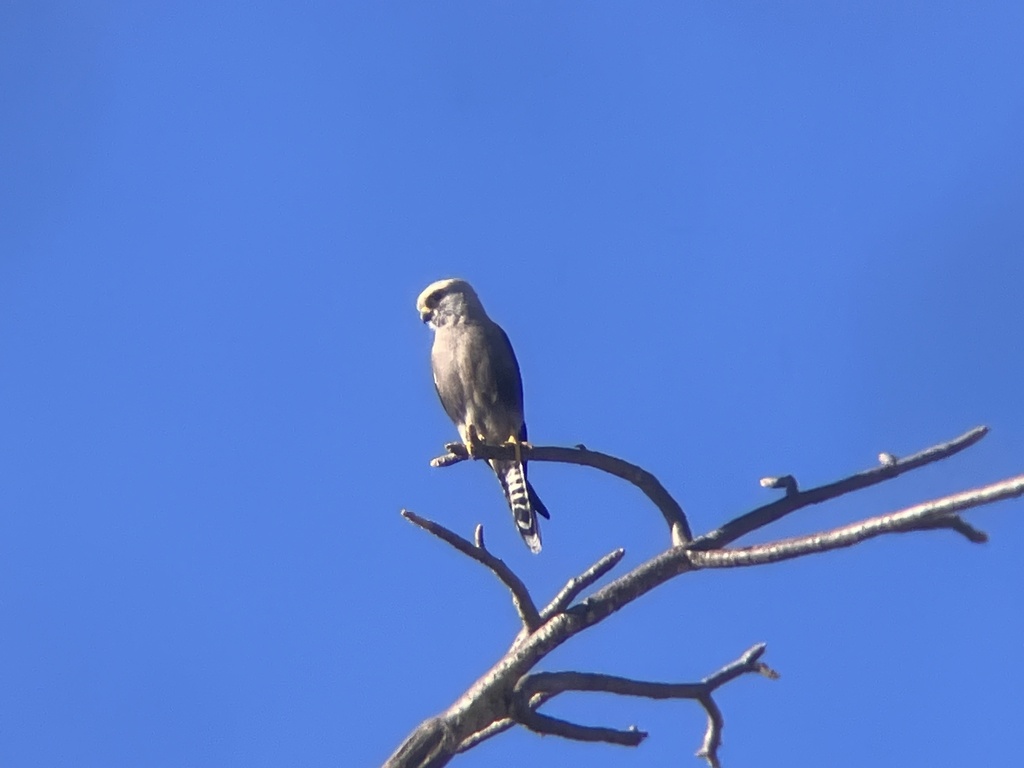
Dickinson’s Kestrel
Photo © rosshawkins
Photo © rosshawkins — CC0 1.0 — Source: iNaturalist #168502618Identification
Dickinson's kestrel is a compact, stocky bird of prey with a distinctively large, square head. Measuring 27–30 cm in length with a wingspan of 61–68 cm, it is a fairly small falcon weighing between 167–246 g, with females noticeably larger and heavier than males. The most striking plumage feature is the contrast between its mostly dark grey upperparts and its notably pale head and rump—a combination that gives the species its alternative name, the white-rumped kestrel. The grey tail is barred with narrow black lines and a prominent broad subterminal band, while the underside of the flight feathers are also distinctly barred. Look for the bright yellow cere and feet, with bare yellow skin encircling the eye, a dark grey bill, and brown eyes. Juveniles are greyer-brown overall with barred flanks and lack the pale head and rump of adults; they also display a greenish rather than yellow cere and eye-ring, making age determination relatively straightforward in the field.
Range & Habitat
This species is endemic to southern and eastern Africa, with a range spanning most of Mozambique, Zimbabwe, Zambia, and Malawi, extending into north-eastern South Africa (primarily Kruger National Park), northern Botswana, north-east Namibia, eastern Angola, southern Democratic Republic of the Congo, and parts of Tanzania, with occasional records from Kenya. The species favours open savanna and woodland habitats, showing a particular preference for swampy areas near water and miombo woodland. It is characteristically associated with palm trees, especially Hyphaene and Borassus species, and is frequently found near baobab trees; in some regions it also inhabits coconut plantations. Though generally rather scarce across much of its range, populations are notably commoner in specific areas such as Zanzibar and Pemba Islands. The loss of palm trees throughout its range represents a potential conservation concern.
Behaviour & Diet
Dickinson's kestrel typically hunts from a fixed perch, only occasionally employing the hovering technique characteristic of many kestrel species. Its diet is dominated by large insects, particularly grasshoppers, supplemented by lizards and amphibians. It also opportunistically takes small birds, bats, rodents, and snakes. The species is often attracted to grass fires, where it exploits the abundance of fleeing prey flushed by the flames. Usually silent, the bird produces a high-pitched alarm and contact call, and at the nest utters a soft, mewing call to attract young birds at feeding time.
Best Time & Places to See It
The breeding season extends from July to October in Tanzania and September to December in southern regions, making these periods potentially productive for observation. Kruger National Park in South Africa offers reliable opportunities, as do suitable habitats in Zambia, Zimbabwe, and Malawi. The islands of Zanzibar and Pemba, where the species is notably commoner, represent particularly good destinations for sighting this bird. Look for it perched conspicuously in palm crowns or baobab trees in open savanna and woodland habitats.
Photography Tips
The pale head and rump contrast strongly against dark grey plumage, making this kestrel visually distinctive and relatively straightforward to photograph once located. Its habit of hunting from exposed perches in palm trees and baobabs offers good photographic opportunities. The bright yellow facial features—cere, eye-ring, and feet—should be rendered clearly in good light. Patience at known nesting or roosting sites during the breeding season may yield images of birds in characteristic perched positions, and active hunting behaviour from a perch can sometimes be anticipated and captured.
Chobe National Park
Botswana
+446 birds+45 mammals
Where the Chobe River cuts a sinuous path through northern Botswana, the landscape transforms into one of Africa's most dynamic wetland-savanna mosaics. This national park encompasses…
VIEW NATIONAL PARKKhaudum National Park
Botswana
+213 birds+13 mammals
Where the Okavango's northern tributaries meander through miombo woodland and riverine forest, Khaudum National Park unfolds across a landscape of profound ecological richness and isolation. This…
VIEW NATIONAL PARKKruger National Park
Ba-Phalaborwa Local Municipality, South Africa
+540 birds+91 mammals
Across the low-lying savanna of northeastern South Africa unfolds one of Africa's largest and most ecologically intact protected areas, where acacia woodlands merge into mopane scrub…
VIEW NATIONAL PARKKhaudum National Park
Namibia
+221 birds+13 mammals
Where the Kavango River flows through northeastern Namibia, vast miombo woodlands and riverine forests create one of southern Africa's most remote and biodiverse wilderness corridors. Khaudum…
VIEW NATIONAL PARKNkasa Rupara National Park
Namibia
+283 birds+17 mammals
Where the Zambezi's floodplains spill across the border between Namibia and Botswana, Nkasa Rupara National Park unfolds across 518 square kilometers of wetland and woodland mosaic.…
VIEW NATIONAL PARKBwabwata National Park
Namibia
+377 birds+35 mammals
Where the Kavango River winds through northeastern Namibia, vast floodplains and dense riparian woodland create one of southern Africa's most ecologically dynamic protected landscapes. Spanning 14,249…
VIEW NATIONAL PARKMakgadikgadi Pans National Park
Gucta, Botswana
+272 birds+27 mammals
Where salt-crusted flatlands stretch endlessly toward a shimmering horizon, one of Africa's most extraordinary ecosystems awakens with the rains. The Makgadikgadi Pans comprise vast mineral-rich basins…
VIEW NATIONAL PARKNo community photos yet. Log in to add the first one.
No community observations of this species yet.