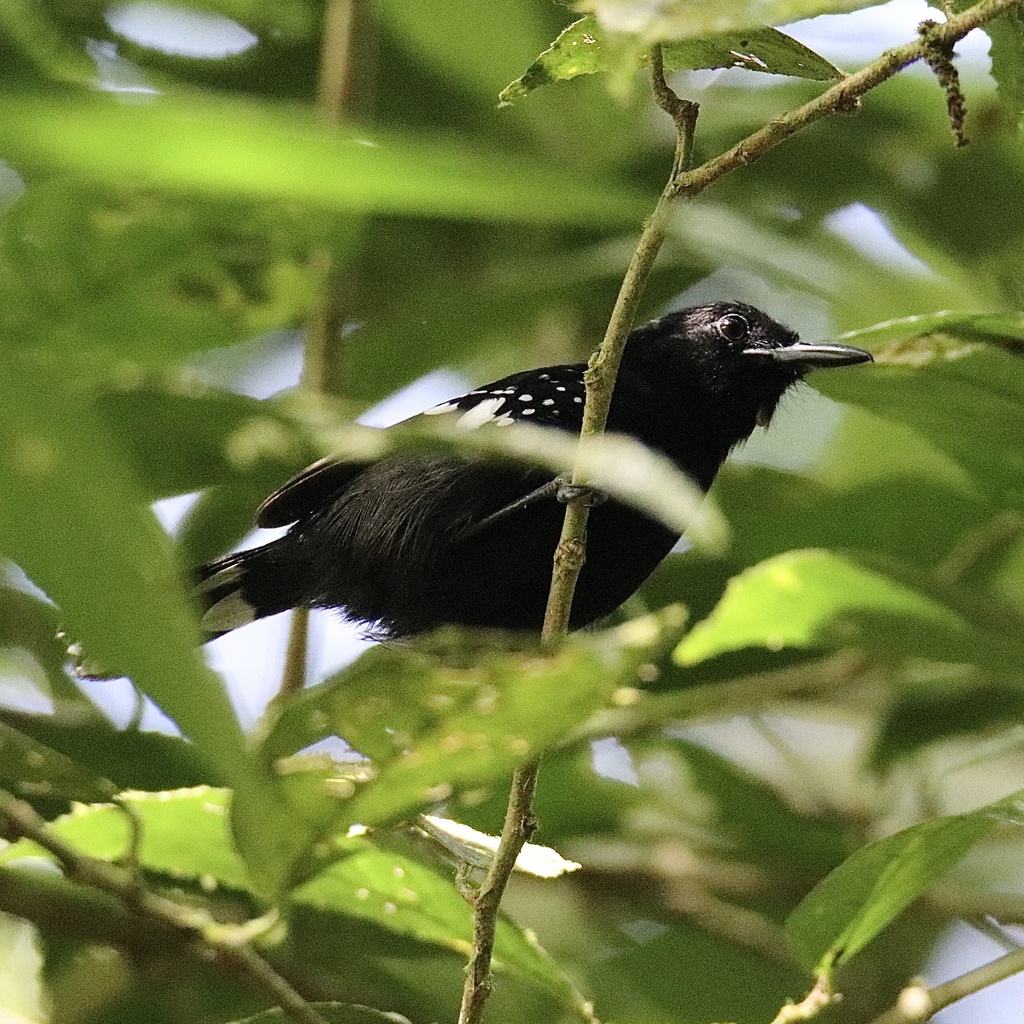
Dot-winged Antwren
Photo © Aitor
Photo © Aitor — CC BY 4.0 — Source: iNaturalist #36497978Identification
The dot-winged antwren is a small passerine measuring 10 to 12.5 cm in length, with a distinctive long graduated tail and marked sexual dimorphism. Males of the nominate subspecies are predominantly black with a partly concealed white shoulder patch, white-tipped greater wing coverts, and progressively larger white tips on the tail feathers from inner to outer. The wings' underside displays additional white areas. Females are more subdued, with blackish-gray upperparts, black throat, and rufous-chestnut underparts darkest on the breast, sharing similar white wing and tail patterns with males. Ten recognized subspecies vary notably in plumage details, particularly in tail-tip size and female underpart coloration, with some authorities suggesting subspecies-level differences warrant full species status.
Range & Habitat
This species inhabits a vast range spanning Mexico through Central America and across much of South America, including Colombia, Ecuador, Peru, Bolivia, Brazil, and the Guianas. Each of the ten subspecies occupies distinct geographical areas, from Mexican highlands to Amazonian lowlands. The dot-winged antwren favors tropical evergreen and secondary forest with dense vine tangles, preferring edges and gaps over continuous forest interior. Across its range, it also utilizes low semi-deciduous forest, rainforest, and shaded agricultural areas including cacao and guava plantations. Several subspecies show particular affinity for bamboo stands and várzea forest, while others occur in gaps within terra firme forest.
Behaviour & Diet
The dot-winged antwren is believed to be a year-round resident throughout its range. It feeds almost entirely on arthropods, seldom foraging alone but typically moving in pairs or small family groups.
Best Time & Places to See It
Given the species' vast and discontinuous range, the best locations depend on your travel plans. In Central America, look for subspecies boucardi in southeastern Mexico through Guatemala and Honduras, and virgatus throughout eastern Central America and into Panama. In South America, Ecuador and Peru offer excellent opportunities for encountering multiple subspecies in their preferred bamboo and várzea forest habitats. The species' preference for forest edges and gaps makes it more accessible than many antbird species, though patience and quiet observation remain essential.
Photography Tips
The dot-winged antwren's small size and preference for dense vegetation present significant challenges. Position yourself along forest edges and gaps where the birds are most active. Early morning hours typically yield the best lighting and activity levels. The contrasting plumage of males, particularly the white markings against black, photographs well but requires careful metering to avoid blown highlights. Female plumage offers more subtle tones requiring slower shutter speeds in shadowy understory conditions. The species' gregarious foraging behavior provides opportunities for multi-bird compositions when family groups are located.
Amazônia National Park
Arenal Volcano National Park
Bahuaja Sonene National Park
Barbilla National Park
Barra del Colorado National Wildlife Refuge
Braulio Carrillo National Park
Cahuita National Park
Campos Amazónicos National Park
Caño Negro National Wildlife Refuge
Nothing matches these filters.
No community photos yet. Log in to add the first one.
No community observations of this species yet.