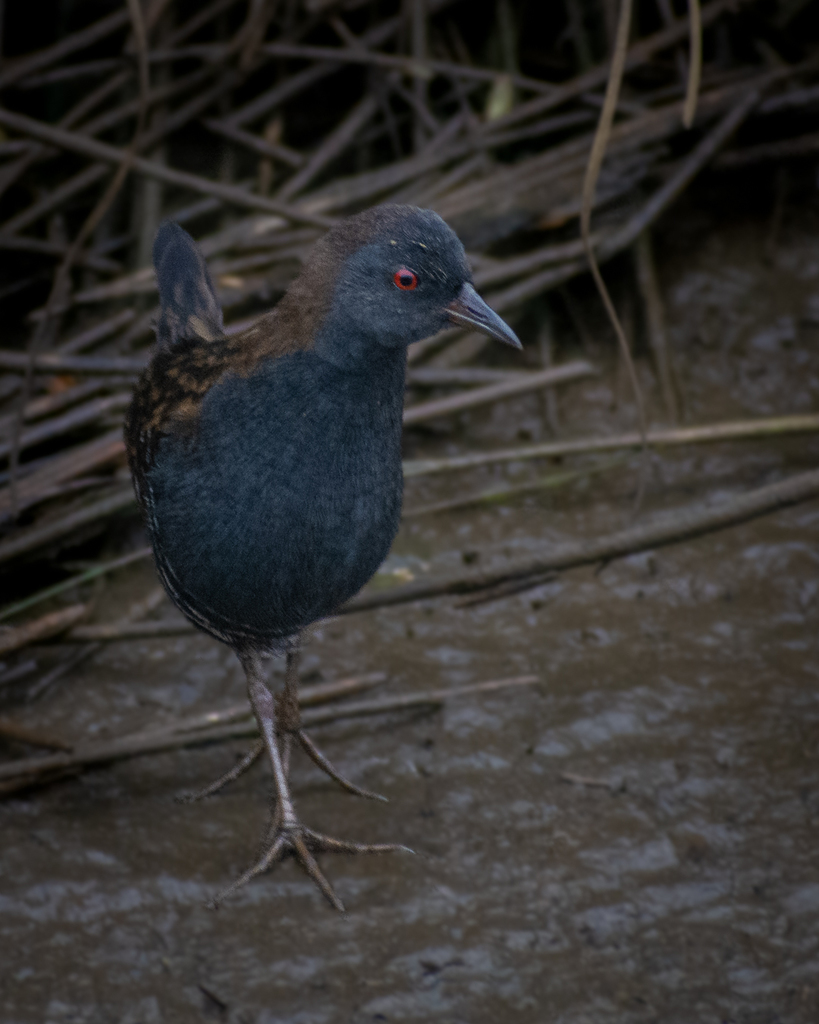
Dot-winged Crake
Photo © felipejarafer
Photo © felipejarafer — CC BY 4.0 — Source: iNaturalist photo #120535889The dot-winged crake (Laterallus spiloptera) is a near threatened species of bird in subfamily Rallinae of family Rallidae, the rails, gallinules, and coots. It is found in Argentina, Brazil, Chile, and Uruguay. == Taxonomy and systematics == The dot-winged crake was originally described in genus Porzana. However, phylogenetic analyses of mitochondrial DNA by Garcia et al. (2014) placed it in the predominantly South American clade Laterallus. Stervander et al. (2019) demonstrated that it is the sister species of the world's smallest flightless bird, the Inaccessible Island rail Laterallus rogersi (previously placed in the monotypic genus Atlantisia) and should bear the binomial Laterallus spilopterus, which was supported by Kirchman et al. (2021). There is a small amount of disagreement regarding the species' binomial name as of 2026, with the International Ornithological Committee (IOC) and eBird/Clements taxonomies using Laterallus spiloptera, and BirdLife International's Handbook of the Birds of the World using Laterallus spilopterus. The South American Classification Committee of the American Ornithological Society (SACC) declined a proposal to move the species to Laterallus, currently maintaining it as Porzana spiloptera. The worldwide taxonomic systems agree that the species is monotypic. == Description == The dot-winged crake is 14 to 15 cm (5.5 to…
Peixe National Park Lagoon
Brazil
+293 birds+4 mammals
Where the coastal plains of Rio Grande do Sul meet the Atlantic, Peixe National Park Lagoon sprawls across nearly 2,200 square kilometres of shallow waters, reed…
VIEW NATIONAL PARKCampos del Tuyú National Park
Argentina
+169 birds+5 mammals
Subtropical forest graces the borderlands where Misiones Province meets Paraguay, a landscape shaped by the Paraná Plateau's weathered topography and the warm, humid climate of northeastern…
VIEW NATIONAL PARKNo community photos yet. Log in to add the first one.
No community observations of this species yet.