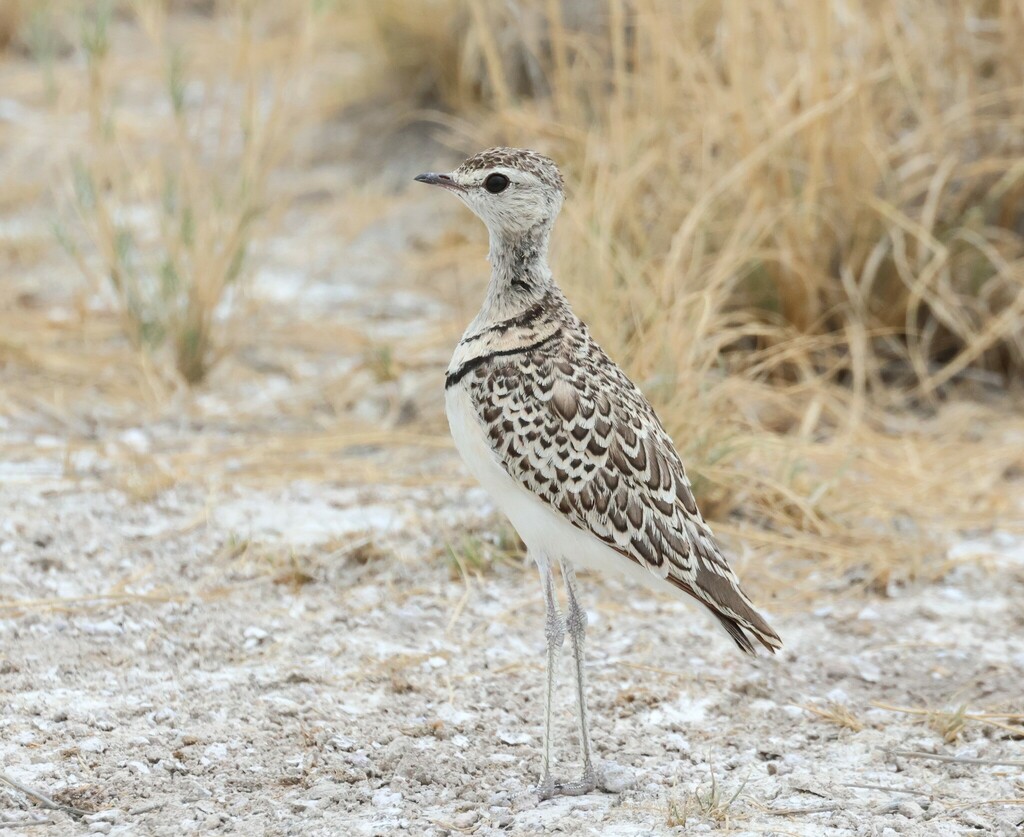
Double-banded Courser
Photo © scaup
Photo © scaup — CC BY 4.0 — Source: iNaturalist #198662656Identification
The double-banded courser is a distinctive ground bird with a subtly patterned plumage that provides excellent camouflage in arid terrain. Its crown is pale and streaked with brown and black feathers, while a narrow black stripe runs from the base of the bill through the eye to the nape, creating a characteristic facial pattern. The cheeks, chin, throat and neck are buff-white flecked with dark brown, while the back and wing coverts are sandy brown with dark centres broadly edged with white or buff. The bird has a short blackish bill, dark brown eyes, and pale grey legs and feet—adaptations suited to its ground-dwelling lifestyle.
Range & habitat
The double-banded courser is found across much of eastern and southern Africa, with populations distributed from Ethiopia and Somalia in the north through Kenya, Tanzania, and the southern African region, including Namibia, Botswana, South Africa, and Zimbabwe. Eight subspecies are recognised across this range, each adapted to local conditions. The species is widespread enough to have practically no conservation concerns.
This bird inhabits flat, stony or gravelly semi-desert terrains with firm, sandy soil and tufty grass or thorn scrub. These harsh, open landscapes provide the ideal hunting grounds and nesting substrate for this specialist ground-dweller.
Behaviour & diet
Double-banded coursers breed in monogamous pairs, with breeding beginning after an elaborate mating dance in which the male dances in semicircles around the female. The female lays a single egg, which both parents incubate in hour-long shifts; the egg hatches after approximately twenty-five days. Chicks leave the nest within 24 hours of hatching but remain close by until 3–4 days old, when they join their parents. Both adults feed the chick with small insects until it achieves independence at around 5–6 weeks old. Breeding seasons vary geographically: April–June in Ethiopia, February–July in Somalia, November in Tanzania, and year-round in South Africa, peaking in October–November.
The double-banded courser feeds primarily on insects, including ants, termites, and beetles. It employs an energetic hunting technique, quickly running after prey and jabbing with its bill to capture it.
Best time & places to see it
For travellers seeking this species, the semi-desert regions of southern Africa offer the most reliable opportunities. The subspecies found in Namibia, Botswana, and South Africa are accessible from well-established safari routes. In East Africa, Ethiopia and Tanzania host populations, though these may be more challenging to locate. Timing visits to coincide with peak breeding seasons—particularly October–November in South Africa—increases chances of observation, as birds are more active during breeding cycles.
Photography tips
Photographing the double-banded courser requires patience and an understanding of its ground-dwelling habits. Early morning and late afternoon light will best reveal the subtle browns, buffs, and blacks of its plumage. The bird's preference for open, stony terrain means there is minimal cover; approach slowly and deliberately to avoid flushing it. A telephoto lens is recommended to maintain distance while capturing detail. Focus on the distinctive facial stripe and the finely patterned back and wings, which show the species' elegant adaptation to arid landscapes.
Serengeti National Park
Tanzania
+558 birds+57 mammals
Across Tanzania's northern plateau, where volcanic soils meet acacia woodland and open grassland, unfolds one of Earth's most dynamic ecosystems. The Serengeti National Park sprawls across…
VIEW NATIONAL PARKArusha National Park
Tanzania
+555 birds+16 mammals
Where the slopes of Mount Mawenzi rise above the Arusha region, a compact yet ecologically rich national park unfolds across montane forest, moorland, and alpine zones.…
VIEW NATIONAL PARKChobe National Park
Botswana
+446 birds+45 mammals
Where the Chobe River cuts a sinuous path through northern Botswana, the landscape transforms into one of Africa's most dynamic wetland-savanna mosaics. This national park encompasses…
VIEW NATIONAL PARKNxai Pan National Park
Botswana
+226 birds+16 mammals
Across the northwestern reaches of Botswana stretches a landscape of profound seasonal transformation—a sprawling pan system where shallow depressions fill and empty with the rains, creating…
VIEW NATIONAL PARKTsavo East National Park
Athi ward, Kenya
+468 birds+50 mammals
Across the semi-arid lowlands of southeastern Kenya, where acacia woodland fragments into scrubland and the landscape rolls toward the Indian Ocean horizon, lies one of Africa's…
VIEW NATIONAL PARKTsavo West National Park
Mwatate, Kenya
+513 birds+49 mammals
Where volcanic ridges and weathered lava flows meet the semi-arid lowlands of south-central Kenya, Tsavo West National Park unfolds across a landscape sculpted by fire and…
VIEW NATIONAL PARKTarangire National Park
Tanzania
+527 birds+50 mammals
Acacia woodland and grassland sweep across the Manyara Region where the Tarangire River carves through low hills and volcanic soils, creating one of East Africa's most…
VIEW NATIONAL PARKNgorongoro Conservation Area
Tanzania
+626 birds+55 mammals
Volcanic calderas and open grassland dominate this high plateau in northern Tanzania, where the landscape rises above 2,000 metres and ancient geological forces have shaped both…
VIEW WILDLIFE MANAGEMENT AREATankwa-Karoo National Park
Hantam Local Municipality, South Africa
+201 birds+20 mammals
Across the semi-arid heartland of the Northern Cape, where winter rains carve ephemeral watercourses through endless ochre plains, Tankwa-Karoo National Park sprawls across more than 3,100…
VIEW NATIONAL PARKMountain Zebra National Park
Inxuba Yethemba Local Municipality, South Africa
+265 birds+35 mammals
Across the windswept plateaus and deeply incised valleys of the Eastern Cape's interior, Mountain Zebra National Park unfolds as a landscape of geological drama and ecological…
VIEW NATIONAL PARKAugrabies Falls National Park
Kai !Garib Local Municipality, South Africa
+176 birds+20 mammals
Where the Orange River cuts a dramatic scar through the Northern Cape's arid interior, Augrabies Falls National Park sprawls across nearly 1,200 square kilometers of raw,…
VIEW NATIONAL PARKAddo Elephant National Park
Sundays River Valley Local Municipality, South Africa
+388 birds+55 mammals
Where the Eastern Cape's semi-arid scrublands meet transitional woodland, Addo sprawls across 13,478 square kilometres of one of southern Africa's most biodiverse landscapes. The terrain rises…
VIEW NATIONAL PARKCamdeboo National Park
Camdeboo Local Municipality, South Africa
+272 birds+24 mammals
Granite ridges and weathered sandstone cliffs rise across a semi-arid landscape where the Karoo transitions into the eastern escarpment of South Africa, creating Camdeboo National Park's…
VIEW NATIONAL PARKEtosha National Park
Namibia
+356 birds+58 mammals
Across northern Namibia's stark semi-arid plateau, a vast shallow depression transforms seasonally into one of Africa's most dramatic wildlife theaters. Etosha National Park, encompassing more than…
VIEW NATIONAL PARKAbijata-Shalla Lakes National Park
Ethiopia
+438 birds+7 mammals
Two crater lakes of contrasting chemistry define this remote corner of Ethiopia's Rift Valley, where soda lakes and freshwater basins create a mosaic of distinct aquatic…
VIEW NATIONAL PARKAwash National Park
Didiga, Ethiopia
+473 birds+23 mammals
Where the Ethiopian Rift Valley carves through volcanic plateaus, a ribbon of riverine forest winds through acacia scrubland and grassland, creating a mosaic of habitats that…
VIEW NATURAL PARKNo community photos yet. Log in to add the first one.
No community observations of this species yet.