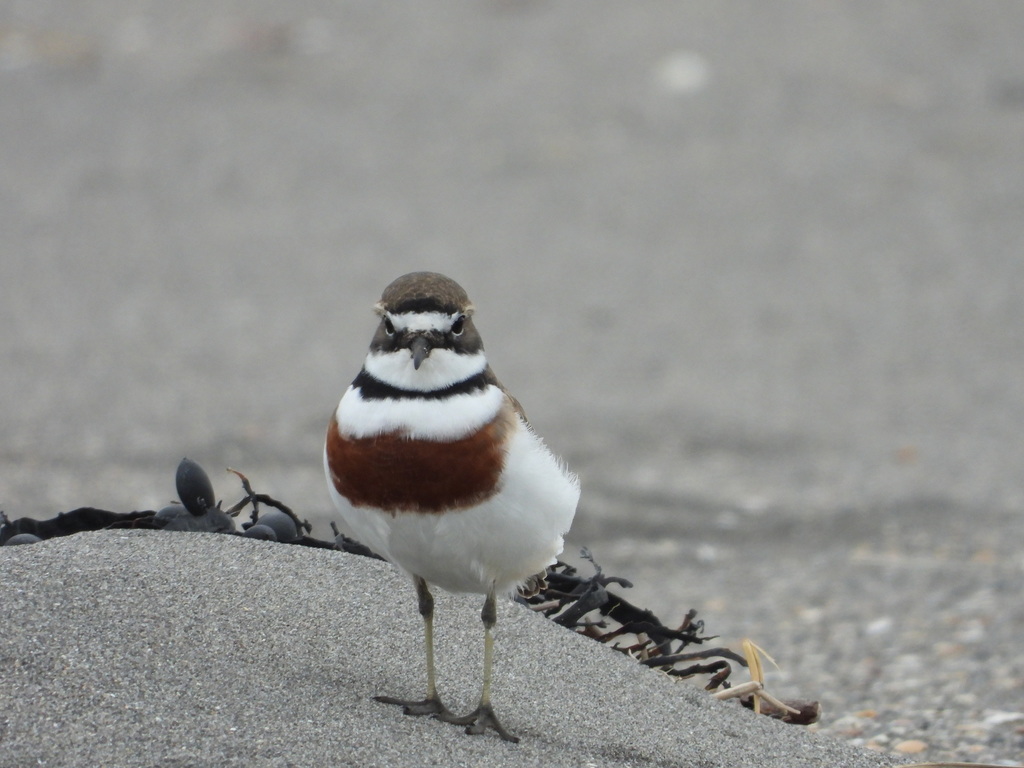
Double-banded Plover
Photo © Emily Roberts
Photo © Emily Roberts — CC BY 4.0 — Source: iNaturalist #55123569Identification
The double-banded plover is instantly recognizable by its distinctive chest markings: a white breast crossed by a thin black band just below the neck, with a larger brown band underneath. Males display these markings more prominently during breeding season, while females show them less boldly. Juveniles lack bands entirely, appearing speckled brown above with reduced white plumage. This compact shorebird has relatively long legs for wading, long pointed wings for long-distance flight, and a sturdy black bill. Large dark-brown eyes and a distinctive "chirp-chirp" call aid identification, as does the bird's characteristic behavior of running quickly then pausing to feed.
Range & Habitat
The double-banded plover is endemic to New Zealand, with two recognized subspecies: the nominate form breeding throughout the North and South Islands, offshore islands, Stewart Island, the Chatham Islands, and the subantarctic Auckland Islands. The largest breeding concentrations occur on braided riverbeds in Marlborough, Canterbury, Otago, and Southland in the South Island, with additional populations on shingle riverbeds in Hawke's Bay, the Manawatū Plains, and the Wairarapa in the North Island. Some breed on sandy coasts near river mouths and in higher altitude areas including Tongariro National Park.
This species exhibits remarkable migratory behavior. Birds breed from August to November, then disperse to coastal wetlands and estuaries from December to March. Many populations undertake an unusual west-east migration, with those nesting in the South Island high country traveling 1,600 kilometers or more to southeastern Australia and Tasmania for autumn and winter (April to July). Northern breeding populations generally remain on New Zealand coasts year-round, while Chatham and Auckland Island populations move only locally.
Behaviour & Diet
Banded dotterels are seasonally monogamous, with pairs remaining together throughout the breeding season to rear young. Males return to breeding grounds first, establishing territories with a distinctive defensive display involving fast, butterfly-like circular flight toward intruders. Females are attracted by the male's loud calls and choose from several nest sites he has prepared. The species typically nests on open, slightly elevated patches of sand or shells, occasionally in cushion plants or between rocks, with nests lined with tussock, stones, shells, grass, lichen, moss, and twigs. Large breeding aggregations of several hundred birds form seasonally. Females lay two to four eggs from August to September, with incubation lasting 28–30 days. Pairs may re-lay up to three times if breeding fails. The plovers feed by running rapidly then pausing to pick food from sandy beaches, estuaries, and coastal wetlands.
Best Time & Places to See It
For breeding birds, visit inland braided riverbeds of the South Island (particularly Marlborough, Canterbury, Otago, and Southland) from August to November. During December to March, look for dispersing birds at coastal estuaries and wetlands throughout New Zealand. Northern populations remain accessible on New Zealand coasts year-round. Vagrant birds occasionally reach New Caledonia, Vanuatu, and Fiji. The species' camouflaged coloring makes visual spotting challenging in its ideal habitat, but listen for the distinctive "chirp-chirp" call and watch for the characteristic run-and-pause feeding behavior.
Photography Tips
The double-banded plover's cryptic grey-brown and white plumage blends remarkably well with sandy and shingle habitats, requiring patience and careful observation. Focus on the striking chest bands and facial markings for identifying shots. Capture the bird's characteristic running-and-pausing feeding behavior, which often catches the eye better than static poses. During breeding season, males' intensified chest bands provide excellent identification photography opportunities. Early morning or late afternoon light will best reveal the subtle coloration of the back and highlight the distinctive black and brown chest bands. The bird's relatively long legs and long pointed wings are distinctive field marks worth emphasizing in flight shots.
Bribie Island National Park
Brisbane, Australia
+284 birds+20 mammals
Across tidal flats and shallow waterways north of Brisbane, Bribie Island National Park spreads across nearly four hundred square kilometres of subtropical coastal wilderness—a patchwork of…
VIEW NATIONAL PARKWilsons Promontory National Park
Australia
+210 birds+21 mammals
Where granite headlands plunge toward Bass Strait, Wilson's Promontory National Park sprawls across nearly 1,300 square kilometers of southeastern Victoria's most rugged coastal wilderness. The park's…
VIEW NATIONAL PARKNo community photos yet. Log in to add the first one.
No community observations of this species yet.