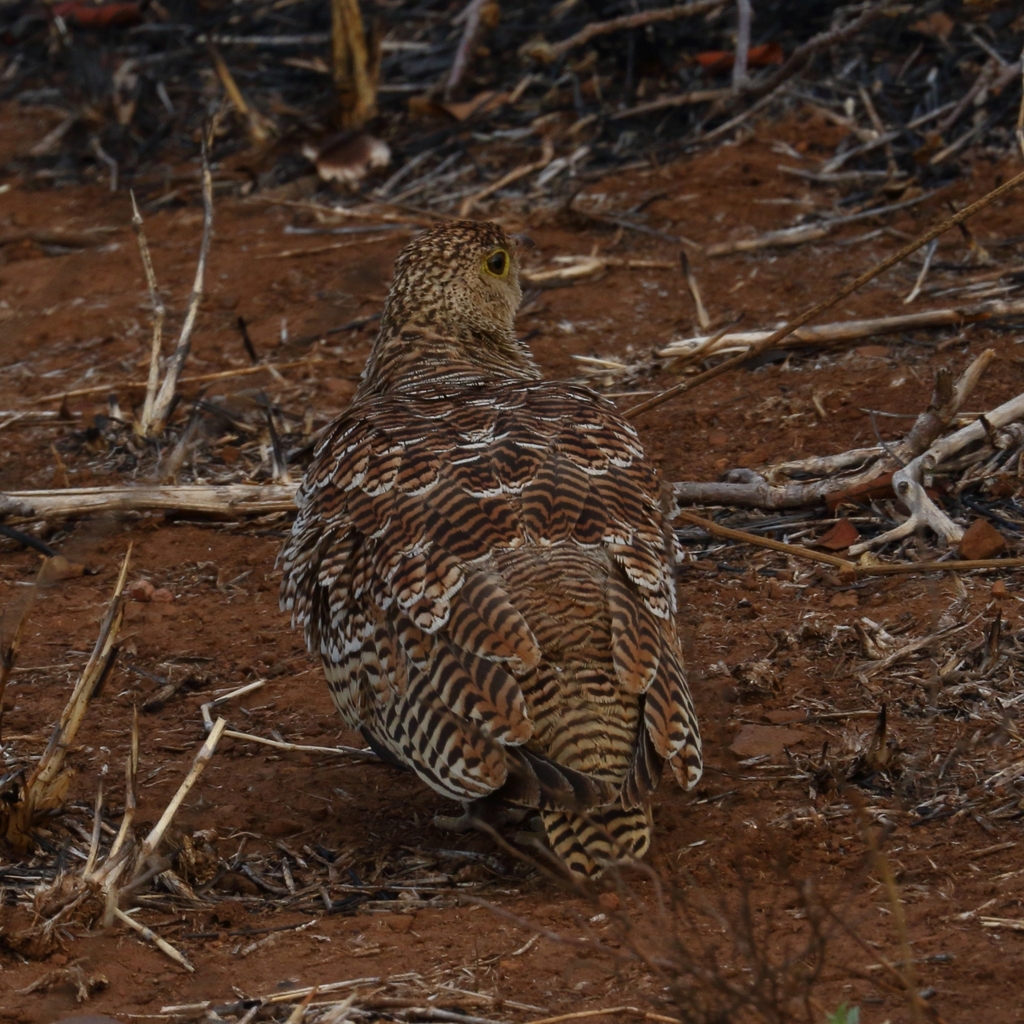
Double-banded Sandgrouse
Photo © Alan Manson
Photo © Alan Manson — CC BY 4.0 — Source: iNaturalist #249349259Identification
The double-banded sandgrouse is a moderately-sized, quail-like bird with a distinctive plump body, small pigeon-like head, long wings and tail. Its plumage is predominantly light brown with darker mottling and rows of whitish specks. The most striking feature is the male's conspicuous black-and-white band across his forehead, paired with a chestnut-coloured throat that is delineated by another black-and-white band. Both sexes display a characteristic area of bare yellow skin surrounding the eye; males additionally sport an orange beak. Females are noticeably smaller and duller in colouration than males, while juveniles resemble females.
Range & Habitat
This species is found across arid parts of southern Africa, with its range spanning Angola, Botswana, Malawi, Mozambique, Namibia, South Africa, Zambia and Zimbabwe. Three subspecies are recognised: P. b. ansorgei in southwestern Angola; P. b. bicinctus in Namibia, Botswana and northwestern Cape Province; and P. b. multicolor in Zambia, Malawi, Mozambique and Transvaal. Notable sightings have been recorded in and around the Okavango Delta in Botswana.
The double-banded sandgrouse shows a strong preference for short trampled grass beside roads and tracks, gravel patches, tussocky grassland, and recently burned scrub areas with emerging green shoots. It also frequents areas of sparse vegetation beneath scattered Terminalia sericea and Burkea africana trees, and scrubby mopane woodland. It is less commonly encountered than its congeners, Burchell's sandgrouse and Namaqua sandgrouse, which share overlapping distributions in the region.
Behaviour & Diet
Double-banded sandgrouse are seed-eaters with a varied diet including acacia, red pea, Tephrosia, Cyperus, blackjack and hairy thorn-apple seeds. They are typically observed in small groups of one to five birds—often pairs or family units—suggesting monogamous social structures. Their daily routine is notably patterned: in the morning they feed in dry areas distant from water, but afternoon activity concentrates near watering places, with visits often occurring after dark in larger gatherings of up to ten birds.
The species breeds between February and September, with breeding peaking earlier in the north than south. Males perform a distinctive courtship display, walking in circles with their beak held near the ground and tail raised high. Nests are shallow soil depressions lined with dried vegetation, typically concealed between grass tufts or beneath bushes. Clutches of two or three eggs are incubated by both parents, hatching in approximately 24 days. The chicks are precocial—active with open eyes and fluffy down plumage from hatching—and acquire adult feathers within about a month, becoming airborne shortly thereafter.
Best Time & Places to See It
The Okavango Delta in Botswana is a documented hotspot for this species. For optimal viewing opportunities, focus on morning hours when birds feed in dry areas away from water, or visit watering holes in the afternoon and after dark. The species shows distinct seasonal patterns: in locations like Borakalalo Game Reserve in South Africa, birds were observed during dry periods in February-March and July-September, but were absent during the wet summer season from September to January. Planning visits around drier months will increase sighting chances.
Photography Tips
Early morning shoots in dry grassland habitats offer the best opportunities to photograph this species away from water in small feeding groups. The male's striking black-and-white facial markings and orange beak are key identification features worth capturing in detail. Afternoon visits to watering holes provide chances for larger group compositions, though the low-light conditions after dark will challenge camera settings. The birds' habit of moving in small, predictable groups makes them more accessible than larger, more wary game species, rewarding patient photographers with intimate behavioural documentation.
Mapungubwe National Park
Musina Local Municipality, South Africa
+358 birds+29 mammals
Where the Limpopo River cuts through sandstone ridges at the convergence of South Africa, Botswana, and Zimbabwe, Mapungubwe National Park preserves a landscape of profound ecological…
VIEW NATIONAL PARKChobe National Park
Botswana
+446 birds+45 mammals
Where the Chobe River cuts a sinuous path through northern Botswana, the landscape transforms into one of Africa's most dynamic wetland-savanna mosaics. This national park encompasses…
VIEW NATIONAL PARKNxai Pan National Park
Botswana
+226 birds+16 mammals
Across the northwestern reaches of Botswana stretches a landscape of profound seasonal transformation—a sprawling pan system where shallow depressions fill and empty with the rains, creating…
VIEW NATIONAL PARKKhaudum National Park
Botswana
+213 birds+13 mammals
Where the Okavango's northern tributaries meander through miombo woodland and riverine forest, Khaudum National Park unfolds across a landscape of profound ecological richness and isolation. This…
VIEW NATIONAL PARKPilanesberg National Park
Moses Kotane Local Municipality, South Africa
+364 birds+49 mammals
Granite peaks and volcanic ridges rise unexpectedly from the savanna floor across this 734-square-kilometre expanse in the North West province, creating a landscape of profound ecological…
VIEW NATIONAL PARKKruger National Park
Ba-Phalaborwa Local Municipality, South Africa
+540 birds+91 mammals
Across the low-lying savanna of northeastern South Africa unfolds one of Africa's largest and most ecologically intact protected areas, where acacia woodlands merge into mopane scrub…
VIEW NATIONAL PARKAugrabies Falls National Park
Kai !Garib Local Municipality, South Africa
+176 birds+20 mammals
Where the Orange River cuts a dramatic scar through the Northern Cape's arid interior, Augrabies Falls National Park sprawls across nearly 1,200 square kilometers of raw,…
VIEW NATIONAL PARKMarakele National Park
Modimolle Local Municipality, South Africa
+341 birds+36 mammals
Granite ridges and sprawling grasslands dominate this 1,176-square-kilometre reserve in Limpopo's heartland, where bushveld transitions between rocky outcrops and open savanna. The park's rugged topography creates…
VIEW NATIONAL PARKKhaudum National Park
Namibia
+221 birds+13 mammals
Where the Kavango River flows through northeastern Namibia, vast miombo woodlands and riverine forests create one of southern Africa's most remote and biodiverse wilderness corridors. Khaudum…
VIEW NATIONAL PARKSkeleton Coast Park
Barcelona, Namibia
+143 birds+7 mammals
Where the Atlantic's cold Benguela Current collides with one of Africa's most hostile coastlines, the Skeleton Coast Park sprawls across more than 104,000 square kilometres of…
VIEW OBSERVATION POINTNamib-Naukluft National Park
Namibia
+217 birds+33 mammals
Across nearly 94,000 square kilometers of southwestern Namibia, a landscape of extremes unfolds where towering sand dunes meet rugged mountain ranges, and ancient riverbeds carve through…
VIEW NATIONAL PARKNkasa Rupara National Park
Namibia
+283 birds+17 mammals
Where the Zambezi's floodplains spill across the border between Namibia and Botswana, Nkasa Rupara National Park unfolds across 518 square kilometers of wetland and woodland mosaic.…
VIEW NATIONAL PARKEtosha National Park
Namibia
+356 birds+58 mammals
Across northern Namibia's stark semi-arid plateau, a vast shallow depression transforms seasonally into one of Africa's most dramatic wildlife theaters. Etosha National Park, encompassing more than…
VIEW NATIONAL PARKNamibRand Nature Reserve
Hammerstein, Namibia
+107 birds+12 mammals
Where rust-coloured dunes surrender to sculpted granite outcrops and vast plains stretch toward an endless horizon, one of southern Africa's most pristine wilderness areas unfolds. The…
VIEW NATURE RESERVEWaterberg Plateau National Park
Okambukonde, Namibia
+198 birds+27 mammals
Where ancient sandstone cliffs rise 200 metres above the surrounding bushveld, a fortress of geology creates one of southern Africa's most compelling ecosystems. The plateau's steep…
VIEW NATIONAL PARKNo community photos yet. Log in to add the first one.
No community observations of this species yet.