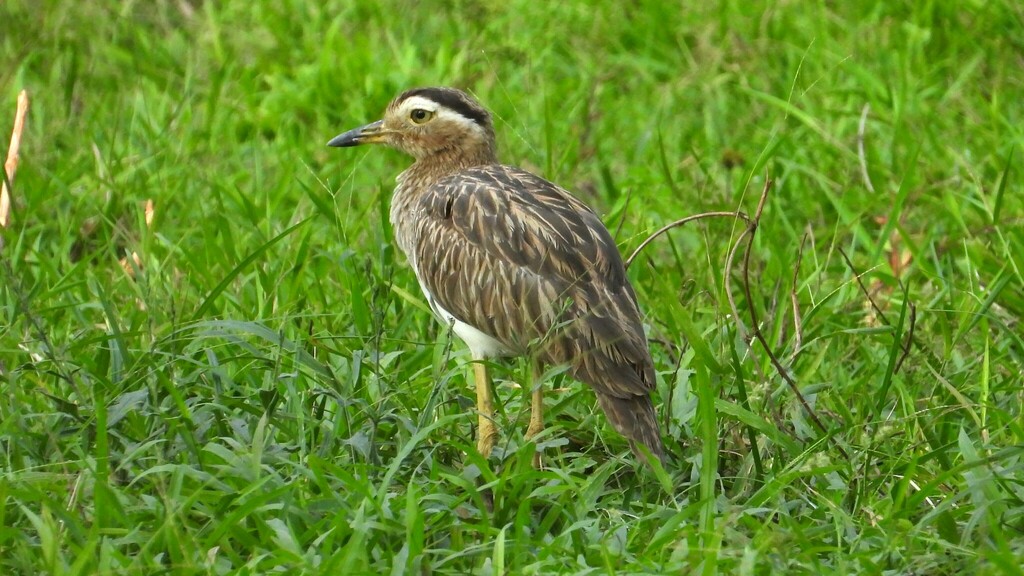
Double-striped Thick-knee
Photo © Dan MacNeal
Photo © Dan MacNeal — CC BY 4.0 — Source: iNaturalist photo #358526254Identification
The double-striped thick-knee is a medium-large wader measuring 46 to 50 cm in length, immediately recognisable by its prominent long greenish-grey legs with striking thick-set joints. It has a strong black and yellow bill, large yellow eyes, and cryptic plumage perfectly suited to its open-country lifestyle. The most distinctive features are the two bold head stripes: a striking white supercilium bordered above by a black stripe. The upperparts are finely streaked grey-brown, while the neck and breast are paler brown, merging into a white belly. In flight, the species is surprisingly striking, displaying a white patch on the otherwise dark upperwing and a white underwing with a black rear edge—a dramatic contrast to its subtle resting plumage. Juveniles resemble adults but have slightly darker brown upperparts and a whitish nape.
Range & Habitat
The double-striped thick-knee is a resident breeder across Central and South America, ranging from southern Mexico south through Guatemala and Central America to Colombia, Venezuela, and northern Brazil. It also inhabits Hispaniola and some Venezuelan Caribbean islands. The species is a very rare vagrant to Trinidad, Curaçao, and the USA, making sightings in these regions exceptional. Four subspecies are recognised across this range, differing subtly in size and plumage tone.
This species shows a strong preference for arid grasslands, savannas, and other dry, open habitats. It has notably benefited from the clearing of woodlands to create pasture, expanding its available habitat. The bird's adaptation to open country is fundamental to its survival strategy and hunting behaviour.
Behaviour & Diet
The double-striped thick-knee is a largely nocturnal and crepuscular species, meaning it is most active at night and during dawn and dusk—a trait that makes it challenging to observe. When threatened, the bird relies on crouching and camouflage rather than flight, flying only reluctantly when necessary. The diet consists primarily of large insects and other small vertebrate and invertebrate prey, hunted during twilight hours.
The species is sometimes semi-domesticated in agricultural settings because of its valuable function in controlling insects. Its nocturnal song is distinctive—a loud, repeated kee-kee-kee call given at night that can carry across open country and serves as a key way to detect this cryptic species.
Best Time & Places to See It
The double-striped thick-knee is best located during dawn and dusk, or at night when it becomes more vocal and active. Visitors should seek out dry, open habitats such as grasslands and savannas across its Central and South American range. In Mexico and Central America, the nominate subspecies bistriatus is most widespread. Listening for the loud kee-kee-kee call at night is often more productive than visual searching, given the bird's nocturnal habits and excellent camouflage.
Photography Tips
Photographing the double-striped thick-knee presents significant challenges owing to its nocturnal habits and reluctance to fly. Dawn and dusk offer the best light for photography when the bird may be more visible. Focus on capturing the striking head pattern with its white supercilium and black stripe, the strong bill, and the distinctive thick-set legs. If the bird takes flight, the white wing patches and underwing pattern are dramatic subjects. A headlamp or spotlight may help locate birds at night, though use such lights respectfully to avoid stressing the bird. The cryptic plumage blends perfectly with grassland backgrounds, so patient observation of likely habitats during twilight hours will offer the best opportunities for both sighting and photography.
Santa Rosa National Park
Santa Elena, Costa Rica
+359 birds+30 mammals
Where Pacific-facing slopes descend from volcanic uplands toward the Guanacaste lowlands, Santa Rosa National Park unfolds across a mosaic of tropical dry forest, gallery woodland, and…
VIEW NATIONAL PARKGuanacaste National Park
Santa Elena, Costa Rica
+461 birds+17 mammals
Where the Pacific slopes of northwestern Costa Rica rise toward the Continental Divide, dry tropical forest gives way to cloud-laden peaks and misty ridges—a landscape that…
VIEW NATIONAL PARKNatural Sierra de la Macarena National Park
Vista Hermosa, Colombia
+566 birds+15 mammals
Across nearly 20,000 square kilometres of Colombia's Meta Department, the terrain rises from lowland savanna into Andean foothills through a mosaic of gallery forests, palm-fringed wetlands,…
VIEW NATIONAL PARKNo community photos yet. Log in to add the first one.
No community observations of this species yet.