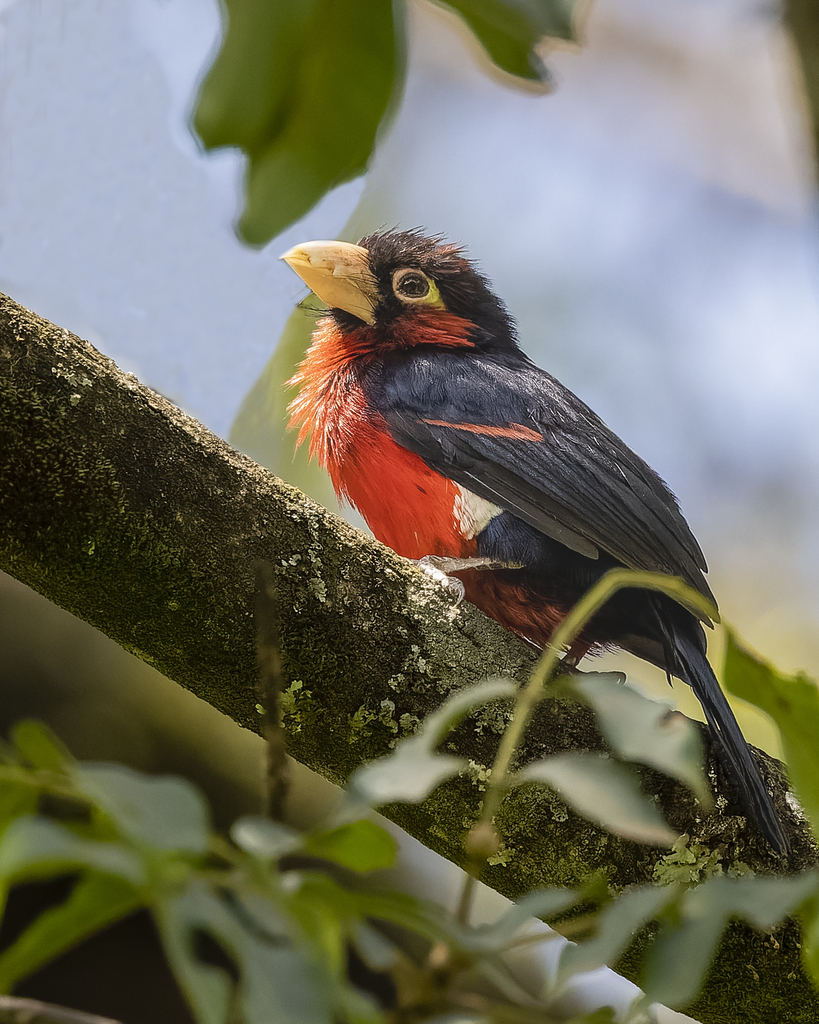
Double-toothed Barbet
Photo © Gary T. Leavens
Photo © Gary T. Leavens — CC BY-SA 4.0 — Source: iNaturalist photo #364805187Identification
The double-toothed barbet is a striking black and red bird with distinctive markings that make it relatively easy to identify in the field. Adults display black plumage on the upper body contrasting with a bright red breast, and a characteristic white patch on the back. The bird's most prominent features are its large, off-white bill and the yellow skin surrounding its eyes, which give it a bold facial expression. Males and females are similar in appearance, though females can be distinguished by fine lines of black feathers on their white side patches. Juveniles are considerably duller, with dark grey plumage rather than the crisp black and red of adults. In flight, the double-toothed barbet appears ungraceful, which can aid identification. It may be confused with the black-breasted barbet or the bearded barbet, so careful attention to the red breast and specific white markings is advised.
Range & Habitat
This species has an extensive range across sub-Saharan Africa, occurring in over twenty countries from West Africa through Central Africa to East Africa. The double-toothed barbet inhabits dense woodland understory, showing a preference for woodland edges, riparian forests, and secondary growth. Birds may also venture into gardens where fruit is available, making them occasionally accessible near human settlements.
Behaviour & Diet
Double-toothed barbets are social birds, typically found in pairs or small family groups that may include helpers, with lone individuals being rare. They maintain large territories and roost communally, with all members of a group sheltering together in the same hole. These birds forage primarily in foliage below ten metres, searching for a mixed diet of fruits and insects. Their insect prey includes beetles, termites, ants, and Hemiptera gleaned from tree bark and leaf clusters; they are particularly adept at capturing winged ants and termites in flight. They also consume various fruits including figs, papayas, avocados, and the fruits of umbrella trees and Solanum species, sometimes consuming seeds as well. The bird's vocalizations are distinctive—its song resembles a cat's purr—and pairs often sing together.
Best Time & Places to See It
Since double-toothed barbets breed year-round across their range, they can potentially be encountered at any time. However, breeding activity may increase visibility during peak breeding seasons in your specific region. Look for them in dense woodland understory and woodland edges, particularly in riparian forests and secondary growth habitats. Early morning hours are often productive for birdwatching, when birds are most vocal and active. Gardens adjacent to suitable woodland habitat may also reward patient observation.
Photography Tips
The double-toothed barbet's striking red and black plumage and bold yellow eye-ring make it a rewarding photographic subject. Since these birds typically forage below ten metres in dense understory vegetation, a telephoto lens (at least 400mm) is essential for obtaining frame-filling images while minimizing disturbance. Their ungraceful flight style offers opportunities for action shots as they move between feeding sites. Pairs singing together present excellent opportunities for behavioural photography. Early morning light filtering through the forest canopy will best illuminate the bird's vivid red breast and contrasting plumage. Patience is key, as these birds can be elusive within dense woodland, though their cat-like purring calls can help locate them.
Serengeti National Park
Tanzania
+558 birds+57 mammals
Across Tanzania's northern plateau, where volcanic soils meet acacia woodland and open grassland, unfolds one of Earth's most dynamic ecosystems. The Serengeti National Park sprawls across…
VIEW NATIONAL PARKVirunga National Park
Uganda
+418 birds+13 mammals
Where the Western Rift Valley fractures the landscape of North Kivu, Virunga National Park sprawls across terrain as geologically dramatic as it is ecologically vital. Volcanic…
VIEW NATIONAL PARKBwindi Impenetrable National Park
Kanyashogi, Uganda
+603 birds+26 mammals
Steep ridges cloaked in montane forest rise from Uganda's southwestern borderlands, where the landscape grows so dense and tangled that early explorers named it impenetrable. At…
VIEW NATIONAL PARKMurchison Falls National Park
Uganda
+608 birds+33 mammals
Where the Victoria Nile compresses through a narrow gorge and explodes across a 45-meter precipice, the landscape speaks in thunder. Murchison Falls National Park sprawls across…
VIEW NATIONAL PARKMgahinga Gorilla National Park
Cyanika, Uganda
+429 birds+6 mammals
Where the Virunga Mountains rise steeply from the Uganda–Rwanda–Democratic Republic of Congo frontier, montane forest cloaks the volcanic slopes in a dense, moisture-laden embrace. Mgahinga Gorilla…
VIEW NATIONAL PARKLake Mburo National Park
Uganda
+505 birds+24 mammals
Rolling acacia woodland and scattered lakes define this intimate savanna preserve in southwestern Uganda, where the rift valley's geological drama shapes every water source and grassland.…
VIEW NATIONAL PARKMount Elgon National Park
Matumbei ward, Kenya
+164 birds+7 mammals
Where the volcanic slopes of Mount Elgon rise above the Trans-Nzoia landscape, a montane wilderness unfolds across multiple ecological zones, each harbouring distinct communities adapted to…
VIEW NATIONAL PARKToro-Semliki Proposed National Park
Uganda
+474 birds+5 mammals
Where the Albertine Rift's western escarpment rises above the Semliki River valley, a vast mosaic of forest, savanna and wetland converges to create one of East…
VIEW NATIONAL PARKQueen Elizabeth National Park
Uganda
+672 birds+30 mammals
Across the southwestern escarpment of Uganda, where the Western Rift Valley descends through ancient volcanic terrain, Queen Elizabeth National Park sprawls across more than 8,300 square…
VIEW NATIONAL PARKMabamba Swamp
Memere, Uganda
+464 birds+2 mammals
Across the Central Region of Uganda spreads one of Africa's most biodiverse freshwater wetlands, a sprawling nature reserve of roughly 283 square kilometres where papyrus swamps…
VIEW NATURE RESERVEZiwa Rhino and Wildlife Ranch
Nakasongola, Uganda
+359 birds+11 mammals
Where papyrus wetlands merge into sprawling savanna, Uganda's central landscape opens into one of East Africa's most vital rhino recovery zones. Ziwa Rhino and Wildlife Ranch…
VIEW WILDLIFE SANCTUARYAbijata-Shalla Lakes National Park
Ethiopia
+438 birds+7 mammals
Two crater lakes of contrasting chemistry define this remote corner of Ethiopia's Rift Valley, where soda lakes and freshwater basins create a mosaic of distinct aquatic…
VIEW NATIONAL PARKBale Mountains National Park
Ethiopia
+397 birds+20 mammals
Where the Ethiopian highlands rise above 4,000 metres, the Bale Mountains create a landscape of stunning ecological extremes—from afroalpine grasslands swept by wind and mist to…
VIEW NATIONAL PARKMago National Park
Ethiopia
+128 birds+3 mammals
Where the Omo River cuts through southern Ethiopia's arid borderlands, Mago National Park sprawls across a landscape of dramatic escarpments, riverine forests, and semi-arid savanna that…
VIEW NATIONAL PARKOmo National Park
Ethiopia
+61 birds+4 mammals
Where the Omo River carves through southwestern Ethiopia, a landscape of riverine woodland, acacia savanna, and scattered grassland unfolds across one of East Africa's most remote…
VIEW NATIONAL PARKNech Sar National Park
Arba Minch, Ethiopia
+191 birds+10 mammals
Where the East African Rift Valley plateaus drop dramatically toward the shore of Lake Abaya, a mosaic of habitats unfolds across sun-scorched savanna and acacia woodland.…
VIEW NATIONAL PARKYabelo Wildlife Sanctuary
Bedewera, Ethiopia
+359 birds+5 mammals
Where acacia woodlands meet volcanic plateaus in southern Ethiopia, a landscape of austere beauty unfolds across nearly 2,500 square kilometers. Yabelo Wildlife Sanctuary sprawls across semi-arid…
VIEW WILDLIFE SANCTUARYRuma National Park
Suba, Kenya
+250 birds+8 mammals
Where the Winam Gulf narrows toward the Kenyan mainland, Ruma National Park rises as a sanctuary of evergreen woodland set within the humid tropics of Homa…
VIEW NATIONAL PARKSaiwa Swamp National Park
Sinyerere ward, Kenya
+255 birds+4 mammals
Where papyrus and sedge marshes stretch across a highland plateau in western Kenya, Saiwa Swamp National Park shelters one of East Africa's most productive freshwater wetland…
VIEW NATIONAL PARKNo community photos yet. Log in to add the first one.
No community observations of this species yet.