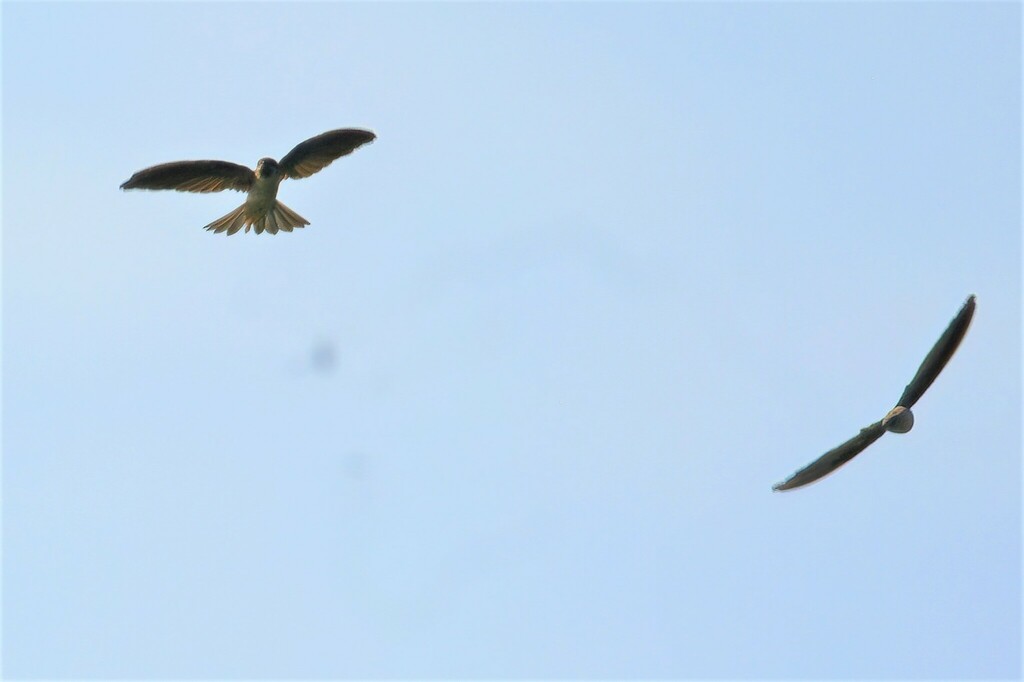
Drab Swiftlet
Photo © Jose Teixeira
Photo © Jose Teixeira — CC BY 4.0 — Source: iNaturalist #126595869Identification
The drab swiftlet is a diminutive swift, measuring just 9–10 cm in length. Look for its characteristic satin grayish-blue back and slightly glossy crown and tail. The throat and upper breast are mid-gray with lighter feather margins, while the lower breast, flanks, and belly are white—a useful field mark. The rump is notably dark, contrasting with the paler underparts. Dull white spots on the inner webs of the tail feathers are visible in close views. Most individuals sport a small tuft of feathers on the hallux (rear-facing toe). The eastern subspecies, C. n. perneglecta, appears darker overall with more gloss on its plumage than the nominate southern form.
Range & Habitat
Endemic to Indonesia's Lesser Sunda Islands, the drab swiftlet's range reflects its recent elevation to full species status in 2017, following detailed taxonomic revision. Two subspecies partition its distribution: C. n. neglecta occurs in the southern Lesser Sunda Islands, while C. n. perneglecta is found in the eastern and central islands. Originally described from Timor, this small swift inhabits the archipelago's varied terrain, though specific habitat preferences require observation in the field.
Behaviour & Diet
Like all swifts, the drab swiftlet is an aerial insectivore, capturing small flying insects in flight with remarkable agility. Its swift family relatives are known for their nearly constant activity in the air, and this species likely follows similar patterns, though detailed behavioral studies specific to C. neglecta remain limited. These birds are typically seen in flight, and their small size demands careful observation.
Best Time & Places to See It
To encounter this endemic species, travel to the Lesser Sunda Islands of Indonesia. The drab swiftlet's presence in both central and southern parts of the archipelago offers multiple opportunities for observation, though specific localities and seasonal patterns merit consultation with local guides familiar with these remote islands. Patient scanning of the skies, particularly during daylight hours, offers the best chance of detection.
Photography Tips
Photographing such a small, fast-moving bird presents significant challenges. Fast shutter speeds (1/2000s or faster) are essential to freeze the swift's rapid wing beats. Position yourself in open areas where swiftlets are likely to forage, ideally with good backlighting to illuminate their plumage details and highlight the glossy crown and tail. Early morning or late afternoon light can enhance the subtle blue-gray tones of the back. Patience and anticipation are crucial; tracking these aerial hunters requires steady panning and quick autofocus responses from your camera system.
Nothing matches these filters.
No community photos yet. Log in to add the first one.
No community observations of this species yet.